
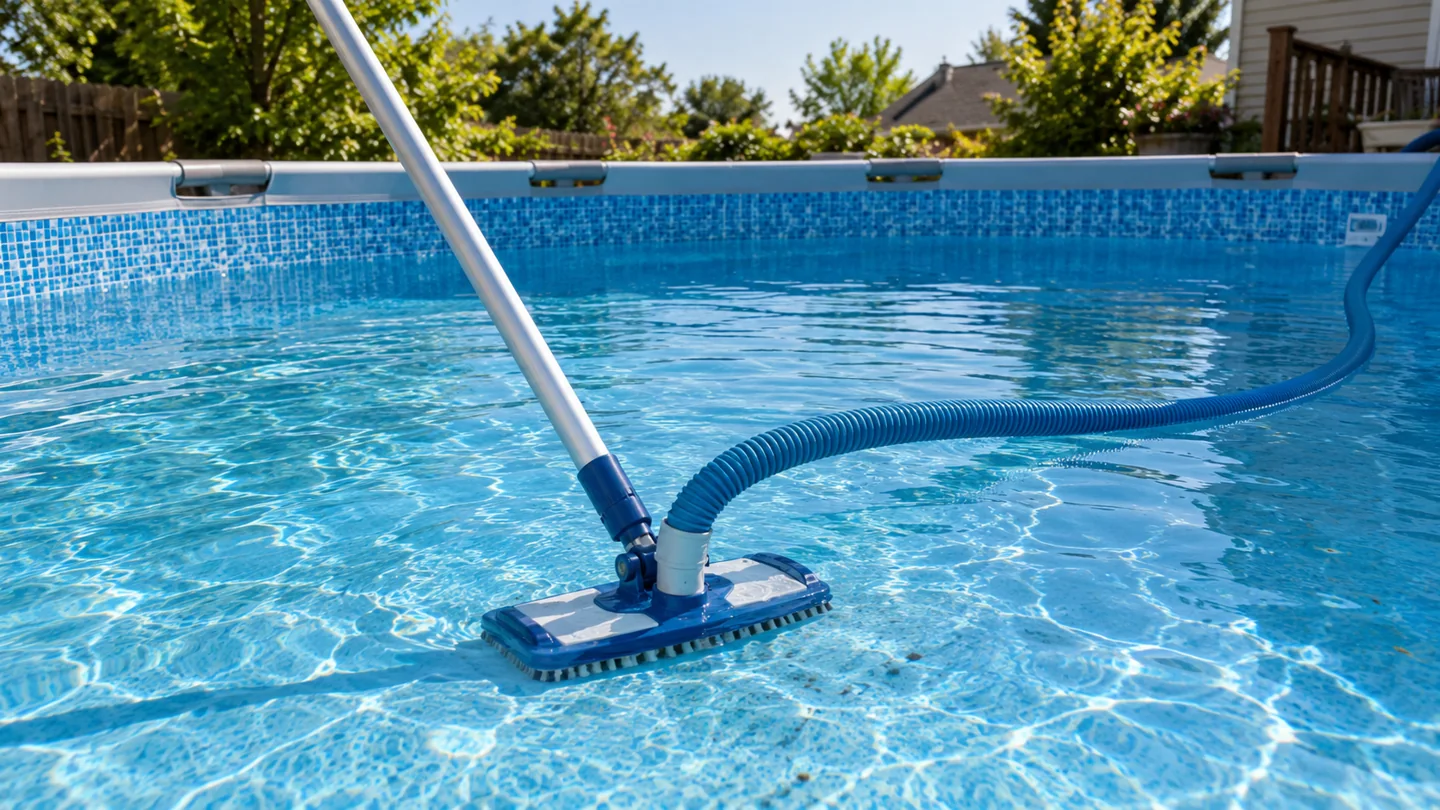
To vacuum an above-ground pool, identify the pool and cleaning system, remove large debris, prepare the approved cleaner, and follow the exact connection and operating instructions. Move a manual head slowly, monitor flow and water level, then shut down and service the equipment as directed. There is no single hose connection or valve setting that fits every above-ground pool.
Cleaning removes debris; it does not replace testing, disinfection, water balance, or a response to algae and contamination. A clear-looking floor alone does not establish that the pool is ready for swimming.
Choose the right cleaning arrangement
| Cleaner type | How it generally works | What to check |
|---|---|---|
| Manual suction head | Uses a compatible pool suction connection and filtration or approved discharge route | Head, hose, adapter, pump, filter, and liner compatibility |
| Suction-side automatic cleaner | Uses a specified suction connection to move and collect debris | Required flow, fittings, hose arrangement, and system restrictions |
| Pressure-side cleaner | Uses a specified pressure-side connection | Correct connection and permitted pump configuration |
| Independent or robotic cleaner | Uses its own collection system | Pool dimensions, liner, depth, charging or cable requirements, and retrieval |
The INTEX ZX50 suction-side cleaner and ZX100 pressure-side cleaner illustrate why connections and requirements differ. Follow the exact product manual; do not swap suction and return connections because two cleaners look similar.
Prepare the pool before vacuuming
Keep swimmers out and clear the working area. Inspect the liner and accessible fittings, and stop if a suction cover is damaged or equipment appears unsafe. Remove reachable large leaves and objects with a suitable net rather than forcing them through a hose or pump system.
Check the water level and the system’s normal operating condition. Clean baskets or service filters only using the shutdown and pressure-release procedure in the manual. Never open a pump basket or filter housing while the system is operating or pressurized.
For algae, cloudiness, or unusual contamination, follow an appropriate water-treatment plan. Vacuuming may be one step, but repeated passes alone do not establish sanitation.
Prepare a manual head and hose
Use a head compatible with the pool liner, a suitable pole, an intact hose, and the specified adapter. Check that connections are secure without improvising a fitting that may detach or restrict flow.
Where the system requires a water-filled hose, remove air using the approved priming procedure before connection. Keep the intended submerged components in position as directed. Do not use your mouth to start a siphon or test suction with your hand.
Connection sequence varies. Some systems use a skimmer plate, some use a designated fitting, and others have manufacturer-specific adapters. Follow the exact manual’s pump-off and startup steps rather than removing baskets or guards by default.
Choose filter or waste only if supported
Routine compatible debris may be collected through the pool filter under its instructions. A supported waste route instead discharges water outside the normal return path. Recirculate is different and generally returns water without filtering it.
Hayward’s sand-filter instructions describe model-specific valve functions. A cartridge filter or another valve can require a different process. Turn the pump off before changing a multiport valve position and follow the system’s pressure precautions.
If no waste route exists, read what to do without a waste setting. Do not improvise plumbing or remove filtration components to create one.
Vacuum slowly and monitor continuously
- Start using the approved equipment procedure and confirm normal flow.
- Move a manual head in slow, overlapping sections without forcing it against the liner.
- Avoid rapid movements that stir settled debris into suspension.
- Watch water level, hose behavior, flow, and any pressure indication the system provides.
- Stop if the head sticks, suction is lost, air persists, or equipment behaves abnormally.
- Shut down as instructed before inspecting fittings, clearing a blockage, or servicing the filter.
Do not leave a discharge process unattended. Maintain the water supply conditions required by the pump and pool. A falling water level can interrupt suction, and substantial draining may create structural or liner problems.
Troubleshoot by symptom
If suction is weak, check the approved connection, hose condition, air entry, water level, collection components, and filter condition using the manual. Do not assume the pump needs more speed or that another valve should be partly closed.
If dirt returns to the pool, check the selected flow path and whether the filter or cleaner retains that material. Very fine material, an incorrect setting, a damaged component, or bypass can require different remedies.
If the head is difficult to move or affects the liner, stop and check the head, flow requirements, and liner compatibility. Do not drag it harder or modify the suction system by guesswork.
Finish with equipment care
Shut down and disconnect in the instructed order. Handle the head, hose, and tools without dragging them over rough edges. Empty a cleaner’s basket or service the pool filter as required for the actual equipment.
Cartridge cleaning, sand-filter backwashing, and other filter procedures are different. Do not backwash a system that does not support it or use an arbitrary pressure increase as the maintenance threshold for every filter.
Clean and store equipment according to the manufacturer, protecting it from damage and leaving the pool’s fittings safely restored before normal use.
Handle discharged water appropriately
If the procedure discharges water, check local rules for the water’s disinfectant, salt, other chemicals, volume, and destination. A storm drain is not a default disposal point.
Portland’s residential discharge guidance provides one municipal example. Your local authority may impose different conditions, so confirm the permitted route instead of applying another city’s rules automatically.
Build a maintenance routine around conditions
Inspect after storms, heavy use, and visible debris accumulation, and follow the pool’s maintenance schedule. A cover, appropriate netting, and routine equipment care may reduce the load, but none removes the need for water testing and treatment.
Our pool-vacuum buying guide compares tools. Choose one that fits the pool and debris rather than assuming every automatic cleaner solves algae or replaces the filtration system.
Can I use a household dry vacuum?
No. Use purpose-designed pool-cleaning equipment and its approved power and connection arrangements.
Can I test a live suction fitting by hand?
No. Keep body parts, hair, and loose items away from suction openings. Stop the system and follow the manual or obtain professional help.
Further reading

Abi Khan is the founder and a content writer at GlobVacs. His published work covers vacuum-cleaner buying guides, product comparisons and practical maintenance advice. Read his author profile and selected articles.