
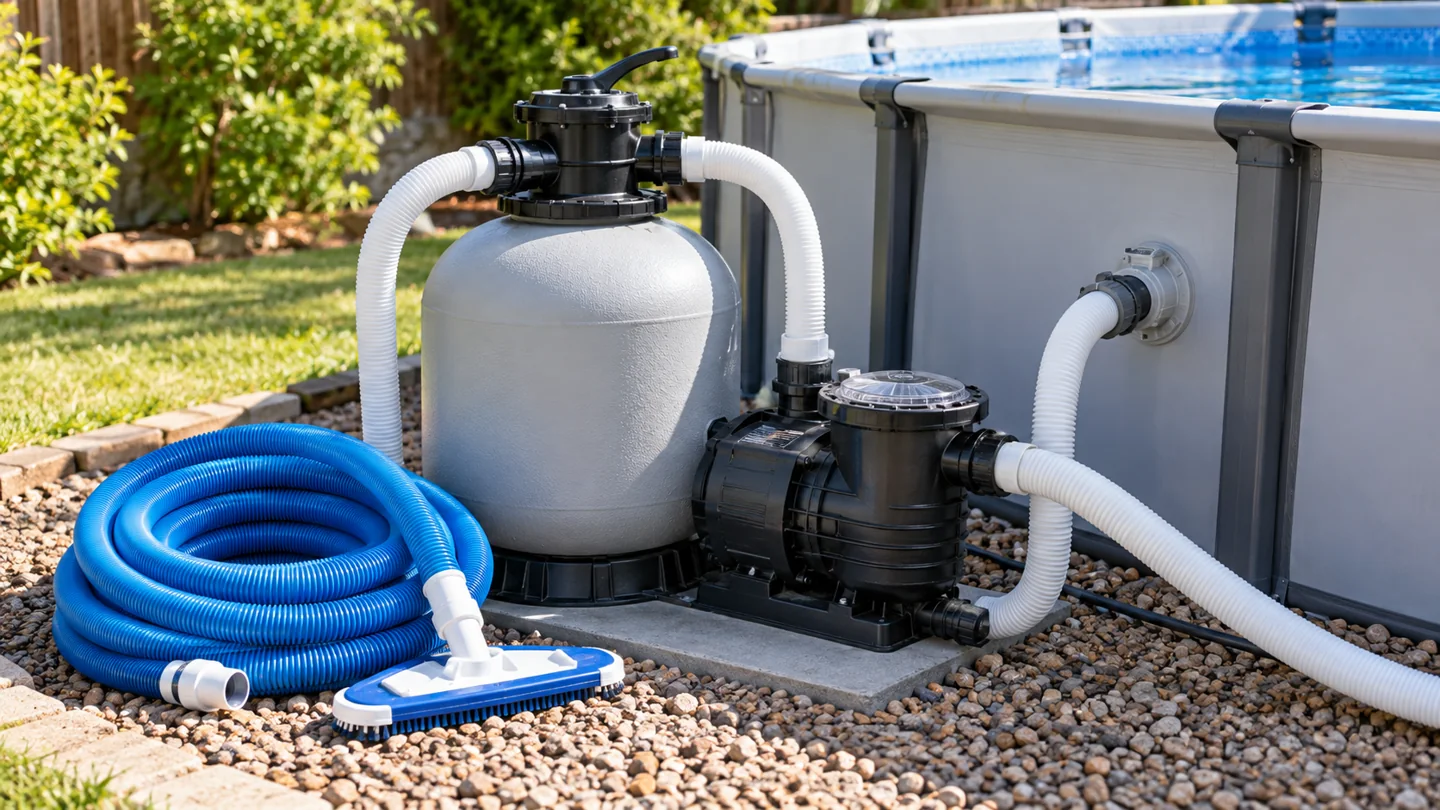
If your pool system has no waste setting, you cannot safely create vacuum-to-waste operation by choosing recirculate, removing a cartridge, or opening the pump basket. You need a manufacturer-approved discharge arrangement or a suitable separate pool-cleaning system planned by a qualified pool professional. An independent cleaner that stores debris is another option, but it is not the same as vacuuming to waste.
First identify the pump, filter, valve, and plumbing. The correct answer depends on those components and on where discharged pool water may legally go. Do not modify pressurized equipment from a generic online diagram.
What vacuuming to waste actually means
In a supported vacuum-to-waste arrangement, dirty water leaves the pool system through an approved discharge route instead of passing through the filter and returning to the pool. Water is lost, so the pool level and pump’s operating requirements must be monitored.
It does not mean sending unfiltered dirty water back into the pool. It is also different from a robotic cleaner collecting dirt in its own basket while remaining in the water.
The Pentair HiFlow valve manual distinguishes filter, waste, backwash, rinse, recirculate, and closed positions. Use your actual valve’s manual; not every system offers those positions.
Why recirculate is not a substitute
Recirculation normally bypasses the filter and returns water to the pool. It does not establish an external discharge route. Vacuuming dirt in that configuration may simply return it to the pool rather than remove it.
Backwash is another specific flow arrangement used to clean supported filter media. It should not be treated as a universal waste-vacuum setting. Likewise, a closed valve is not a useful way to increase vacuum suction and must not be used with the pump operating.
Never move a multiport valve while the pump is running. Follow shutdown and pressure-release instructions before any adjustment or service. Do not loosen filter clamps or open pressurized components.
Identify the system before choosing an option
- Record the pump and filter model numbers.
- Identify the valve type and its labeled operating positions.
- Locate the official manuals and any approved accessory instructions.
- Ask whether the installed plumbing includes a supported external discharge path.
- Check the pool manufacturer’s limits on lowering water level.
- Confirm local discharge rules, destination, and flow restrictions.
A cartridge system without a multiport valve is not automatically missing a simple hidden switch. Its normal filtration route may be the only supported route in the installed arrangement.
| Option | When it may help | Important limit |
|---|---|---|
| Vacuum through the filter as instructed | Routine compatible debris within the system’s capability | Monitor and service the filter as required; not ideal for every heavy load |
| Use a suitable independent cleaner | Debris that its collection system can retain | Collection quality and material suitability vary; it does not discharge to waste |
| Use an approved external discharge arrangement | Where the actual equipment and local rules permit it | Needs a correct design and operating procedure |
| Arrange professional cleanup | Heavy contamination, unknown equipment, or complex plumbing | Discharge, water level, treatment, and equipment protection still need planning |
Do not remove the cartridge and run the system in the hope that it creates a waste route. Do not disconnect a return hose, cut pipework, or attach a household vacuum as an improvised pool pump.
Pool robots are a different collection method
A pool robot normally collects debris in its own filter or basket. Some material may be too fine for its collection media, and it does not replace all water-treatment or filtration tasks.
Do not claim that a particular robot provides vacuum-to-waste capability unless its manufacturer explicitly documents that function. Likewise, a large advertised flow number does not establish suitability for a homemade discharge arrangement.
Our pool-cleaner buying guide can help compare cleaning tools, while the system manual governs the operating setup.
Plan water loss and equipment protection
Any approved discharge procedure lowers the water level. Follow the pool and pump instructions so the suction supply remains adequate and the pump does not run dry or lose prime. Do not leave the process unattended.
Water level, pool structure, liner condition, groundwater, and installation details can affect whether draining is safe. Do not lower the pool substantially without appropriate manufacturer or professional advice.
If flow fails, air appears persistently, pressure behaves abnormally, or the pump sounds wrong, stop according to the manual and investigate. Increasing pump speed is not a universal remedy.
Choose a permitted discharge destination
Pool water can contain disinfectants, salt, treatment chemicals, and debris. Do not assume a storm drain, street, neighboring land, or a garden is permitted. Ask the local wastewater or environmental authority about the actual water and quantity.
Portland’s pool-draining guidance is an example of municipal restrictions. Its allowed routes and conditions are local, not a worldwide rule.
Vacuuming does not make unsafe water safe to swim in
Removing settled debris is one maintenance task. It does not establish disinfectant levels, water balance, visibility, or treatment completion. Algae or heavy contamination may require a coordinated treatment and filtration plan.
Keep swimmers out during cleaning and follow equipment and water-safety instructions. Never place a hand, body part, or hair against a live suction opening to test flow. A missing or damaged suction fitting requires correction before use.
For routine cleaning, see vacuuming an above-ground pool. That guide explains preparation and monitoring without treating every filter system as identical.
Can a normal household vacuum do this?
No. Use purpose-designed pool equipment in its approved arrangement.
Should I buy a new valve myself?
Have a qualified pool professional assess compatibility, plumbing, pressure ratings, and discharge requirements. A different valve is not automatically a complete solution.
Further reading
How many vacuums are made per year in the US?

Katy James contributes vacuum-cleaner explainers and practical cleaning guidance at GlobVacs. Her published topics include robot-vacuum operation and vacuum airflow. Read her author profile and selected articles.