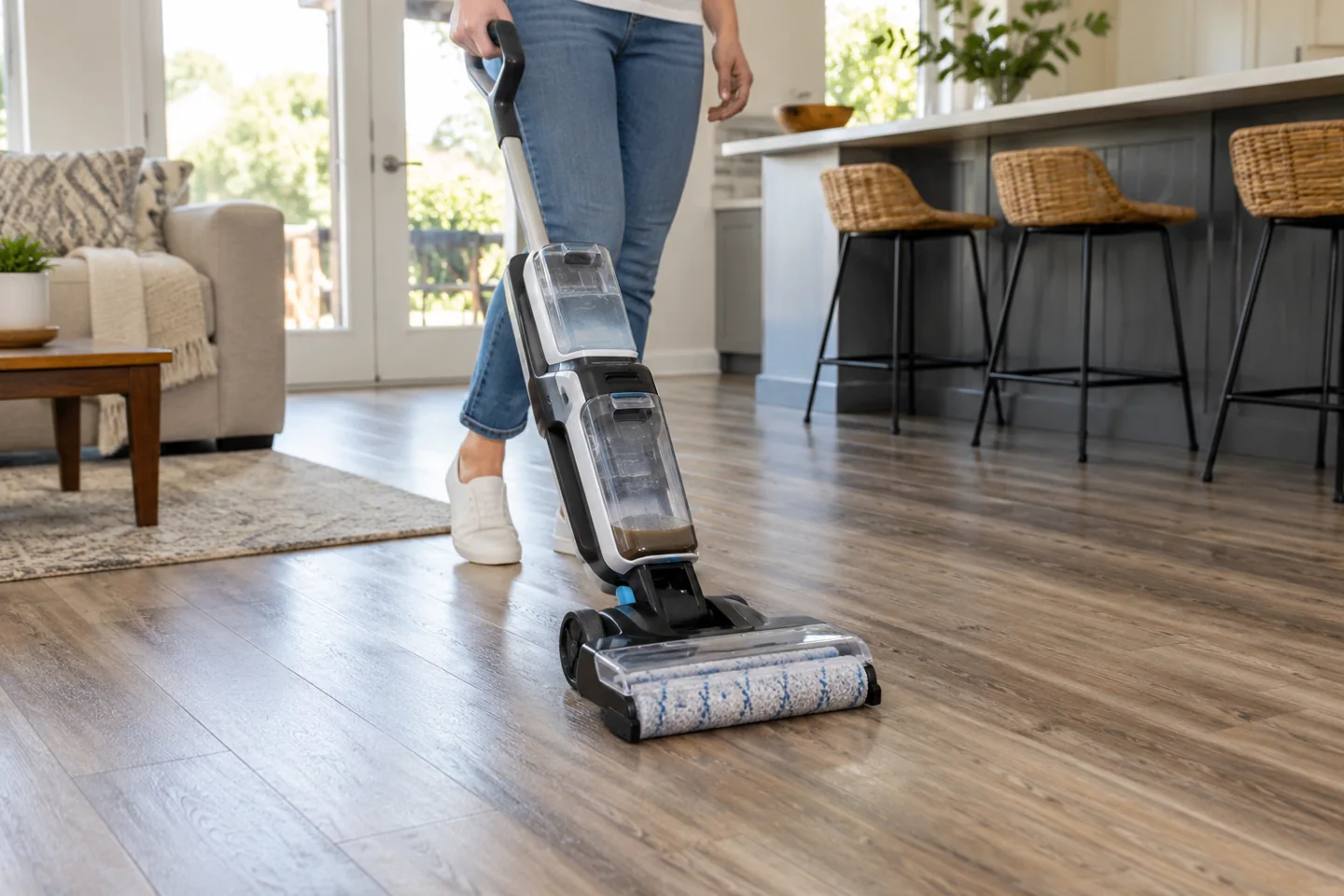
A BISSELL CrossWave can be used on suitable sealed hard flooring, but you should confirm that your exact vinyl-plank product permits its powered cleaning method and the intended solution. BISSELL includes vinyl plank in its hard-floor guidance and advises checking the flooring manufacturer’s instructions. Do not treat that as an unconditional guarantee for every installed LVP floor.

The decision involves two manuals: the CrossWave model’s operating instructions and the vinyl floor’s care requirements. If the floor prohibits the machine’s brush or wet-cleaning method, use an approved alternative. A small hidden test does not override a written restriction or warranty condition.
Check these details before filling the tank
| Item | What to establish |
|---|---|
| Vinyl product | Brand, collection, installation type, condition, and care document |
| CrossWave model | Permitted surfaces, correct brush, operating mode, solution, and maintenance |
| Floor condition | No loose edges, damaged seams, unresolved water problem, or prohibited coating |
| Cleaning method | Whether the floor allows the powered brush action and amount of moisture involved |
| Solution | Approved by the machine instructions and compatible with the flooring |
BISSELL’s hard-floor recommendation guide is a useful manufacturer starting point. Read the matching CrossWave manual as well, because controls, accessories, and functions vary across the range.
Understand what a CrossWave does
A CrossWave combines powered cleaning action, liquid application, and collection of dirty water and suitable debris. It is different from a dry-only vacuum and different from a simple manual damp mop.
The family includes models with different controls and features. Do not assume every version uses the same trigger, cleaning mode, brush, tank, or self-cleaning sequence. A feature on a steam-equipped or newer model should not be attributed to every CrossWave.
Likewise, the machine’s ability to recover liquid does not mean the floor is left completely dry, or that seams are immune to prolonged exposure. Use the prescribed technique and inspect the actual result.
Vinyl plank is not one identical floor specification
LVP products differ in surface finish, wear layer, backing, installation, seam design, and approved cleaning methods. Some products carry waterproof claims, but those claims do not approve every tool, cleaner, or exposure at every edge of the installation.
Do not use a generic statement that all vinyl plank is merely water-resistant, or that all waterproof vinyl can be soaked. Read the specific claim and care conditions. Installation and adjacent materials can also matter when liquid reaches edges or transitions.
If the floor is peeling, lifted, cracked, or showing a moisture problem, stop and ask the installer or manufacturer for advice. A wet-cleaning machine is not a repair for damaged flooring.
Powered-brush restrictions can change the answer
Some flooring manufacturers restrict powered rotary brush heads. For example, Mohawk’s vinyl care guidance includes such a restriction. Do not assume a soft-looking roller automatically falls outside the wording.
If your floor’s care document and the CrossWave’s operating method do not clearly agree, contact the manufacturers before use. Give them the exact floor collection and machine model so they can address the actual combination.
Do not remove a required roller, alter the machine, or use it in an undocumented configuration to try to satisfy a restriction. A compatible manual cleaning method may be the better option.
Choose the correct mode and solution
Where the combination is approved, use the hard-floor procedure and correct cleaning formula for the exact CrossWave. Measure and fill according to its tank markings and instructions. More detergent is not automatically more effective and can leave residue.
Do not put vinegar, bleach, dish soap, essential oils, disinfectant, or a homemade mixture in the tank unless the machine’s instructions explicitly permit it and the floor guidance agrees. A cleaner sold for a manual mop may not be compatible with the machine’s internal components.
For relevant models, BISSELL’s streaking guidance distinguishes hard-floor mode from area-rug mode. Use that instruction only for the covered machine rather than assuming every CrossWave has identical controls.
Prepare the floor and machine
- Remove unsuitable objects. Pick up larger debris, sharp fragments, cords, and items outside the machine’s permitted use.
- Inspect the brush and underside. Remove trapped grit and check for damage or a poorly seated cover.
- Check the tanks and required parts. Fit them in the correct position and ensure seals and latches are sound.
- Use the approved solution and fill level. Follow the exact model’s instructions.
- Start in a small permitted area. Inspect the cleaning result before continuing across the room.
A small test is useful for observing residue, handling, and drying where the method is already permitted. It is not evidence that prohibited equipment becomes safe after one successful pass.
Control moisture during the job
Follow the prescribed pass speed and solution-control method. Do not hold a wet brush stationary over one seam or repeatedly dispense liquid into the same patch. Watch edges, transitions, and low areas where moisture can remain.
For the CrossWave Pet Pro models covered by its guidance, BISSELL describes dry passes without pressing the spray trigger when less moisture is needed. Other models can have different controls, so use the matching procedure.
If excessive liquid remains, stop and check the dirty-water tank, suction path, brush cover, and assembly using the manual. Do not continue adding more solution while the machine fails to collect it properly.
Why streaks or sticky patches can appear
Residue can involve incorrect solution concentration, a dirty brush, contaminated water, unsuitable settings, remaining old product film, or a collection problem. Do not immediately add a stronger chemical mixture.
Check the machine’s troubleshooting and the floor’s approved residue-removal method. Rinse or clean removable parts only as directed, and use the correct fresh solution for the next permitted attempt.
For the broader issue of tacky floors, see our guide to sticky floor residue. Its wood-floor advice should not be transferred blindly to vinyl; the useful shared principle is to identify the source and use the surface-specific method.
Aftercare matters
Empty and clean the dirty-water components, brush, tray, and required filter using the model’s instructions. A self-cleaning cycle does not necessarily replace manual removal, washing, inspection, and drying of every designated part.
Store the machine in its intended tray or position, avoiding prolonged wet contact with the floor. Do not leave dirty liquid in the tank between sessions. Reassemble only the parts that meet the specified drying conditions.
Keep a separate dry-cleaning routine with a compatible tool where appropriate. Our vinyl-floor vacuum guide covers selection questions, and robot-vacuum use on vinyl discusses a different cleaning system.
Frequently asked questions
Does CrossWave guarantee no scratches?
No universal guarantee is established here. Floor compatibility, brush condition, trapped grit, damaged components, and technique all matter. Follow both manufacturers’ instructions.
Is every CrossWave a steam cleaner?
No. Features differ across the product family. Use the exact model name and manual rather than assuming a function from another variant.
Can I use it on damaged or loose vinyl planks?
Have the flooring problem assessed first. Do not use wet cleaning to force down a lifted edge or conceal a moisture issue.
What if the floor manufacturer says no powered brush?
Do not assume the machine is approved. Ask for clarification about the exact combination or choose another permitted cleaning method.
Confirm the combination before use
A CrossWave can be useful on compatible vinyl plank, but suitability comes from the exact floor and machine instructions together. Use the approved brush, mode, solution, and moisture-control process, then maintain the equipment after every required session.

Katy James contributes vacuum-cleaner explainers and practical cleaning guidance at GlobVacs. Her published topics include robot-vacuum operation and vacuum airflow. Read her author profile and selected articles.