
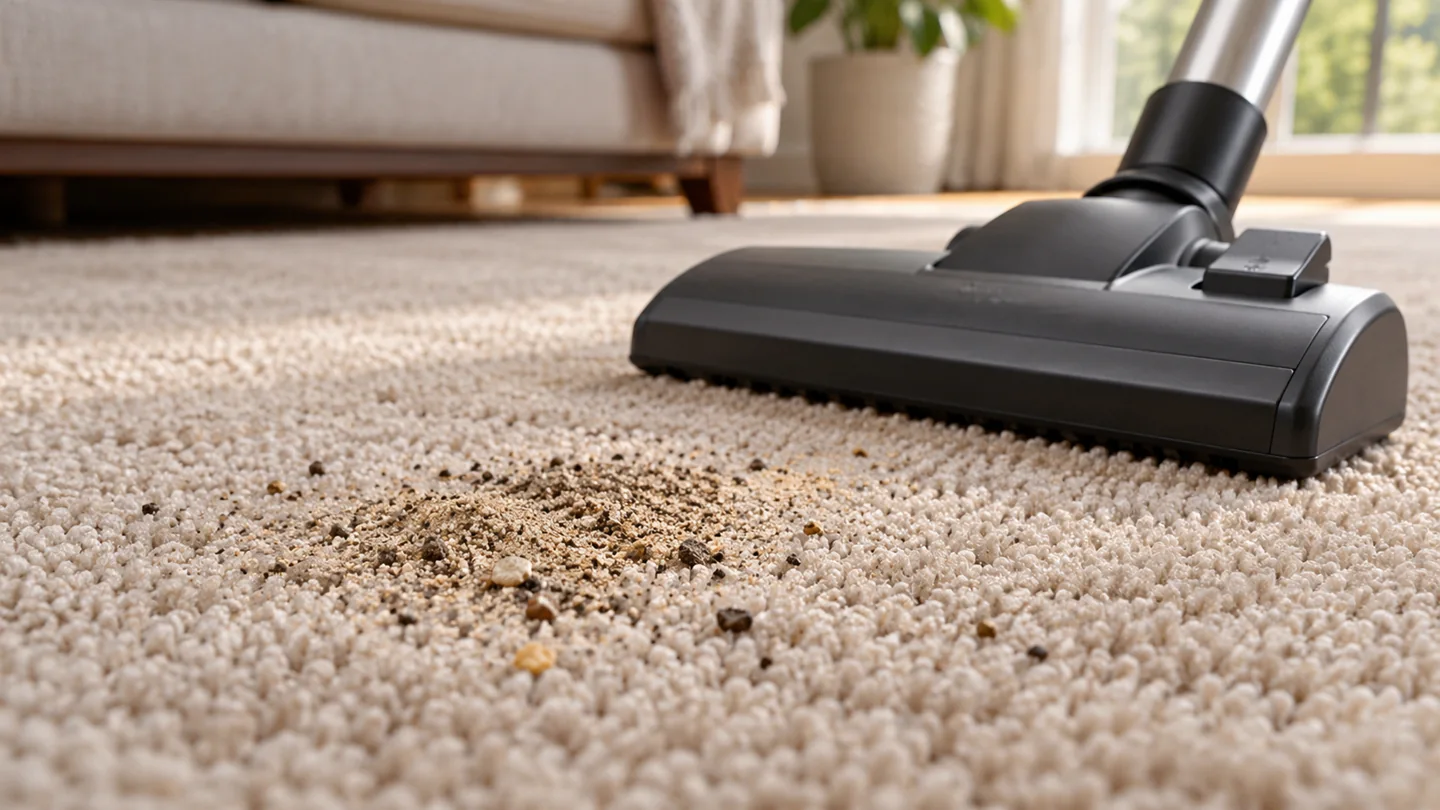
If your carpet sounds or feels crunchy after vacuuming, stop and check whether the issue is loose grit, dried cleaning residue, a stiff spill, or a problem beneath the pile. Vacuuming may reveal the texture without causing it. Repeated aggressive passes, more detergent, or adding water before identifying the cause can make the situation worse.
The key questions are where the crunch occurs, whether the carpet was recently wet-cleaned, and whether the sound comes from the fibers or the floor underneath. A localized dried spill needs different treatment from a whole room that changed after professional cleaning.
Separate the carpet texture from the sound below it
Inspect a small area in good light. Look for visible granules, flattened or stiff fibers, a spill outline, loose yarn, discoloration, or a change in sheen. Do not pull loops or scrape the surface. If the carpet is dry and safe to handle, compare the affected area gently with a nearby unaffected area.
A crackle underfoot can also relate to backing, cushion, installation, or the subfloor. Sound alone does not identify the fault. If the pile feels normal but the noise persists beneath it, ask an installer or flooring professional rather than escalating cleaning.
Likely patterns and what they mean
| Observation | Possible issue | Best first response |
|---|---|---|
| Visible dry granules | Tracked soil, powder, or a dry spill | Identify the material and check equipment suitability |
| Stiff patch after a spill | Dried residue in fibers | Use carpet-specific spot-treatment guidance |
| Widespread change after cleaning | Residue, treatment aftercare, or incomplete drying | Contact the cleaner with the product and method used |
| Fuzzing or pulled loops | Incompatible brush action or another source of damage | Stop the tool and consult the carpet supplier |
| Noise with normal-feeling pile | Possible backing, cushion, installation, or floor issue | Arrange inspection rather than more wet cleaning |
These possibilities overlap. For example, a dried spill can trap grit, and a powder can remain after vacuuming if the equipment is not suitable. Avoid treating the table as a diagnosis without checking the actual material.
If loose dry soil is the problem
Check that the debris is something your vacuum is designed to collect. Ordinary household soil is different from plaster dust, an unknown chemical powder, or a large baking-soda application. A stronger suction claim does not override the manual’s restrictions.
For compatible dry debris, check collection capacity, filters, airflow, height setting, and the floorhead. Use deliberate overlapping passes without forcing a head that is difficult to move. Clean the machine as directed if pickup has declined; our vacuum-care guide explains the components to inspect.
If a brush is winding up yarn, roughening the pile, or pulling loops, stop. Some carpets need different brush settings or suction-only tools. Our Berber-carpet care guide covers the importance of protecting loop construction.
If it started after carpet cleaning
Contact the cleaning provider and describe when the texture changed. Ask what treatment was used, whether a final vacuum is part of its process, how dryness should be checked, and whether a follow-up assessment is appropriate. A dry compound, an extraction clean, and a spot treatment have different aftercare.
Do not add another shampoo because the carpet feels stiff. Some residue requires an appropriate removal process, and applying more product can add to it. Similarly, “rinse thoroughly” should not be interpreted as pouring water into carpet and cushion.
The Carpet and Rug Institute’s maintenance guidance provides a framework for approved care. For a persistent problem after paid cleaning, document the affected area and give the provider an opportunity to inspect it before trying unrelated chemicals.
If the affected patch contains soap or a dried spill
A vacuum removes loose material; it does not necessarily remove a film bonded to fibers. Identify the original spill and use the carpet manufacturer’s approved procedure. Test as directed and control moisture. Do not scrub a stiff spot with an aggressive brush.
For detergent, use our soap-removal guide. If the spill was a strongly colored food, the turmeric-stain guide explains why piling on solvents or heat can be a poor choice.
Tell a professional about every treatment already applied. That history can be more useful than the name of the stain alone, especially when a carpet has been treated repeatedly.
Do not vacuum damp carpet with a dry machine
Check aftercare and readiness before using a normal dry vacuum on recently cleaned carpet. A dry-looking surface does not necessarily describe the condition deeper in the system. See vacuuming after carpet cleaning for a method-based approach rather than an arbitrary waiting time.
If moisture persists, odor develops, or the cushion may be wet, seek appropriate advice promptly. The EPA’s mold-cleanup guidance explains why moisture control matters and why some mold-affected porous materials may need removal. Fragrance or deodorizing powder cannot resolve a wet backing.
When to stop home treatment
- The carpet is changing color, shedding unusually, or developing pulled loops.
- A recent cleaning left a widespread persistent change in texture.
- There is an unknown powder, hazardous contamination, or substantial moisture.
- The sound appears to originate beneath the pile.
- Approved routine care is not improving a small test area.
Ask the relevant professional: a cleaner for residue or spill treatment, an installer for backing or floor movement, and a restoration specialist for water damage. Replacing the whole carpet should not be the first response to an undiagnosed sound.
Build a routine around the actual carpet
Use compatible equipment, remove dry soil before it builds up, and follow product-specific maintenance advice. A fixed weekly schedule may be too little for a busy entrance and more than a lightly used room needs. Our carpet-cleaning hub connects routine vacuuming with spot care and deeper cleaning.
Does low pile automatically mean crunchy carpet?
No. Pile height alone does not establish the cause of a new sound or stiff texture. Check residue, soil, care history, and installation before blaming the carpet type.
Should I apply a protector to fix it?
Do not apply a coating over an unexplained problem. A protector is not a substitute for removing residue or correcting moisture, and it must be compatible with the carpet.
Further reading
Benefits of Vacuuming Your Home Regularly

Katy James contributes vacuum-cleaner explainers and practical cleaning guidance at GlobVacs. Her published topics include robot-vacuum operation and vacuum airflow. Read her author profile and selected articles.