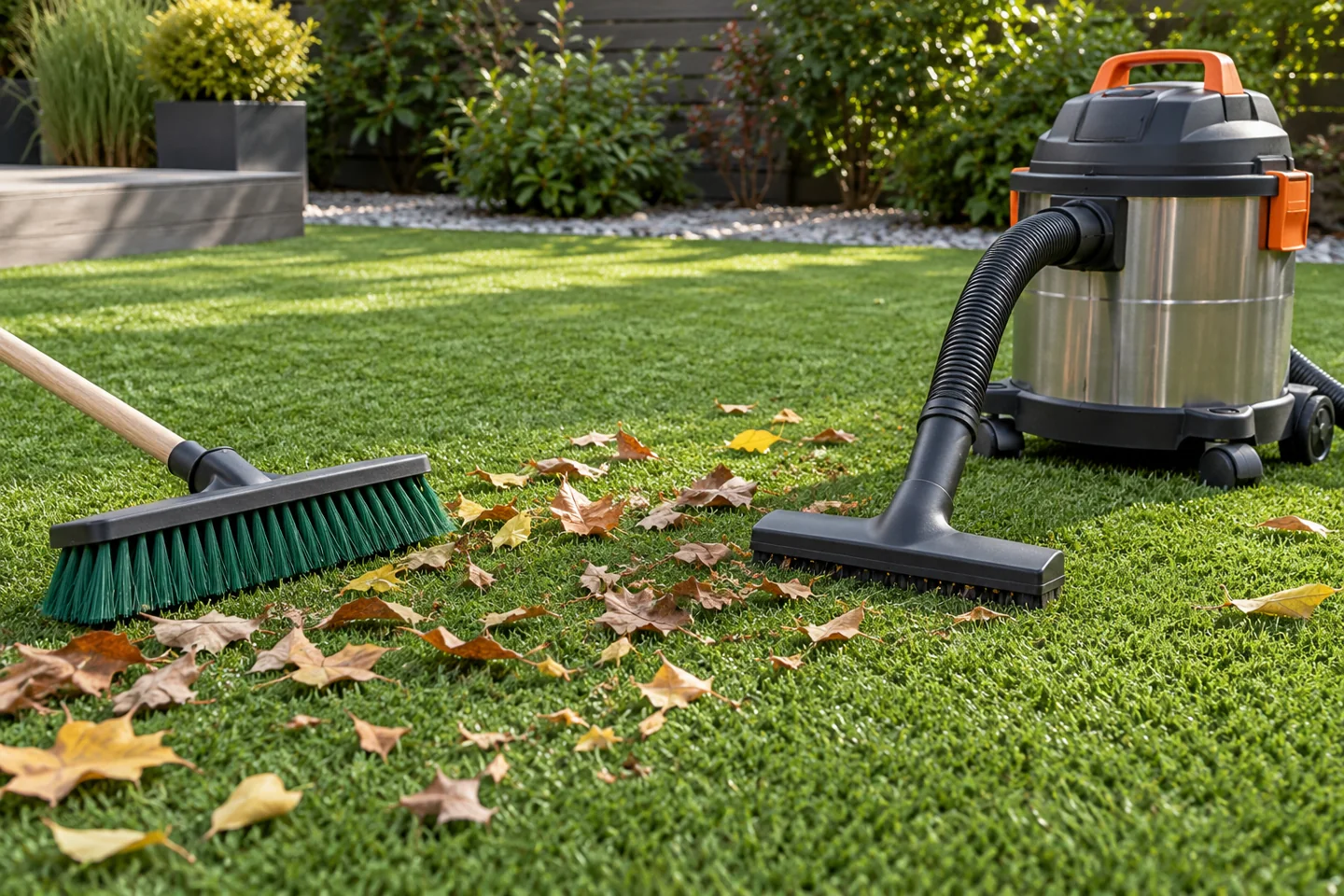
Do not use an ordinary household vacuum on artificial grass unless both the turf and equipment manufacturers approve the exact setup. Infill, backing, seams, pile, moisture, and outdoor electrical conditions all matter. Some installations use specialist maintenance equipment, but that does not make every indoor vacuum or robot suitable.

Also reject the blanket claim that artificial grass must never be rinsed. Manufacturer care instructions can include brushing and rinsing. Follow the installed turf’s actual maintenance plan rather than treating all synthetic lawns as identical.
Identify the turf system before choosing equipment
Find the manufacturer, product, installation details, infill type if present, and care document. Landscape turf, pet areas, putting greens, sports surfaces, and indoor artificial-grass mats can have different requirements.
The visible fibers are only part of the system. Backing, drainage, seams, edges, and infill influence what cleaning methods are appropriate. A tool that looks gentle at the surface may remove material that belongs in the installation.
Ask the installer if the product information is missing. Do not infer compatibility from the appearance or thickness alone.
Why a household vacuum can be the wrong tool
| Issue | What can go wrong | What to establish |
|---|---|---|
| Infill | Suction may remove material intended to remain between fibers | Whether vacuuming is permitted and whether an approved machine separates debris appropriately |
| Brush action | An unsuitable head may pull fibers, edges, or seams | Permitted brush type and method |
| Moisture | A dry-only appliance can encounter wet turf or liquid | Equipment rating and the actual surface condition |
| Outdoor use | Indoor electrical equipment may be unsuitable for the environment | Manufacturer operating restrictions |
| Loose edges or damage | Repeated contact can worsen the installation problem | Repair before further cleaning |
Do not assume a powerful motor solves these issues. More suction can be the opposite of what an infilled system needs.
What manufacturer care can look like
SYNLawn’s care guidance describes periodic brushing and rinsing, including use of a suitable rake or broom and a garden hose for the products covered. This directly contradicts a universal “never use water” instruction.
It does not mean every installation should be flooded or every chemical is acceptable. Follow the specific product’s brush, water, drainage, and cleaning instructions. A roof deck, indoor mat, or poorly draining area may need a different approach.
If water stands or the area remains persistently wet, investigate drainage and installation rather than repeatedly applying more water or attempting to dry it with a household vacuum.

A practical routine for ordinary loose debris
- Inspect first. Identify sharp objects, pet waste, damaged seams, loose edges, and unusual contamination.
- Remove larger litter carefully. Pick up suitable items without driving them into the fibers.
- Use the approved debris-removal tool. This may be a specified broom, rake, blower, sweeper, or service method.
- Brush as directed. Follow the turf manufacturer’s method rather than aggressive scrubbing.
- Rinse only where appropriate. Use the approved process and avoid creating drainage or slip problems.
- Inspect afterward. Check that infill, seams, edges, and fibers remain in their intended condition.
Keep children and pets away while powered equipment is operating. Manage cables, hoses, and debris so they do not create trip or projectile hazards.
Using a leaf blower is not automatically the best answer
A suitable blower may move some dry leaves, but check the turf instructions, debris, neighboring areas, and equipment limits. Avoid blowing sharp fragments, contaminated material, or infill into people, drains, or adjacent property.
Use the equipment’s required protective measures and noise restrictions. A blower moves material; it does not necessarily collect it or remove the source of an odor.
Choose the method for the actual debris. Wet leaves, embedded material, and pet contamination may need different handling from a light dry layer.
What about a turf sweeper or power broom?
A purpose-designed tool may suit some installations, but confirm the permitted machine, brush, depth, and technique. A product name is not proof of compatibility with every turf system.
If considering a Turf Electric Power Sweeper/Cleaning Broom, check the exact model instructions and ask the turf manufacturer whether its action is approved. Confirm how it handles infill, seams, wet conditions, and edge areas before purchase.
Do not set an aggressive depth to force a dramatic before-and-after result. Stop if fibers pull, seams move, infill is removed unexpectedly, or the surface changes.
Pet areas need source-specific cleaning
Remove solid waste promptly using an appropriate method and follow the turf maker’s approved rinse or cleaner instructions. Do not assume dry vacuuming sanitizes the area or removes contamination from the drainage layer.
Use only products compatible with the turf, pets, and installation, following the label’s access and rinsing requirements. Do not mix bleach, acids, ammonia-based products, or other cleaners.
Persistent odor can involve maintenance, drainage, or material below the visible surface. Ask the installer or manufacturer rather than adding fragrance or a household powder.
Can a robot vacuum clean artificial grass?
Do not assume an indoor floor robot is rated for outdoor turf, infill, dampness, uneven ground, or the debris present. Its wheels, sensors, intake, and charger have operating limits.
Even an indoor artificial-grass mat needs compatibility checks for pile, loose fibers, backing, and edge crossing. A robot successfully climbing onto it does not establish appropriate cleaning.
Our robot systems guide explains why navigation and pickup capability are separate. Use equipment designed and approved for the actual installation.
When to call the installer or maintenance specialist
Seek advice for loose seams, lifted edges, unexpected infill loss, persistent standing water, strong recurring odor, or a surface that changes after cleaning. Record the product and equipment used and take photographs before applying another treatment.
Do not glue, cut, or add infill without the correct installation guidance. More material is not automatically the right repair, and an unapproved adhesive can create a separate problem.
For ordinary indoor floors, use the floor-by-floor guide instead of transferring turf procedures. Our vacuuming-versus-sweeping comparison also emphasizes choosing the tool for the surface and debris.
Describe the installed turf before asking about a machine
When asking an installer for care advice, identify whether the area has infill, the backing or drainage arrangement if known, the debris involved and the equipment proposed. A loose leaf on a domestic lawn and fine material within a sports-turf system are different tasks.
Ask which method is permitted and which material should remain in place. Do not remove infill because it resembles dirt or assume a strong shop vacuum is suitable simply because it can collect it.
Keep the resulting care instructions with the property records. The useful outcome is a method for the installed system, including pet-area cleaning where relevant, rather than a general yes or no about all artificial grass.
Frequently asked questions
Is all vacuuming forbidden on artificial grass?
No universal statement fits every system and specialist machine. The practical rule is to obtain approval for the exact turf and equipment rather than use an ordinary household vacuum by default.
Will water always damage synthetic turf?
No. Some manufacturer routines include rinsing. Follow the installed product’s method and address drainage problems separately.
Can I remove infill because it looks dirty?
Do not remove or replace it without the correct maintenance plan. Infill may be an intended part of the surface system.
Is a shop vacuum automatically suitable?
No. A wet/dry rating does not establish turf, infill, seam, or contamination compatibility. Check both manufacturers’ instructions.
Follow the installed system’s care plan
Identify the turf and infill, use approved tools, manage debris and pet areas appropriately, and protect drainage and seams. Avoid both extremes: an ordinary indoor vacuum is not automatically suitable, and water is not universally prohibited.
Further reading
Turf Electric Power Sweeper/Cleaning Broom

Katy James contributes vacuum-cleaner explainers and practical cleaning guidance at GlobVacs. Her published topics include robot-vacuum operation and vacuum airflow. Read her author profile and selected articles.