
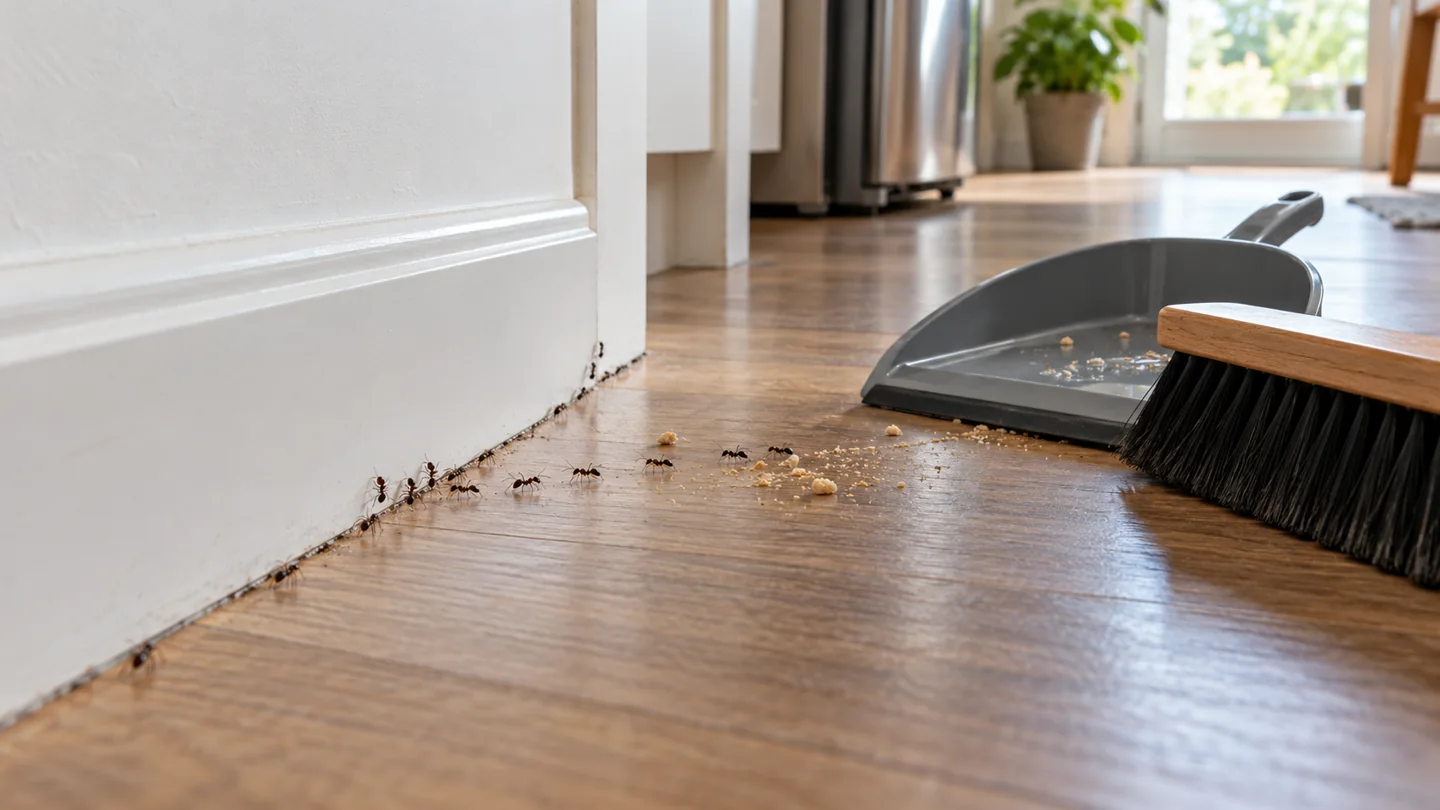
Vacuuming can remove visible ants, but it does not reliably eliminate an ant colony. Some collected ants may be killed and others may survive. The more important task is finding why ants are entering, removing food and moisture sources, and choosing species-appropriate control when needed.

A trail disappearing into a hose is an immediate cleaning result. A trail returning the next morning is evidence that the source remains. Treat those as separate problems rather than buying a stronger vacuum to repeat the same temporary solution.
What vacuuming achieves
A suitable vacuum can remove reachable foragers and loose food debris. That can be useful when ants are crossing a dry floor or collecting around a spill. It does not prove that queens, brood, or the nest have been reached.
Do not promise that suction alone kills every ant. Machine design, the collection path, the amount of debris, and the pest itself differ. After collection, contain and dispose of material through the normal approved procedure rather than relying on survival assumptions.
The UC IPM ant-management guide includes mechanical removal alongside sanitation, exclusion, and other control measures. The point is a combined approach, not a single appliance setting.
Check the source before cleaning away every clue
Observe the route from a safe distance. Note the entry point, food source, moisture, and whether activity is concentrated near a particular wall, pipe, window, or appliance. A photograph can help with identification if professional advice is needed.
Do not dismantle electrical outlets, open walls, or disturb an unknown nest to follow a trail. Ants appearing near damp or damaged wood deserve assessment of the underlying condition as well as pest identification.
If treatment or baiting is already underway, ask the provider before removing ants or cleaning the trail. Do not disrupt a planned treatment simply because a visible trail remains during the service period.
A useful household sequence
- Identify accessible food or liquid attracting the ants and secure it.
- Record the trail and entry area if identification or professional follow-up may be needed.
- Check whether pesticide or bait is present before vacuuming.
- Remove compatible dry crumbs and visible ants using a permitted cleaning method.
- Handle the vacuum’s contents according to its manual, containing removed material.
- Clean the affected surface with a surface-compatible method and address entry gaps or leaks appropriately.
- Monitor for renewed activity rather than assuming one clean has solved the problem.
Do not vacuum liquid spills, wet cleaning solution, pesticide deposits, or an unknown powder with an ordinary dry machine. If the ants are on a wet countertop, a compatible manual cleaning method may be more appropriate.
Why a HEPA filter is not an ant-control feature
HEPA filtration concerns fine particles under defined conditions. It does not establish that ants are killed, that a colony has been removed, or that a vacuum can safely collect pesticide. Bag and bin handling remain separate tasks.
Choose a vacuum for floor compatibility, ordinary cleaning performance, maintenance, and containment needs. Our HEPA guide explains the filter’s actual role, while the bug-collection guide covers pest-handling limits.
Remove the attractants that keep the trail active
Clean accessible food spills, store food and pet food securely, manage bins, and address leaks. Check less obvious sources such as residue beneath a food container, a sticky recycling item, or a damp area around plumbing.
Use a suitable dry-cleaning routine for crumbs and tracked debris, then spot-clean the actual spill. A vacuum does not remove dissolved sugar from a hard floor. Our vacuuming-versus-sweeping comparison helps choose a practical dry-soil method without confusing it with wet cleaning.
Seal appropriate entry gaps when you understand the location and property requirements. Repairs involving utilities, structural damage, or rental-property obligations may need the relevant professional or property manager.
Baits and sprays are not interchangeable
Some ant-management plans use bait that workers carry back toward the colony. The choice and placement depend on the ant and the product. Follow the exact label and keep products inaccessible to children and animals as directed.
Do not apply a repellent spray around a bait station, wash away a planned treatment, or add homemade poison to food containers. Ask the provider how visible ant activity should be handled while the treatment works.
UC IPM’s species-specific pharaoh-ant guidance is one example of why identification matters. A generic promise that any bait or spray will eliminate every ant problem is not justified.
Avoid ineffective or incompatible household recipes
Vinegar, lemon, spices, and essential oils are not dependable universal colony-control methods. They can also affect finishes, leave residues, or expose pets and people to products used inappropriately. Do not sprinkle powders over carpet and then assume your vacuum is designed to collect them.
Never spray insecticide into a vacuum bag or bin to kill ants. The machine is not a pesticide applicator or a controlled chemical container. For treated areas, use the after-pest-control cleaning guide and the actual service instructions.
When to seek professional help
Get help when ants return persistently despite sanitation and appropriate exclusion, identification is uncertain, activity suggests a concealed nest, or the site involves stinging ants or vulnerable occupants. Repeated sightings around damaged wood or moisture also justify inspection.
Provide locations, photographs, timing, and products already used. This information is more useful than simply reporting that the vacuum did not kill the ants.
Will ants die if I leave them in the vacuum?
Do not rely on an arbitrary waiting time. Contain the collected material and follow the machine’s disposal procedure instead.
Can I vacuum the bait?
Only as instructed by the label or applicator. Removing bait can interrupt treatment, and collecting pesticide may be unsuitable for ordinary household equipment.

Abi Khan is the founder and a content writer at GlobVacs. His published work covers vacuum-cleaner buying guides, product comparisons and practical maintenance advice. Read his author profile and selected articles.