
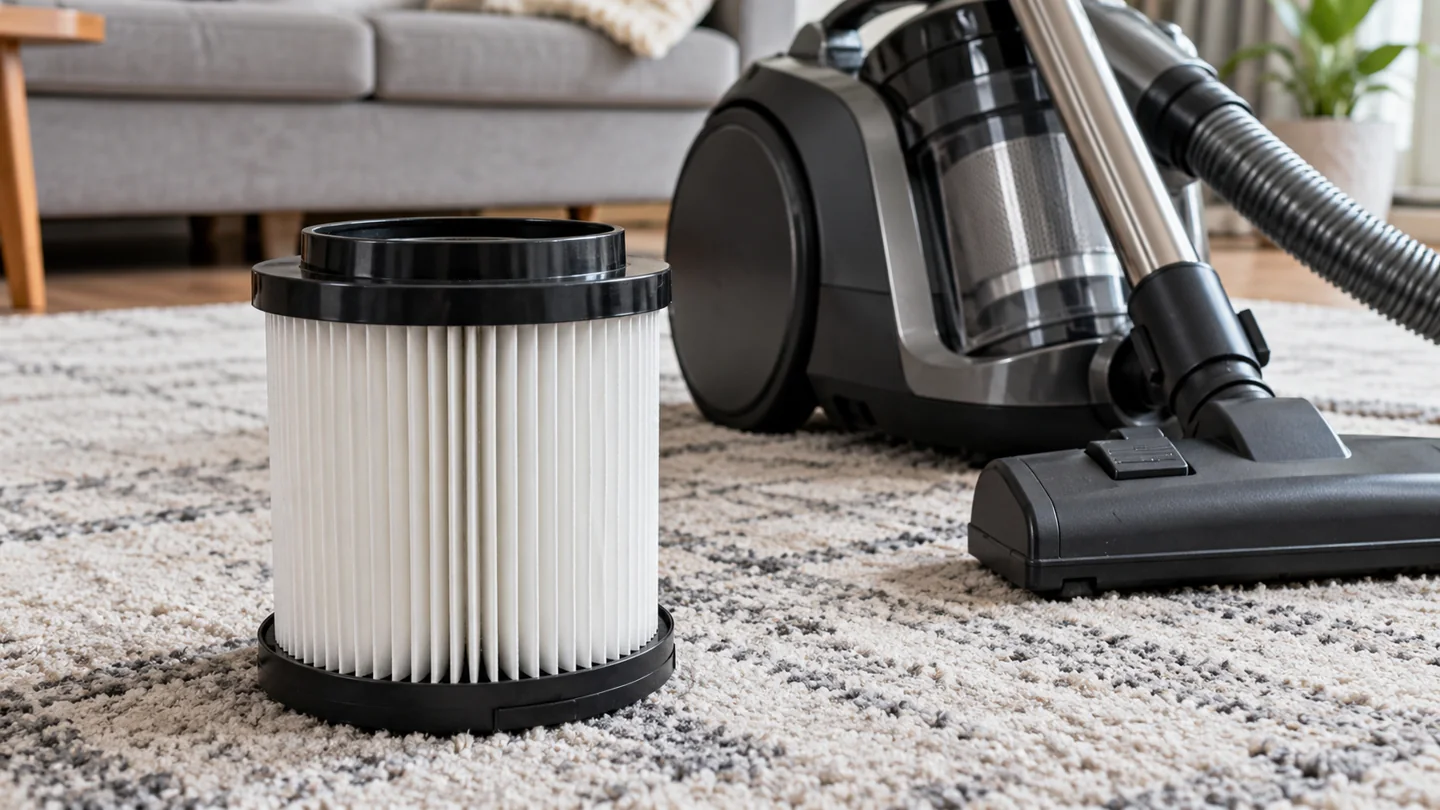
HEPA filtration in a vacuum cleaner can help retain fine particles collected during cleaning, provided the filter is genuine, correctly fitted, and part of a suitable well-maintained system. A HEPA element alone does not guarantee that the entire machine is sealed, that emptying is dust-free, or that using it will resolve allergy or asthma symptoms.
The useful buying question is therefore broader than “does it have HEPA?” Ask what was tested, where air can bypass filtration, how the machine is emptied, and what maintenance is needed to preserve performance.
What HEPA means
The EPA’s HEPA explanation describes a filter capable of removing at least 99.97% of airborne particles at 0.3 micrometers under the relevant definition. The percentage describes filtration conditions; it is not a promise to remove that proportion of all pollution from a room during vacuuming.
The 0.3-micrometer reference is not a universal minimum particle size below which everything passes through. Filtration mechanisms and efficiency vary with particle size. Avoid interpreting a headline specification as a simple sieve-hole dimension.
Products may use different classifications, test methods, and wording. Check the applicable documentation rather than assuming terms such as “HEPA-style” or “high efficiency” mean the same thing as a demonstrated HEPA claim.
The main benefit: retaining collected particles
A suitable high-efficiency filter can reduce fine-particle release through the filtered exhaust stream. That supports the wider task of removing ordinary dust and particle-bearing debris from surfaces.
Pickup still depends on the floorhead, airflow, brush compatibility, access, and technique. A good filter does not reach a missed corner, lift hair from upholstery by itself, or compensate for an unsuitable floorhead.
Our vacuum-technology guide explains the path from floorhead to collection and exhaust. Filtration is one stage of that complete process.
Filter efficiency and whole-machine performance differ
Air can bypass a filter through a poor fit, damaged seal, incorrectly seated container, missing component, or another unintended path. Ask whether testing describes just the filter or the assembled machine under stated conditions.
The EPA’s explanation of HEPA vacuums in renovation work makes the whole-system distinction important. That specialized context does not authorize ordinary household equipment for lead, asbestos, or other hazardous cleanup.
Do not retrofit an unapproved filter and assume you have created a certified hazardous-dust vacuum. Material suitability, containment, handling, and the relevant rules remain separate requirements.
Allergy and asthma claims need realistic limits
Some household dust contains particles associated with allergens. Removing and retaining appropriate debris can be one part of exposure management, but results depend on the home, sources, routine, equipment, and individual condition.
The EPA’s asthma-trigger guidance includes HEPA vacuuming and advises that people with asthma or allergies avoid the area during vacuuming when appropriate. Do not promise symptom relief, fewer attacks, or a medical outcome from buying one appliance.
Follow the person’s healthcare plan and address relevant sources such as moisture or smoke. A vacuum is not a replacement for medical care, ventilation decisions, or fixing a building problem.
HEPA is not an odor or gas filter by itself
HEPA media primarily addresses particles. It does not automatically remove gaseous pollutants or every odor. Some equipment includes additional media for other purposes, but those claims need their own evidence and maintenance instructions.
If a vacuum smells bad, investigate collected material, moisture, blocked airways, or another cause. Do not add fragrance to conceal an unresolved problem. For abnormal electrical or hot-rubber smells, use the burning-smell guide and stop use as appropriate.
Emptying can create a separate exposure
A machine can filter well while running but release dust when opened. Consider bag closures, bin-release design, the waste container, and who performs maintenance. A powered auto-empty dock introduces another collection and filtration system to assess.
Our bagged-versus-bagless guide compares these ownership tasks. Neither format is automatically dust-free, and neither should be judged only by the main unit’s filter label.
Maintenance preserves the intended system
- Use the specified filter and fit every component correctly.
- Observe fill limits and model-specific maintenance indicators.
- Clean or replace components using the exact instructions.
- Wash only elements explicitly identified as washable.
- Allow washed parts to dry completely as directed before fitting them.
- Inspect seals and contact support if dust leakage or abnormal operation persists.
Do not tap or blow dusty filters indoors as a routine improvisation, operate without required components, or assume all HEPA filters last the same number of months. Our filter-schedule guide explains the difference between care, indicators, and replacement.
Questions to ask before buying
| Question | What a useful answer includes |
|---|---|
| What is the filtration claim? | Defined filter class or efficiency and relevant testing conditions |
| Was the complete machine tested? | Scope, configuration, and evidence beyond a loose filter element |
| How is dust handled? | Bag or bin procedure, dock handling, and maintenance access |
| What does ownership require? | Filter availability, replacement cost, wash restrictions, and drying needs |
| Does it clean my floors appropriately? | Compatible heads, relevant pickup evidence, and practical handling |
Check floor compatibility alongside filtration. A suitable vacuum must both collect the right material and retain it appropriately.
Does HEPA make powder pickup safe?
No. The machine’s approved uses and fine-dust restrictions still apply.
Does HEPA guarantee lower electricity use?
No. Energy use depends on the complete appliance and routine, not the filter label alone.
Can it remove mold from a damp carpet?
Do not treat a household HEPA vacuum as a mold-remediation solution. Address moisture and obtain appropriate advice for the affected material.
Read a filter claim at the correct level
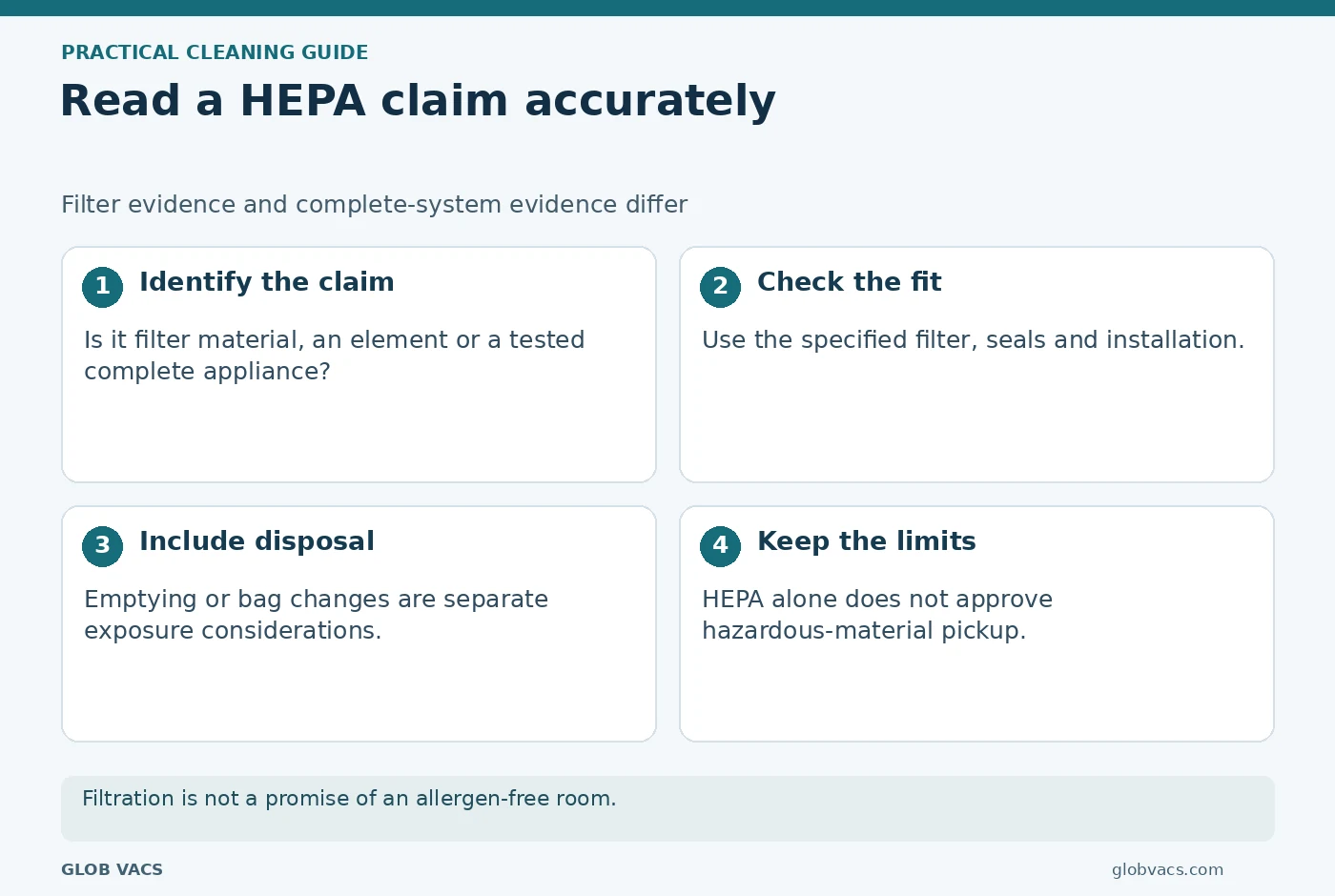
Look for what the documentation actually tests or specifies: filter material, a filter element, a sealed system or a complete appliance result. Those are different levels of evidence. A high-efficiency element can be part of a useful design, but its number should not be presented as a measured room-air result without appropriate evidence.
Also inspect the path before the filter and the way the collection container or bag is fitted. Missing seals, an incorrectly seated filter or an unsuitable replacement part can change the intended system. Match the exact part and installation method rather than relying on the HEPA word alone.
The useful benefit is retention of collected particles within the documented design. It does not turn an ordinary household vacuum into equipment approved for asbestos, lead, pesticide residue or other hazardous material.
Include disposal and upkeep in the buying comparison
Follow the actual bag or cup emptying method and choose an appropriate location for the task. A sealed filtration path during operation and dust released while emptying are separate ownership considerations.
Keep the specified filter and bag supplies available, and wash only the elements the manufacturer permits. A washable-looking surface is not proof that washing preserves its specification. Allow all required drying before reassembly.
For allergy or asthma concerns, use appropriate medical guidance and broader environmental measures rather than treating one appliance as a guaranteed treatment. Compare the machine’s documented containment, handling and maintenance without promising an allergen-free home.
Keep hazardous-material questions separate
If the material may be hazardous, identify the appropriate collection equipment and procedure before using a household vacuum. A filter label alone does not establish the appliance’s suitability, containment during servicing or disposal method.
Use relevant professional and manufacturer guidance for the substance involved. The consumer filtration discussion here concerns ordinary permitted household cleaning; it should not be extended into an approval for remediation or industrial dust collection. This boundary is part of an accurate explanation of HEPA’s benefits.

Katy James contributes vacuum-cleaner explainers and practical cleaning guidance at GlobVacs. Her published topics include robot-vacuum operation and vacuum airflow. Read her author profile and selected articles.