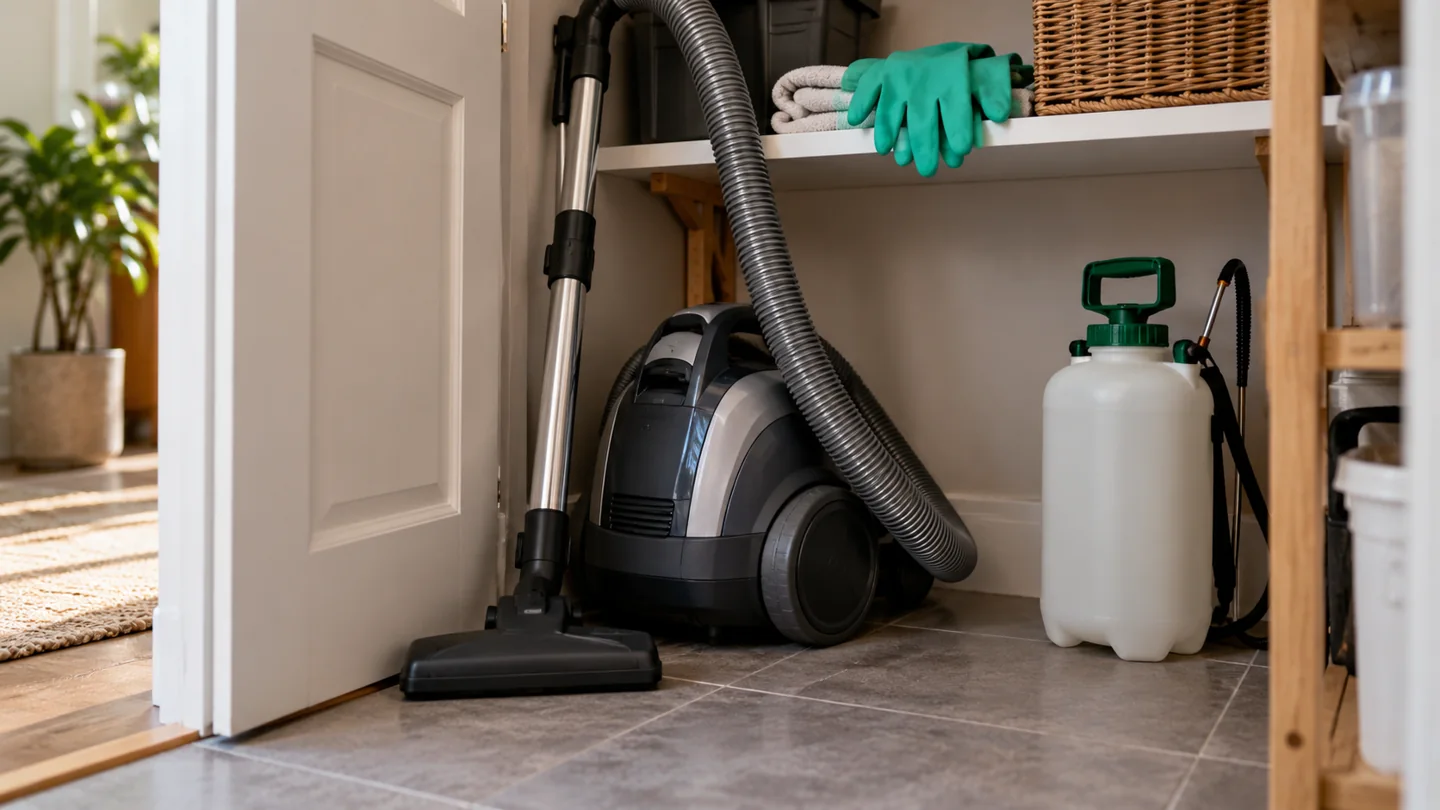
You can vacuum after pest control only when the product label and treatment instructions permit it in the area you want to clean. There is no universal waiting period for sprays, foggers, baits, dusts, or heat treatments. Ask the applicator which surfaces can be cleaned, which deposits should remain, and when each task is allowed.
Being allowed to re-enter a room is not the same as permission to vacuum every treated surface. Likewise, a surface feeling dry does not tell you whether removing a residual treatment will reduce effectiveness or create an exposure problem.
Get these details before starting
- The pest being treated and the treatment method.
- The exact product names and applicable label directions.
- The locations treated, including baseboards, cracks, furniture, rugs, or voids.
- Re-entry, ventilation, cleaning, and pet-access instructions.
- Areas that should remain undisturbed and for how long.
- Instructions for dead pests, eggs, droppings, or contaminated materials.
- The contact to use if deposits, odors, or symptoms appear abnormal.
Request written aftercare where possible. If several treatments were used, one simple “wait until tomorrow” instruction may not cover every room and surface. Clarify the specific task, not just whether cleaning in general is allowed.
Different treatments create different cleaning decisions
| Treatment or situation | Question to ask | Why it matters |
|---|---|---|
| Residual spray along edges | Which treated bands must remain undisturbed? | Cleaning may remove an intended deposit |
| Bait stations or gel placements | Where are they and how should nearby cleaning be handled? | Removal or contamination may interrupt control |
| Dust applied in a specific location | Is any visible deposit expected, and who should clean excess? | Ordinary vacuuming may spread or collect pesticide |
| Heat or another nonchemical service | What follow-up cleaning and inspection are required? | Cooling and treatment completion do not establish all aftercare |
| Suspected overapplication or spill | Who will assess and direct cleanup? | This is a contamination problem, not routine housekeeping |
Do not convert this table into a timed schedule. The missing information is the actual product, treatment plan, and site-specific instruction.
Why routine vacuuming is not pesticide cleanup
A domestic vacuum is designed for specified cleaning materials. It is not automatically suitable for wet pesticide, loose pesticide dust, or unknown chemical residue. A household HEPA filter does not by itself establish chemical-cleanup suitability.
The National Pesticide Information Center’s guidance on indoor pesticide misuse explains that cleanup depends on the pesticide and affected material. Do not improvise a remedy for a suspected misuse event with ordinary cleaning equipment.
If a machine has collected a concerning chemical, stop using it in other rooms and ask the applicator or appropriate authority how to handle it. Normal filter washing is not proof of decontamination.
Removing dead pests after treatment
Once cleaning is permitted, ask whether accessible pest remains can be vacuumed and what containment is required. Different pests and materials need different handling. Do not assume all droppings or nesting materials are suitable for dry vacuuming.
For an ordinary permitted vacuum task, isolate power before removing the bag or opening the bin. Follow the equipment’s handling instructions and contain removed material. Do not scatter contents outside or reach into debris.
For bed bugs, the EPA’s control guidance includes vacuuming as part of a broader plan with careful handling. That is a pest-specific example, not permission to vacuum every treatment residue.
Keep treatment areas and normal cleaning areas distinct
A provider may allow cleaning in a room’s open floor area while asking that particular edges or cracks remain undisturbed. Make those boundaries clear to anyone who cleans the home, including a cleaner or family member.
Pause robot schedules if their routes could cross restricted areas, disturb bait, or collect unknown deposits. Supported boundaries may help only when the provider approves the task and the machine reliably avoids the area. Do not assume a robot can interpret treatment locations on its own.
Our robot scheduling guide covers normal routines; a pest-control plan takes priority over that routine.
After ant treatment, do not clean away the plan
Ask how to handle visible ants near bait and whether trail cleaning is appropriate during treatment. A bait plan can depend on foragers interacting with the product. Removing everything immediately may work against the chosen method.
At the same time, sanitation remains important. Get clear advice on food spills, bins, pet bowls, and unaffected surfaces. Our ant-cleaning guide separates visible removal from controlling the source.
If the instructions are unclear or something seems wrong
Do not guess based on internet tables. Contact the applicator with the product, room, surface, and task. Ask a concrete question such as whether the open carpet can be vacuumed while the treated baseboard edge is left alone.
Unexpected puddles, piles of dust, spills, or strong irritation deserve prompt advice. Keep people and pets away as appropriate, and follow product-specific or emergency guidance if exposure is suspected. Do not add bleach, solvent, or another cleaner to neutralize an unknown pesticide.
Resume the normal routine after clearance
Once the relevant restrictions have ended, return to compatible floor care and the treatment’s monitoring plan. Record renewed pest activity and arrange the promised follow-up instead of assuming more vacuuming will resolve an unsuccessful treatment.
Use floor-specific tools, maintain the machine normally, and manage ordinary food debris. Keep service records so future cleaners know what was used and where.
Is four hours always enough?
No. A single number cannot cover all products and tasks. Follow the actual label and applicator’s instructions.
Should I vacuum residual chemicals to protect my family?
Do not improvise. Ask whether the deposit is expected and what cleanup, if any, is required. Ordinary vacuuming can be unsuitable and may spread contamination.
Does heat treatment always mean waiting 24–48 hours?
No universal rule applies. Use the provider’s completion, re-entry, cleaning, and monitoring instructions for the service performed.
Further reading
Why Does My Carpet Sound Crunchy After Vacuuming?

Abi Khan is the founder and a content writer at GlobVacs. His published work covers vacuum-cleaner buying guides, product comparisons and practical maintenance advice. Read his author profile and selected articles.