
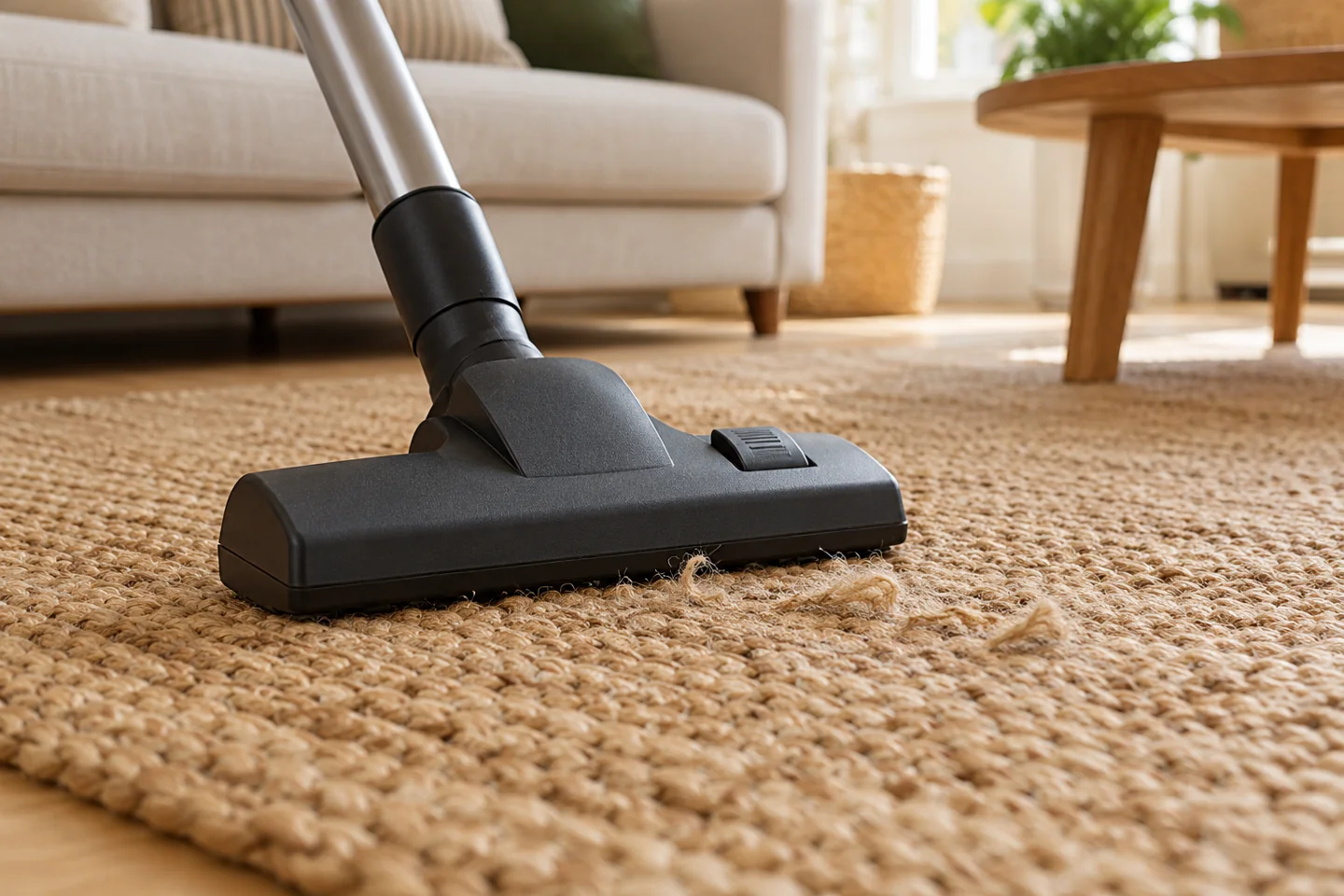
Jute rug shedding when vacuuming can leave you wondering whether you are cleaning the rug or wearing it away. Loose fibers and dust in the bin do not automatically mean the rug is ruined. However, increasing suction or repeatedly scrubbing one area can be the wrong response if the head is pulling at the weave.
Start by checking the care label, reducing unnecessary agitation, and looking for visible changes in the rug. The aim is to collect loose material without tugging on fibers that are still part of its structure.
Distinguish loose fibers from visible damage
Check the rug in good light before and after cleaning. A few loose fibers in a bin tell you less than a change you can see on the rug itself.
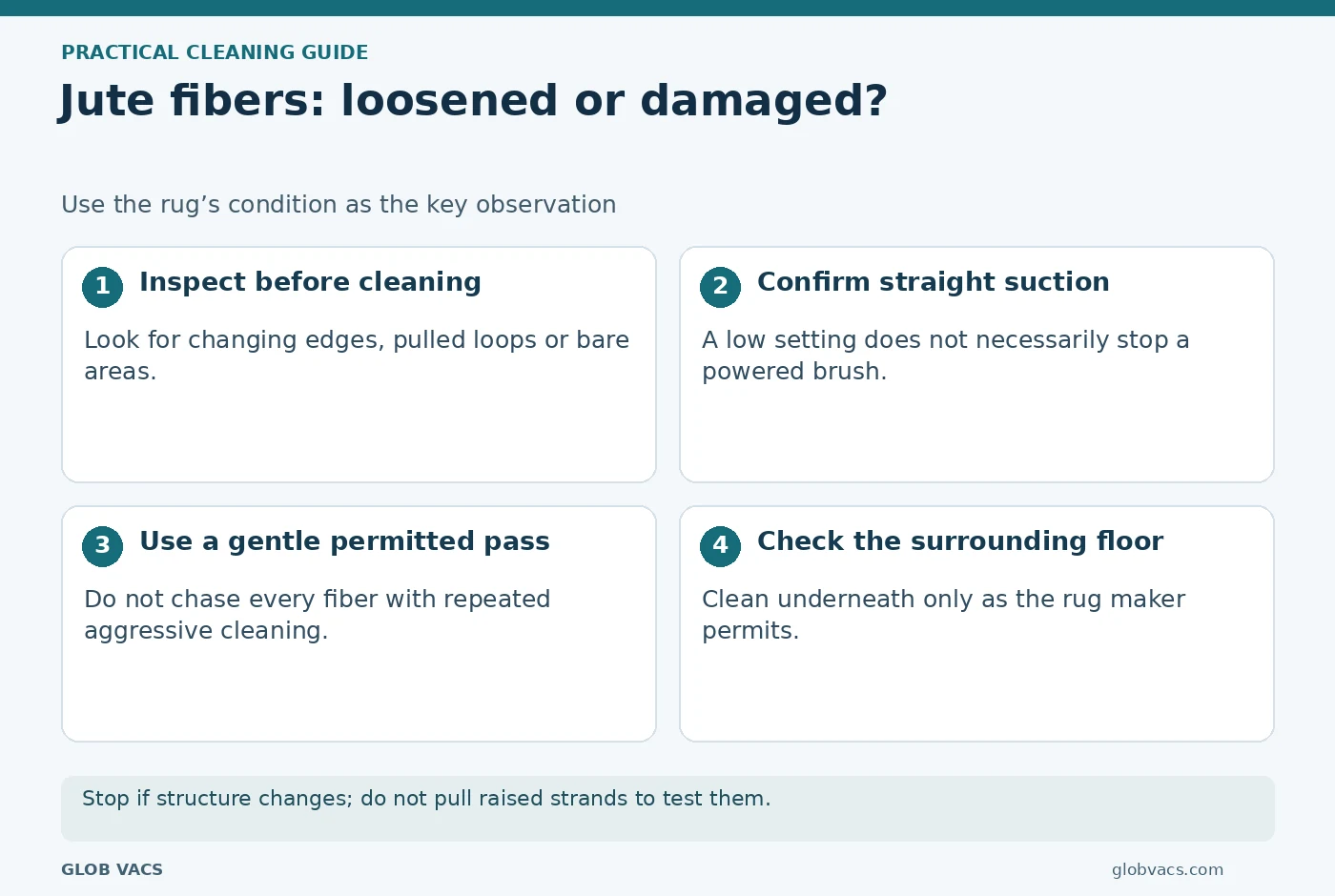
Look for raised loops, an opening in the weave, a damaged edge, or a patch that appears thinner than its surroundings. Stop using an attachment that catches or pulls at the surface. Do not tug a protruding strand to find out whether it is loose.
There is no useful universal deadline after which every jute rug must stop shedding. Construction, blends, condition, and use differ. If shedding changes suddenly or the weave is deteriorating, send photographs to the seller or manufacturer and ask for advice about that specific rug.
Use the care label to choose your vacuum setup
Check whether the rug is pure jute or a blend and whether it has a backing. Instructions for one construction may not suit another.
Rugs USA’s shedding guidance recommends light vacuuming with the grain and avoiding a heavy beater bar. Its Perfect Handwoven Jute-Blend Rug care instructions specify low suction without a beater bar. These are useful examples of why a powerful carpet head should not be your automatic choice.
Use the setting specified for your rug. If no instructions are available, ask the seller before using powered agitation. Our best vacuum for jute rugs guide can help you compare equipment, but the rug's own care requirements remain the starting point.
Follow a gentle cleaning sequence
- Remove larger loose objects by hand.
- Inspect and clean the vacuum attachment.
- Select the approved suction-only or other permitted setup.
- Make light passes in the direction advised by the rug maker.
- Stop if the head lifts, catches, or distorts the rug.
- Inspect the surface rather than repeatedly passing over it to fill the bin with more fibers.
Avoid pressing down to make the head “dig in.” If a tool grips the rug, adjust the setup within the manufacturer's instructions rather than forcing it across the weave.
Fringes and loose edges deserve particular care. Keep them out of a powered head and follow the rug maker's method for cleaning those areas.
Clean underneath instead of chasing every fiber on top
Loose material can collect beneath a rug. If you clean only the upper surface, you may leave a layer of debris on the floor underneath.
When practical, move the rug with help if needed and vacuum the exposed floor using an attachment suitable for that floor. Rugs USA’s general rug-care guidance also advises periodically vacuuming beneath natural-fiber rugs.
Inspect the rug pad while the rug is lifted. Clean it according to its own instructions and check that it is dry and positioned correctly before replacing the rug. Do not assume a pad can be washed just because it sits beneath a washable floor surface.
Do not turn dry maintenance into an improvised wet clean
A shedding problem is not a reason to soak the rug, apply carpet shampoo, or scatter powder over it. Check the care instructions before introducing any cleaning treatment.
For stains, odors, or a large spill, contact the manufacturer or a cleaner experienced with the rug's material. Blot and other immediate actions should follow the supplied care guidance. A household dry vacuum is not a spill extractor.
Keeping moisture advice specific to the rug is more useful than treating all products sold as “natural fiber” as identical.
When should you reconsider the vacuum?
Consider another attachment or machine if your current cleaner has no permitted setting, its head repeatedly catches the weave, or its suction cannot be adjusted enough for controlled handling.
Prioritize usable controls, a suitable floor tool, and easy maintenance. A “pet hair” brush designed to agitate carpet may solve a different problem from the one your jute rug presents.
Compare normal loose fibers with a changing rug
Record what the rug looks like before cleaning and inspect a small area afterward. Loose fibers in a cup do not by themselves establish damage, but a growing bare patch, opening edge or pulled loop is a different observation. Stop and consult the rug supplier if the structure is changing.
Do not vacuum repeatedly until the cup contains no fibers. That endpoint can encourage excessive work on a natural-fiber rug. Follow the care label’s tool and frequency instructions and assess the condition of the surface rather than treating every collected fiber as proof that another pass is needed.
If there is a raised strand, avoid pulling it to find out whether it is loose. Follow the supplier’s specific guidance on trimming or repair instead of applying a general rule to every construction.
Check the actual straight-suction configuration
A head can look soft while still containing a driven roller. Identify whether the supplied tool is non-powered, air-driven or electrically powered and how suction is adjusted. A low-power setting does not necessarily stop a rotating brush.
Our jute-rug shortlist identifies non-powered tool routes and their trade-offs. That does not override the rug maker’s instructions; it makes the equipment configuration easier to verify.
Use a setting that allows controlled movement without dragging an unsecured edge, if that method is permitted. Stop if the rug lifts, catches or changes appearance. Do not defeat a tool control to invent a configuration the manufacturer does not support.
Plan the surrounding-floor cleanup
Loose fibers can settle beneath or beside the rug. If the rug maker permits moving it, clear the surrounding area and use an appropriate method for the floor underneath. Avoid shaking or moving it in a way that strains the backing or sends debris across other furnishings.
Inspect the vacuum’s wheels and tool before returning to a delicate floor. A tool carrying grit from the rug’s edge has a different contact condition from a clean one.
If the main frustration is repeated fiber accumulation around the rug, separate that floor-maintenance task from cleaning the rug itself. More aggressive top-surface passes may not solve it. A gentle permitted rug routine plus ordinary surrounding-floor collection can be a more useful plan.
Frequently asked questions
Should I keep vacuuming until no fibers enter the bin?
No. That is not a reliable cleaning target. Remove loose debris with the approved method and inspect the rug for changes instead of repeatedly working the same patch.
Can I use a robot vacuum on jute?
Check both sets of instructions. Brush action, rug edges, fringes, and suction settings vary. Do not assume a robot is gentle simply because it is small.
Should I cut every raised fiber?
Do not pull it. Ask the rug maker how to handle the particular construction before trimming a strand that might belong to the weave.

Abi Khan is the founder and a content writer at GlobVacs. His published work covers vacuum-cleaner buying guides, product comparisons and practical maintenance advice. Read his author profile and selected articles.