
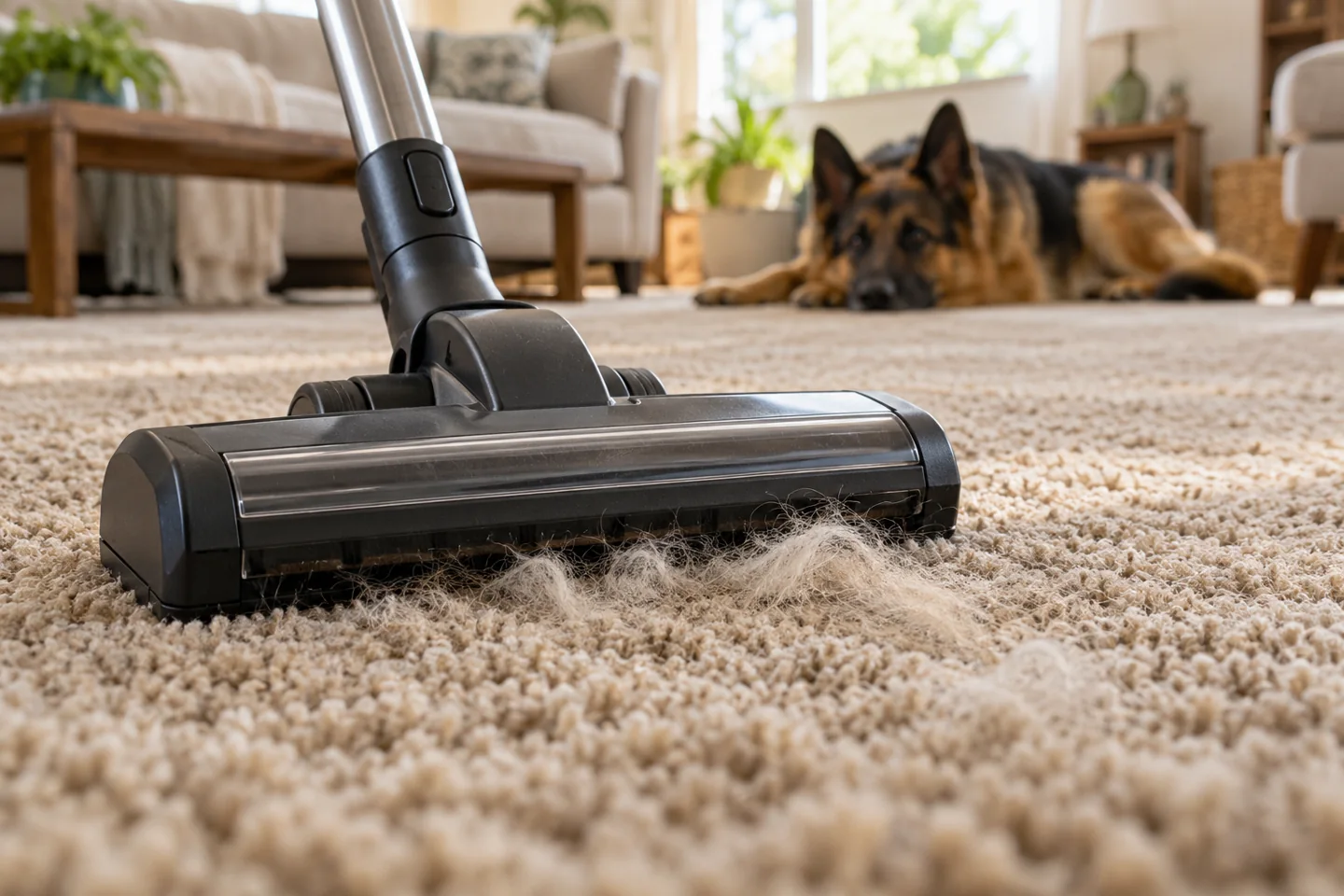
Learning how to remove embedded dog hair from carpet starts with checking whether your vacuum is lifting hair, collecting it, or simply moving over it. Loose tufts can disappear quickly while strands caught among the carpet fibers remain behind. Repeated fast passes may produce tidy-looking tracks without solving that problem.
Use a method that matches your carpet's care instructions, then inspect the vacuum before increasing power. A suitable head, clear airflow path, and deliberate cleaning pattern are more useful than assuming every pet-hair problem needs a new machine.
Identify the carpet before choosing a tool
Find the carpet manufacturer's vacuum guidance. Fiber, pile, and construction affect which tools are appropriate. Do not assume every carpet needs an aggressive powered brush.
Mohawk's carpet-care guidance explains that the appropriate choice can include a rotating brush, beater bar, or suction-only cleaning depending on carpet type. Follow the instructions for your actual carpet, especially for looped, delicate, or unusually soft constructions.
The same caution applies to rubber rakes, stiff brushes, and scraping tools. Use them only when the carpet manufacturer permits them. A tool that gathers a dramatic pile of material is not automatically treating the carpet appropriately.
Check the vacuum before working harder
Switch off and unplug or isolate the machine as its manual directs. Inspect the brush, intake, hose, and bin or bag.
Hair wrapped around a roller can interfere with its movement. Dyson's brush-bar troubleshooting guidance identifies hair-related jamming as a possible reason a brush stops spinning. Follow your own machine's removal and cleaning procedure; roller designs differ.
Also check the bin fill line or bag condition. Inspect filters according to the manual, washing only those that are washable. Allow washed parts to dry fully for the specified time before refitting them.
If pickup has declined sharply, resolve that change before judging the vacuum's ability to handle your dog's coat.
Work through a small area methodically
Choose a manageable patch near the dog's usual resting place. Remove toys, cords, and unsuitable objects first. Pick up large loose clumps by hand if they would immediately overwhelm the intake.
Set the head height and suction as instructed for the carpet. Make a slow forward and backward pass, then move to an overlapping strip. If the carpet guidance allows it, try a second pass from another direction and check the result.
There is no universal number of passes that proves a carpet is clean. Inspect a representative area and stop if the head drags, the brush stalls, or the surface shows pulling. A vacuum that becomes hard to push needs a setting or compatibility check, not more force.
For equipment comparisons, our best vacuum cleaner for Husky hair guide focuses on a heavy-shedding household use case. Match the included head to your flooring before choosing a model.
Treat edges and stairs as separate tasks
Hair beside skirting boards or around furniture legs may sit outside the floor head's effective reach. Use a suitable crevice tool along those boundaries without scraping or forcing it into the carpet. Hair can also wind around rolling furniture; see how to remove hair from chair wheels when cleaning the floor does not free a sticking caster.
On carpeted stairs, use an attachment approved for that task and follow the vacuum's stair-use instructions. Keep the main machine stable; do not balance it above you where it could fall. Work around the tread edges and risers rather than expecting a full-size floor head to reach every corner.
An upholstery attachment may be useful for the dog's chair or sofa, but check the fabric care instructions separately. A tool suitable for carpet is not automatically suitable for every furnishing.
Use what remains to diagnose the problem
| Result after cleaning | What to investigate |
|---|---|
| Hair remains across the whole patch | Head compatibility, settings, brush movement, and airflow |
| Hair remains mainly around edges | Attachment access and cleaning pattern |
| Pickup starts well and declines | Bin capacity, hair wrapping, and possible restrictions |
| Head stalls or becomes difficult to push | Height, suction adjustment, and carpet compatibility |
This comparison helps separate a maintenance problem from a machine that does not suit the task. For another heavy-shedding household comparison, see our best vacuum for German Shepherd hair guide.
Build a routine around the areas that collect hair
Check the dog's resting spots and main routes more often than lightly used rooms. Short, targeted sessions may be easier to maintain than waiting until hair is visible throughout the house.
Wash removable pet bedding according to its care label and groom your dog using appropriate care advice. Do not use a household vacuum directly on an animal unless the manufacturer has specifically designed and approved the equipment for that use.
Judge the routine by whether hair is manageable and the carpet is being treated properly, rather than by how full the bin becomes.
Frequently asked questions
Is maximum power always best for dog hair?
No. Excessive suction can make some heads difficult to move. Use the settings recommended for the carpet and machine, and check brush action and airflow first.
Do I need a vacuum labeled “pet”?
The label alone is insufficient. Check the included tools, carpet compatibility, bin or bag capacity, and how easily you can remove wrapped hair.
Can a robot handle all embedded hair?
A robot may help maintain accessible areas, but stairs, edges, furnishings, and persistent embedded hair can still require other tools. Assess the actual cleaning result in your home.

Abi Khan is the founder and a content writer at GlobVacs. His published work covers vacuum-cleaner buying guides, product comparisons and practical maintenance advice. Read his author profile and selected articles.