
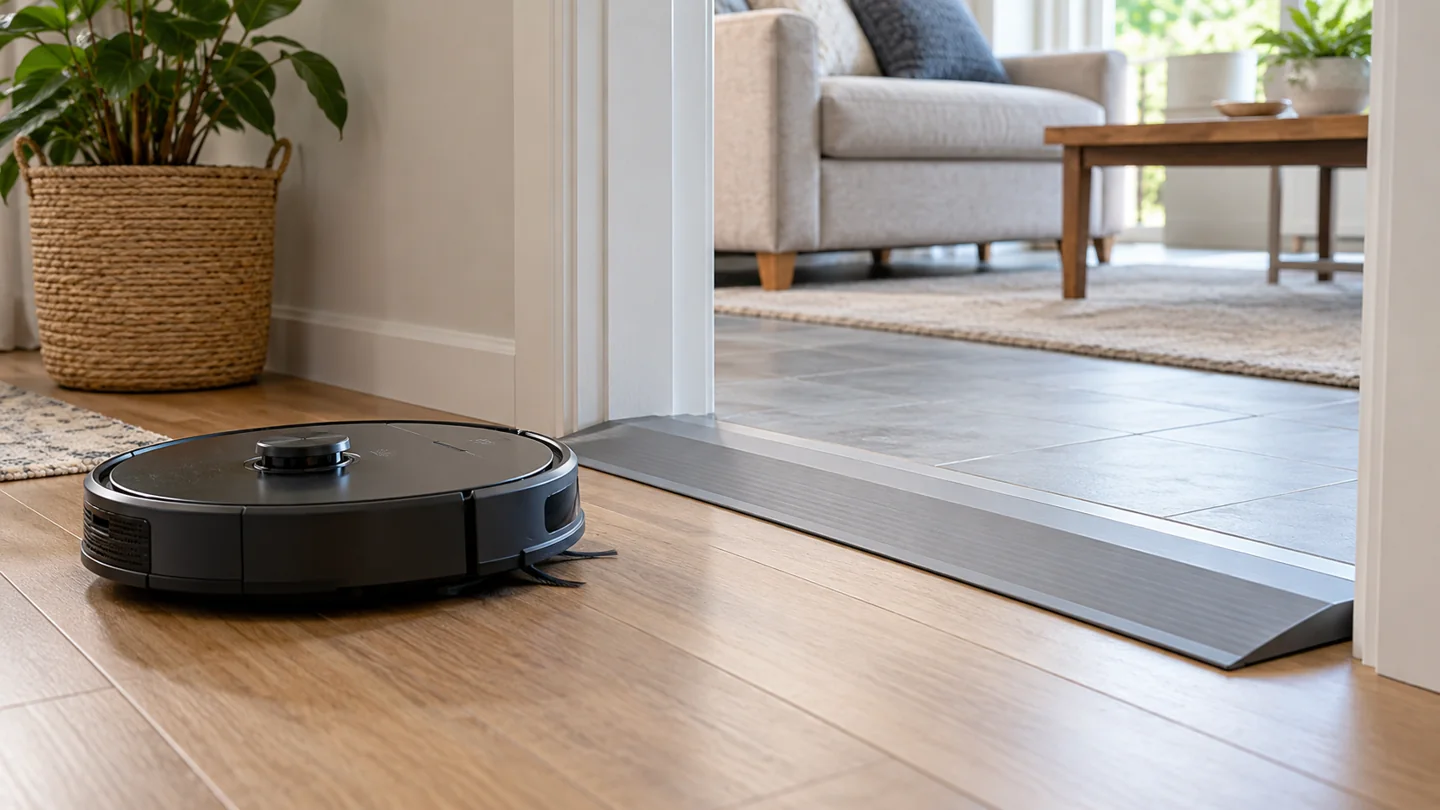
A robot-vacuum threshold ramp provides a sloped transition over a small permitted change in floor level. It may help a compatible robot cross an abrupt doorway lip that otherwise stops its wheels or catches its underside. It is not a universal fix for high steps, unsafe drops, loose flooring, or a robot that is unsuitable for the surface beyond.

Choose a ramp by the actual threshold profile, robot specifications, floor compatibility, stability, and the needs of people using the doorway. A ramp that moves, damages the finish, obstructs a door, or creates a trip hazard can cause more trouble than it solves.
When a ramp may help
A robot can struggle with a sharp rise even where a more gradual approach might be manageable. A suitable ramp changes the approach geometry. It does not change the robot’s wheel size, sensor system, traction limits, or permitted operating environment.
Before buying one, confirm that the problem is physical crossing rather than a tangle, dirty wheel, sensor response, or mapping boundary. A robot that refuses a dark surface may need a different solution from one whose underside rests on a raised strip.
See robot bump and threshold capability for that diagnosis. Do not use a ramp to defeat a safety boundary near stairs, water, a fireplace, or another hazard.
Measure the threshold before choosing a product
| Measurement or check | Why it matters |
|---|---|
| Rise on each side | The doorway may have different heights in each direction |
| Threshold top width and profile | A narrow ridge or second lip can still catch the robot after the first climb |
| Available ramp length | A longer run gives a gentler geometric slope for the same rise |
| Clear width | The robot needs room for its actual approach and turning behavior |
| Door clearance | The accessory must not block normal door operation |
| Floor finish and attachment | Backing or adhesive must not stain, lift, or damage the surface |
| Human traffic | The change must remain safe and practical for everyone using the doorway |
Measure from the actual surface the wheels travel on, including any relevant rug or mat. A side photograph with a ruler can help the robot manufacturer or floor installer assess the situation.
There is no universal safe ramp angle for every robot
Do not rely on a blanket claim that all robots can climb a particular slope. Traction, wheel travel, ground clearance, approach shape, load, and the manufacturer’s limits vary. An angle calculation describes geometry, not a validated capability.
For the same rise, increasing the ramp’s horizontal length makes the slope gentler. However, the robot still needs to negotiate the entry edge, top transition, and descent. A smooth slope with a sharp raised leading edge may leave the original problem partly unresolved.
Roborock’s threshold information for specified models illustrates that climbing guidance is product-specific. Use current instructions for the exact machine and ask support if the proposed transition is outside the documented examples.
Compare removable and fixed approaches
A removable ramp may suit a supervised cleaning session where it can be placed securely and taken away afterward. Its practical limitation is consistency: the robot may fail if the ramp shifts, is forgotten, or is positioned differently each time.
A fixed transition can provide a more consistent route, but installation affects the floor and doorway. Adhesive, screws, underfloor services, rented-property restrictions, and flooring warranties can all matter. Do not drill into a threshold or floor without understanding the installation requirements.
For permanent work, consult the floor installer or a suitable professional. A robot-cleaning convenience should not compromise a door, structural detail, fire-safety requirement, or required access route.
Material, grip, and backing need separate checks
A ramp needs enough traction for the robot’s wheels and a stable contact with the floor. Soft material can compress; a slick surface can allow spinning; an unstable base can move under load. Check the accessory’s intended use rather than assuming any rubber wedge is suitable.
Backing materials and adhesives can interact with floor finishes. Verify compatibility with the floor manufacturer and follow the accessory’s installation instructions. Do not add a stronger improvised glue because the product moves.
Keep grit away from the underside. A ramp shifted repeatedly over a dirty floor can drag debris across the finish. Inspect the contact area when cleaning and stop using an accessory that cracks, curls, sheds, or becomes unstable.
Check both directions and the robot’s full route
A robot must usually return to its dock. A crossing that works only from the lower side can leave it stranded. Watch the approach, climb, top transition, descent, turn, and reverse crossing during a supervised permitted test.
A narrow ramp may work when you line the robot up by hand but fail during normal navigation. Give it the approach space the layout requires without interfering with human use of the doorway. Do not repeatedly force failed attempts.
For mapped robots, follow the manufacturer’s instructions if a changed transition affects the map or route. A map does not guarantee that the machine will recognize a particular ramp as an accessible passage.
Never modify the robot to fit the ramp
Do not screw a ramp to the robot, remove its underside cover, add weights, enlarge wheels with improvised material, or tape over sensors. A threshold ramp belongs at an appropriate floor transition; it is not a chassis modification.
Do not disable cliff detection to make the robot proceed. Manufacturer guidance on dark carpet and cliff sensing shows why a refusal can involve sensing rather than the height alone.
If the robot cannot use the route within its permitted design, clean the areas separately or choose another appropriate tool. Preserving a safe boundary is more important than making one continuous automated route.
A practical installation and test checklist
- Confirm the robot, floor, and accessory are compatible with the intended use.
- Measure the complete transition and check doorway clearance.
- Clean the contact area using the floor-approved method.
- Install or place the ramp exactly as its instructions require.
- Check stability before running the robot.
- Supervise a normal crossing and return, stopping for scraping, movement, spinning, or errors.
- Inspect the floor and accessory afterward and retain a safe human walking route.
Do not call the test successful if someone has to push, lift, or redirect the robot every time. The intended benefit is a repeatable route, not a demonstration that works only with assistance.
Alternatives when a ramp is unsuitable
Use supported boundaries to keep the robot within a compatible area and clean the other side separately. Some mapped models can support multiple areas or floors, but follow the carrying, setup, and docking instructions for that model.
Address damaged flooring through the installer rather than covering it with an accessory. For a loose rug, check the rug’s care and backing requirements. For furniture entrapment, a doorway ramp is unlikely to solve the actual clearance problem.
Our guides to hardwood-to-carpet transitions, furniture clearance, and unexpected stops address those distinct situations.
Frequently asked questions
Will a ramp improve battery life?
It may reduce repeated failed attempts if it solves a route problem, but no fixed battery-life improvement is established here. Judge whether the robot finishes more reliably rather than expecting a guaranteed runtime gain.
Can I use any household wedge?
Do not assume so. Check stability, geometry, floor compatibility, door operation, and human traffic. A makeshift wedge that slides or creates a trip hazard is unsuitable.
Does every robot need a ramp?
No. Many compatible transitions need no accessory, while some should remain excluded. Measure and diagnose before purchasing.
Choose a transition solution, not a promise
A threshold ramp can help in the right setting, but it needs a compatible robot, stable installation, appropriate geometry, and a safe doorway. Use manufacturer guidance and a realistic supervised test before relying on it.
Further reading

Katy James contributes vacuum-cleaner explainers and practical cleaning guidance at GlobVacs. Her published topics include robot-vacuum operation and vacuum airflow. Read her author profile and selected articles.