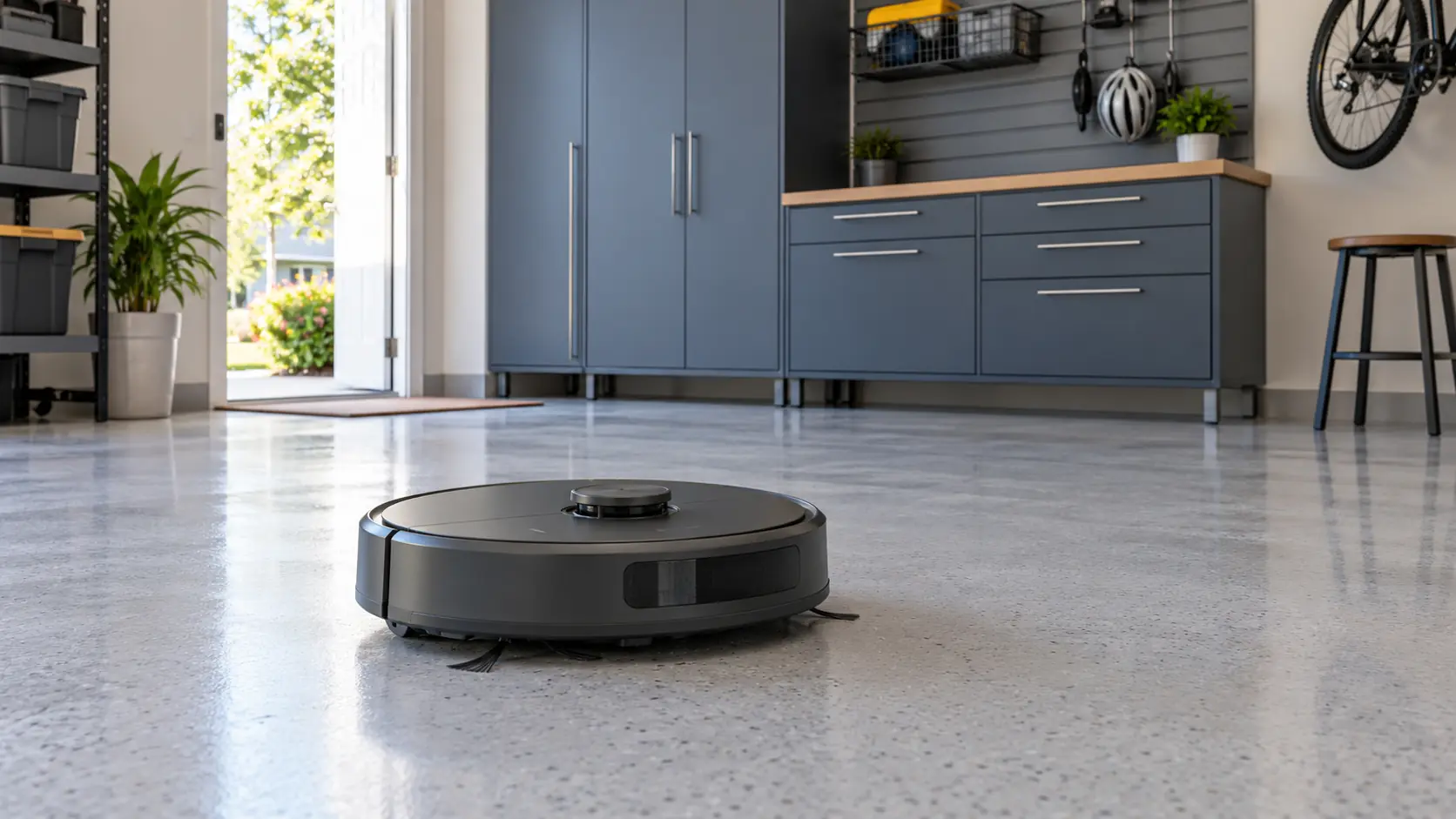
The best robot vacuum for garage floors is only useful when the garage resembles a clean indoor room: dry, smooth, uncluttered, and free of hazardous debris. The six household robots below are conditional options for light maintenance on suitable sealed floors. They should not be treated as replacements for workshop cleanup or as machines designed to collect metal fragments, oil, water, or construction dust.
The recommendation applies only to a finished, suitable indoor-style room. A household robot is a poor way to resolve changing workshop hazards, regardless of its app controls or suction headline. Establish the space first, then compare the six identified models.
Affiliate disclosure: As an Amazon Associate I earn from qualifying purchases.
Quick verdict: For a dry finished garage used like an indoor room, compare Roborock Q5 for mapped exclusions with eufy 11S for local remote control. S7 MaxV Ultra adds a larger dock; Lefant, Shark and ILIFE serve simpler maintenance routines. An active vehicle or woodworking workshop is outside the recommendation.
Compare the options
Compare the cleaning configuration and ownership trade-off. On a small screen, scroll the table sideways.
| Product | Best fit | Important limit | Amazon |
|---|---|---|---|
| Roborock S7 MaxV Ultra | Mapped light maintenance on a suitable sealed floor | Household robot; premium dock does not create workshop capability | Check Price |
| Roborock Q5 | Mapped dry maintenance in a suitable finished room | Standard Q5 does not include Q5+ emptying base | Check Price |
| eufy RoboVac 11S T2108 | Local remote control in one cleared indoor-style room | No editable no-go map | Check Price |
| Lefant M210 Pro | Compact direct-suction household maintenance | Original M210 Pro has no editable LiDAR room map | Check Price |
| Shark ION AV752 | Simple household debris pickup in a clear dry space | Tri-brush design does not prove a self-cleaning roller | Check Price |
| ILIFE V5s Plus | Light floor maintenance with a vacuum-and-mop format | Basic navigation and manual preparation limit its role | Check Price |
Jump to a section
How we selected these options
The six entries are identified household robots, not garage-rated equipment. We replaced unclear Lubluelu, Laresar and AIRROBO shortlist roles with documented Q5, Lefant M210 Pro and eufy 11S configurations. We considered navigation, local controls, dry collection, dock needs and the preparation each layout requires. We have not tested workshop debris pickup or certified any model for rough concrete, hazardous dust, liquids or a marine or industrial environment.
1. Roborock S7 MaxV Ultra — Mapped light maintenance on a suitable sealed floor

Key features
- Mapped robot with exclusion controls
- Ultra dock adds emptying and mop-maintenance functions
- Suitable indoor surfaces only
- Household robot; not a workshop dust extractor
Roborock S7 MaxV Ultra Robot Vacuum is the mapping-focused option in this selection for a garage that already meets indoor cleaning conditions. App-based exclusion zones can help keep the robot away from stored items and areas it should not enter. The Ultra dock adds maintenance functions but also needs a suitable protected location.
Its household design does not establish suitability for harsh garage use. Pre-clean unsuitable debris, keep liquids out of its path, and follow the manual’s environmental limits. Neither strong suction nor obstacle avoidance makes it safe to collect screws, metal fragments, fuel residue, or workshop dust.
Reasons to consider it
- Mapped light maintenance on a suitable sealed floor
Trade-offs
- Household robot; premium dock does not create workshop capability
2. Roborock Q5 — Mapped dry maintenance in a suitable finished room

Key features
- LiDAR mapping and app room controls
- Dry-vacuum robot with rotating main brush
- Standard Q5 charging dock differs from Q5+ emptying dock
- Prepared indoor floor maintenance
Roborock Q5 is the dry mapping choice in this selection. Its LiDAR-based room layout and app exclusions are useful when an indoor-style hobby room has predictable storage areas that should remain outside the cleaning route. The standard Q5 package uses a charging dock; do not assume it includes the automatic-emptying base supplied with Q5+.
That configuration is easier to evaluate than an unnamed robot-and-mop listing. It still requires a properly prepared floor and a protected dock location within the manual’s environmental limits. A no-go zone is a convenience control, not a substitute for removing a dangerous material or physically securing a drop.
Choose Q5 when mapped dry maintenance is the goal and you can maintain its brush, bin and filter. It does not become a dust extractor because it can follow a map. Keep it away from sawdust, fasteners, oil and water; the safe use case remains ordinary household-type debris on an appropriate dry floor.
Reasons to consider it
- Mapped dry maintenance in a suitable finished room
- An identified model and cleaning configuration
Trade-offs
- Standard Q5 does not include Q5+ emptying base
3. eufy RoboVac 11S T2108 — Local remote control in one cleared indoor-style room
Key features
- Local remote and onboard controls
- Reactive navigation without editable room maps
- Dry household floor cleaning
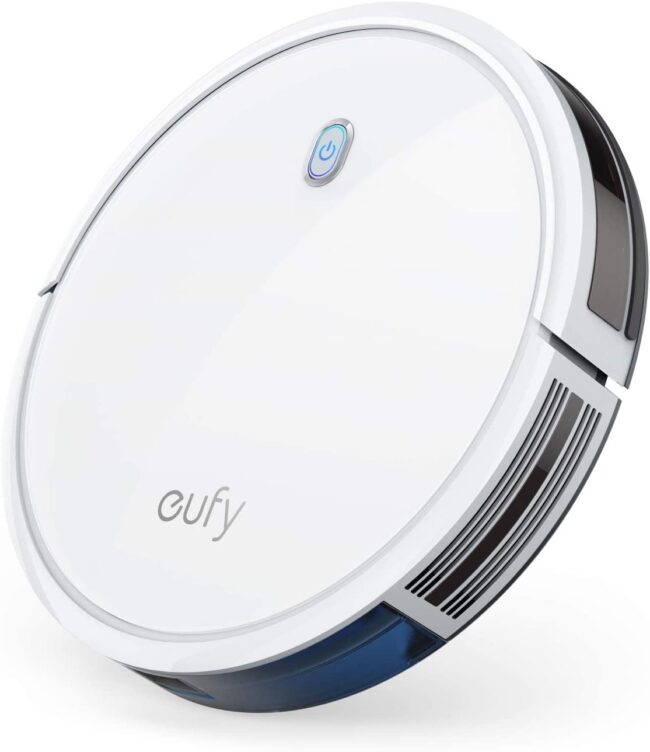
The original eufy 11S T2108 is the local-control option here. It uses onboard and remote controls instead of an editable room map. That can suit one clear, dry, finished room where you want to start cleaning nearby without making app setup part of the routine.
Its reactive route means the entire reachable area must be appropriate, and physical boundaries need to be arranged before a run. The remote cannot draw a reliable digital exclusion around a workbench spill or a pile of parts. Keep those conditions out of the cleaning space rather than expecting the robot to identify them.
Compare this with Q5 when deciding whether local simplicity or mapped exclusions matters more. 11S is an older platform, so check the exact T2108 unit, charger, remote and compatible consumables before buying. An attractive used price is less useful if the remote or battery needed for your routine is missing.
Reasons to consider it
- Basic scheduled dry maintenance in a cleared area
Trade-offs
- Do not assume editable maps or workshop durability
4. Lefant M210 Pro — Compact direct-suction household maintenance
Key features
- Compact robot with direct suction port
- Reactive navigation rather than LiDAR room maps
- Physical start control and app-dependent features
- Distinct from M210 and later Pro variants
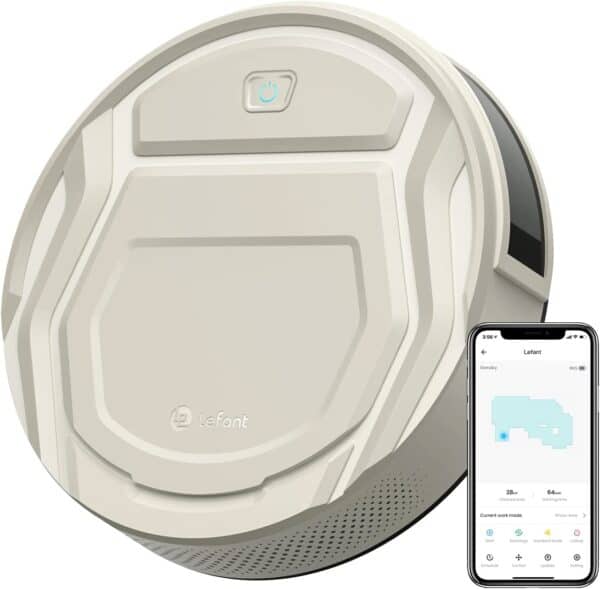
Lefant M210 Pro identifies the compact direct-suction robot in this selection. The original M210P/Pro is distinct from later Pro+ and OMNI products, so match the offer and manual rather than borrowing a newer model’s navigation claims. The direct suction opening avoids a full-width main roller but does not remove all brush and wheel maintenance.
A physical start control is useful for a short supervised session. App-dependent scheduling and other connected functions are separate considerations. Its reactive behavior is better suited to a simple prepared area than a maze of loose cables and storage items.
For a finished garage room, compare the work of clearing the floor and emptying the small bin with using a normal manual vacuum. No-roller marketing does not establish safe collection of metal pieces or workshop dust. Choose it for modest permitted dry floor debris and easy access, not because its compact body seems disposable enough for harsh use.
Reasons to consider it
- Compact direct-suction household maintenance
- An identified model and cleaning configuration
Trade-offs
- Original M210 Pro has no editable LiDAR room map
5. Shark ION AV752 — Simple household debris pickup in a clear dry space

Key features
- Reactive Auto-Sense navigation
- Physical cleaning controls and connected app functions
- Tri-Brush cleaning system
- Standard charging dock; manual dustbin emptying
Shark AV752 ION Robot Vacuum offers a household floor-cleaning format with app-based convenience. It is more appropriate to evaluate for a clear, dry, smooth area than for a workshop with small parts scattered around. Verify the exact controls and navigation in the AV752 documentation rather than transferring features from other Shark families.
The Tri-Brush System should not be described as proof of a self-cleaning brush roll or advanced editable mapping. Inspect the roller for hair and fibers, clear cords and small objects, and keep the charging area within the manual’s conditions. Use it only where the type of dirt is appropriate for a household robot.
Reasons to consider it
- Simple household debris pickup in a clear dry space
Trade-offs
- Tri-brush design does not prove a self-cleaning roller
6. ILIFE V5s Plus — Light floor maintenance with a vacuum-and-mop format

Key features
- Household robot with separate vacuum and mop setups
- App functions differ from V5s Pro
- Reactive navigation
- Manual tank and cloth maintenance
ILIFE V5s Plus Robot Vacuum and Mop is an option for routine light cleaning where the surface and layout suit its household design. Its compact format may help it reach beneath some storage furniture, but that depends on clearance and obstacles. Confirm the exact model’s controls and permitted cleaning conditions.
Treat vacuuming and damp mopping as separate operating setups, following the instructions for each. Neither setup is intended for workshop liquids or hazardous dust. A small household collection chamber can fill quickly in a dusty space, so inspect it frequently rather than assuming the robot can run unattended through an entire garage.
Reasons to consider it
- Light floor maintenance with a vacuum-and-mop format
Trade-offs
- Basic navigation and manual preparation limit its role
Decide whether automation fits the finished garage
Decide whether a robot belongs in the space
A finished garage used like a hobby room presents a different problem from a vehicle workshop. Look at the actual debris, moisture, temperature, floor condition, and charging location. If those conditions fall outside a model’s instructions, a more powerful household robot does not solve the mismatch.
For a realistic view of the role of automation, read about whether a robot replaces a normal vacuum.
Prepare the floor before every run
Remove fasteners, fragments, cords, loose parts, and any unsuitable debris manually using equipment intended for it. Block unsafe areas using the model’s supported method. No-go zones and obstacle sensors are helpful controls, but neither replaces checking the space yourself.
For suitable indoor transitions, understand robot-vacuum threshold ramps.
Inspect after cleaning
Check the wheels, brush area, collection container, and filter for damage or buildup. Do not bring a dirty robot from a workshop-like area straight onto delicate indoor floors. Follow the manual for filter cleaning and charging, and stop if the machine struggles with the floor or repeatedly jams.
If the layout causes repeated problems, troubleshoot why a robot vacuum keeps stopping.
Use a suitability gate before a product shortlist
Start with four observations: the floor’s condition, the material on it, the environment around the charger and every area the robot can reach. A dry sealed floor in a finished hobby room presents a different job from rough concrete beside a vehicle, saw or chemical shelf.
If the space contains sharp fragments, fasteners, fuel or oil residue, wet patches or hazardous fine dust, do not treat one of these robots as a suitable collection tool. Removing one visible screw does not establish that the rest of an active workshop floor is safe for a household appliance.
This gate should apply before every run because garage use changes. A room suitable yesterday may contain unsuitable debris after today’s task. If repeating that inspection is unrealistic, automation may not reduce the work enough to justify the purchase.
Choose boundaries that fit the actual risk
A Q5 or S7 map can help exclude an ordinary storage zone in a suitable room. It does not identify the contents of a spill or provide a certified barrier around a dangerous material. Keep the entire permitted cleaning area appropriate, and use physical separation where the manual or layout requires it.
With reactive models such as 11S or AV752, plan the whole reachable route without relying on an editable room map. Close an appropriate door or use the model’s documented boundary method. A strip or virtual wall from another platform should not be assumed compatible.
Do not use repeated near-misses as proof that cliff sensors or obstacle detection are sufficient. Secure drops, raised storage and other no-access areas according to the instructions. Navigation convenience should make a safe layout easier to maintain; it should not be asked to create that layout.
Assess the floor beyond the word concrete
Concrete can be smooth and finished or rough, dusty and uneven. Inspect the actual surface and check the appliance’s permitted use. A coating does not make a floor appropriate if there are abrasive fragments, damaged areas, moisture or contaminants.
Small wheels and brush assemblies are not substitutes for workshop equipment designed for the relevant debris. A robot that repeatedly catches, scrapes or jams should be stopped rather than sent back with more suction. Inspect the reason and the manual before continuing.
If a finished garage is used as an indoor exercise or hobby room, ordinary permitted household dust may be the recurring job. That is the narrow use case considered here. The recommendation does not extend to construction dust or automotive debris merely because they occur on the same underlying floor material.
Place the dock where the manual permits
Choose a dry protected charging location with the specified access and clearance. Consider temperature, sunlight, moisture, foot traffic and moving storage before installing a dock. A premium station has additional bags, tanks or components that also need safe access.
Do not place charging equipment beside fuel containers, damp floor areas or where a vehicle or stored object can strike it. Follow the model’s environmental instructions rather than assuming a garage is equivalent to any indoor bedroom. A covered location is not necessarily an appropriate charging environment.
For seasonal storage or extended nonuse, use the battery-care instructions for the exact model. Do not improvise with another adapter because the plug fits. The charging arrangement is part of suitability and should be resolved before the robot is purchased.
Keep household robots separate from workshop extraction
A household robot filter does not establish safe capture or disposal of hazardous fine dust. Woodworking, masonry, metalwork and chemical-related tasks can require specifically suitable collection equipment and controls. This guide does not recommend any of the six robots for those materials.
A rotating side brush can also move particles into the air or across the floor before they enter the bin. The fact that some visible dust disappears does not measure filtration or exposure. No suction-pressure figure here is a substitute for equipment suitability.
Use the documented cleaning approach for the actual work material, and keep the household robot’s permitted room physically separate where necessary. If the room routinely changes between workshop and living use, manual inspection and an appropriate cleaning process remain central.
Treat mopping as a separate surface-care decision
S7 MaxV Ultra and V5s Plus include different mop arrangements, but neither is permission to spread automotive residue or drive through liquid. Identify the surface and permitted cleaning solution and follow the exact tank, cloth and dock instructions.
For the narrow indoor-style use case, dry collection may be all that is needed between proper manual cleanings. Adding a damp cloth can add water handling and pad maintenance without resolving the main limitation of the room. Compare those chores before paying for a mop dock.
Never assume a mop function turns a dry robot into a general spill collector. If the material is oil, fuel, a chemical or unknown, keep the robot away and use the appropriate collection and disposal method for that substance.
Decide whether the saved effort is real
Estimate the full session: inspect the floor, remove unsuitable items, prepare boundaries, start the robot, inspect the result and clean the bin, wheels and brushes. If preparation takes longer than manually vacuuming the suitable room, a robot may offer little practical gain.
A mapped model can be worthwhile in a consistently prepared finished space. A local-control model can be enough for one simple room where the user starts each run. The expensive dock is useful only if its maintenance functions reduce a recurring task the owner actually has.
Do not move a dirty garage robot directly onto delicate indoor floors without the permitted inspection and cleaning. Trapped grit changes the contact condition. Choose a realistic defined role, and be willing to use none of these models when the space does not meet it.
Keep a written stop condition for changing room use
If the finished room is later used for repairs, sanding, chemical storage or vehicle work, pause the robot routine and reassess the space. A saved map describes geometry; it does not establish that the newly introduced material is safe to collect.
Make the stop condition simple enough for everyone who uses the room: no run after a task that leaves an unknown, wet, sharp or workshop-related residue. Resolve that cleanup with suitable equipment first. This prevents an appropriate household maintenance setup from gradually becoming an unsupported workshop application.
Frequently asked questions
Can a robot vacuum clean bare concrete?
That depends on the surface, debris, and appliance instructions. Rough, dusty concrete and workshop contamination are poor assumptions for a household robot.
Can these robots collect small screws or sawdust?
Do not use this guide as approval for workshop debris. Sharp parts and hazardous fine dust require equipment specifically suitable for the task.
Is mopping useful in a garage?
Only on a compatible surface under appropriate indoor cleaning conditions. A household mop robot should not spread oil, fuel, chemicals, or other vehicle-related residues.
Which listed models provide an editable room-map approach?
Q5 and S7 MaxV Ultra provide the mapped approach discussed here. The original 11S, M210 Pro, AV752 and V5s Plus should not be given LiDAR no-go-map claims borrowed from other models. Match the exact version and control route.
Can I remove the dangerous debris and then run a robot?
Only if the remaining reachable space and environment genuinely meet the appliance’s instructions. In an active workshop, fine residue, fragments or liquids may remain after a quick sweep. This guide does not certify that manual pre-cleaning makes such a floor suitable.
Final recommendation
Use Q5 or S7 MaxV Ultra only when an appropriate indoor-style layout and their documented operating conditions make mapping useful. eufy 11S, Lefant M210 Pro, Shark AV752 and ILIFE V5s Plus are simpler household maintenance alternatives. First establish that the whole reachable space is suitable; then choose controls and upkeep. If vehicle residue, sharp parts or workshop dust are routine, choose equipment specifically suitable for that job instead.

Abi Khan is the founder and a content writer at GlobVacs. His published work covers vacuum-cleaner buying guides, product comparisons and practical maintenance advice. Read his author profile and selected articles.