
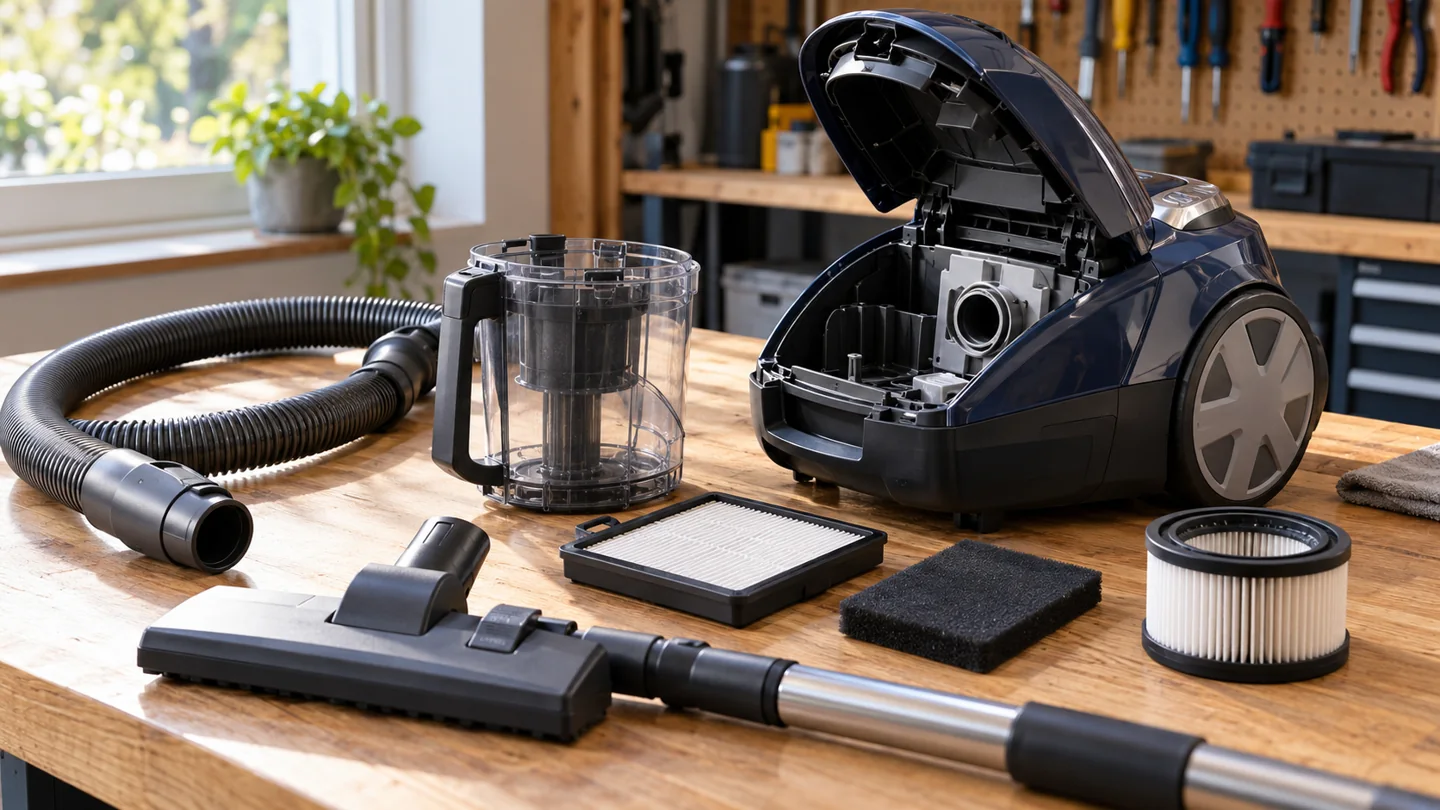
A vacuum cleaner uses a motor-driven fan to move air through a cleaning head, collect debris, and return filtered air to the room. The fan creates lower pressure inside the intake path than in the surrounding room. Air moves into that lower-pressure area, carrying loose dirt toward a bag or collection bin. Brushes and other head features help release debris that airflow alone would struggle to remove.
The important point is that cleaning needs moving air. A household vacuum is not an airtight container that traps all incoming air. Its collection system separates debris while allowing air to continue through the machine and out of an exhaust. Understanding that route makes it easier to choose attachments, diagnose weak pickup, and maintain the parts that affect performance.
Follow the airflow from the floor to the exhaust
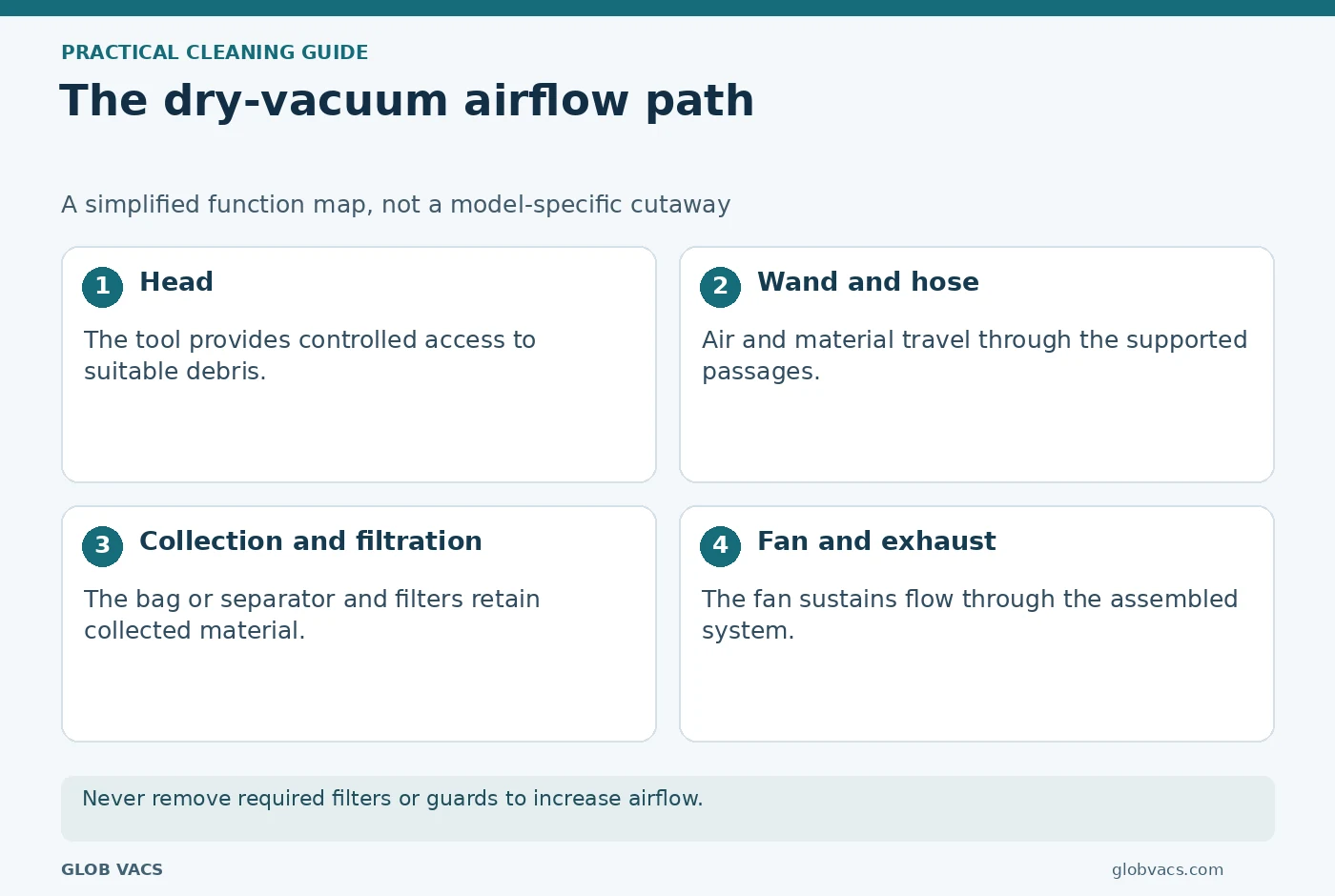
- The cleaning head admits air and debris. Openings in the nozzle let surrounding air enter near the material you want to collect.
- A brush may loosen dirt. A powered brushroll, turbine tool, or passive bristles interact with the surface, depending on the design.
- The airway carries the mixture. A wand, hose, or internal duct directs air and debris toward the collection system.
- The bag or separator captures material. A porous collection bag or a bagless separation system removes much of the debris from the airflow.
- Filters capture remaining particles. Their number and location vary, and some protect the motor as well as filtering exhaust.
- Air leaves through the exhaust. The fan keeps this process moving while the machine operates.
The exact order of the motor, filters, and collection components differs between designs. A diagram in your owner’s manual is more useful for servicing your particular machine than assuming every upright, robot, or workshop vacuum has the same internal arrangement.
Suction is commonly used as a general word for vacuum performance, but technically it refers to a pressure difference. Airflow describes the amount of air moving through a passage over time. A vacuum needs a useful combination of both at the cleaning tool, together with a head suited to the surface.
A nozzle pressed tightly against a rug can feel very difficult to move while allowing little air through. That resistance is not proof that it is collecting more dirt. Similarly, an open hose may move plenty of air but fail to remove hair woven into upholstery because it lacks the mechanical action of a suitable tool.
Pressure figures in pascals or kilopascals, airflow figures in cubic feet per minute, electrical watts, and air watts describe different things. Do not compare them as interchangeable measures. For a closer explanation of specifications and testing conditions, see how vacuum suction is measured.
What each main component does
| Component | Its job | What can go wrong |
|---|---|---|
| Motor and fan assembly | Provide the energy that moves air | Electrical or mechanical faults; overheating symptoms require attention |
| Cleaning head | Position airflow and, where fitted, agitation at the surface | Wrong setting, blocked opening, trapped grit, tangled roller |
| Hose, wand, and internal ducts | Carry air and debris | Blockages, splits, loose connections, damaged seals |
| Bag or bin | Contain collected debris | Overfilling, incorrect fitting, broken latch, damaged bag |
| Filters | Intercept particles at designated stages | Loading, damage, incorrect installation, washing a nonwashable element |
| Exhaust | Return air after it passes through the machine | Obstruction or unexpected dust leakage |
How bagged vacuum cleaners collect dirt
A bagged vacuum directs dirty air into a collection bag made from air-permeable material. Air passes through the bag while much of the debris stays inside. The bag must fit its holder correctly, and its inlet needs to connect as designed. An incorrectly installed or torn bag can let dust enter areas where it does not belong.
The bag is not simply a disposable container with no effect on cleaning. As debris accumulates, resistance can increase. Replace it according to the indicator, fill guidance, and actual pickup performance rather than squeezing in more material. Fine dust can load a bag before it appears physically full.
Many bagged machines also have separate motor-protection or exhaust filters. Replacing the bag does not automatically complete every maintenance task. Check the manual’s component diagram before ordering supplies.
How bagless and cyclonic vacuum cleaners collect dirt
A bagless machine stores debris in a reusable bin. In a cyclonic design, air follows a swirling path that helps separate particles from the moving air. The collected material falls into the bin while the remaining air continues through the filtration and fan system. Designs can use several separation stages.
“Cyclonic” does not mean maintenance-free or filter-free. Empty the bin before its marked limit and clean its screens or filters only as directed. A full bin, a blocked separator, or a poorly fitted lid can affect the route that air is meant to follow.
Bagless emptying can release dust when debris falls into a waste container. Lower the bin close to the receiving bag, avoid shaking it into the room, and follow the manufacturer’s emptying procedure. Our bagged versus bagless comparison explains the ownership tradeoffs beyond the collection mechanism.
Why a brushroll matters on carpet
Carpet can hold grit and hair among its fibers. A compatible rotating brush helps disturb that material so airflow can carry it away. The brush may use a belt, a dedicated motor, or an air-driven turbine, depending on the tool. A failure in one of those drive systems can reduce carpet pickup even when suction through the hose still feels normal.
More agitation is not always appropriate. Delicate rugs, long pile, looped fibers, and some hard-floor finishes need specific tools or settings. Follow the flooring maker’s requirements as well as the vacuum manual. If the head stalls, pulls fibers, or is difficult to push, stop and check compatibility instead of forcing it.
On hard flooring, trapped grit in wheels or under the head can be a problem even if the brush is switched off. Inspect the underside before moving from a dirty entrance mat to a sensitive floor.
What the filters can—and cannot—do
A vacuum filter captures particles passing through its material. The EPA explains that a HEPA filter meets a high particle-capture efficiency specification. That label concerns filtration; it does not by itself establish strong floor pickup, low noise, odor removal, or disinfection.
The route around the filter matters too. A poorly seated filter or leaking housing can allow air to bypass the intended filtration path. A machine described as having a HEPA filter is not automatically the same as a fully sealed system verified as a whole. Use the exact manufacturer specification rather than treating similar marketing terms as identical.
Washability is component-specific. Some foam filters can be rinsed; some pleated or paper-like filters must stay dry. Never run the machine without required filters to increase airflow. Refit washed components only after the drying procedure specified in the manual is complete.
How upright, canister, stick, and robot designs differ
An upright generally places the main body above its floorhead. A canister separates the body from the head with a hose and wand. A stick emphasizes a narrow form, often with a battery and motor near the handle. Handheld models shorten the route for smaller jobs. These layouts change reach, weight distribution, storage, and the tools available.
A robot adds wheels, sensors, navigation logic, and automatic control to a compact collection system. It still needs an intake, airflow, debris collection, and maintenance. Navigation determines where it goes, while the cleaning system determines what it can collect along that route. See how robot vacuums work for that separate explanation.
A wet/dry utility vacuum has a different intended use from an ordinary dry household vacuum. Do not assume a similar-looking hose makes either machine suitable for liquids, hot ash, hazardous dust, or flammable material. Use the appliance only for materials its instructions allow.
Use the airflow path to diagnose poor pickup
Start with the machine switched off and disconnected from power, following its instructions for battery removal where relevant. Check the collection level, correct filter installation, accessible airway, tool connection, and roller condition. A fault near the floorhead may leave hose performance relatively normal; a restriction farther along the shared route may affect several tools.
Do not test suction against skin or eyes, run the machine with a blocked nozzle, or probe energized components. Smoke, a persistent burning smell, sparking, or damaged electrical parts call for stopping use and arranging appropriate service. For routine care, follow our vacuum-cleaning guide alongside the model manual.
Frequently asked questions
Does a vacuum create a perfect vacuum?
No. Household cleaning machines create a pressure difference while continuously moving air. They are not designed to remove all air from a sealed space.
Does a higher-watt motor always clean better?
No. Electrical input does not account for the complete cleaning head, airflow path, filtration resistance, surface compatibility, and debris being collected. Compare relevant cleaning evidence and practical handling as well as specifications.
Why can the vacuum sound normal but leave dirt behind?
The motor can continue running while a roller is tangled, the head is poorly adjusted, a hose is blocked, or a seal is leaking. Noise alone does not confirm that air and debris are moving correctly through the whole system.
What this means when you clean
Choose a compatible head, allow air to enter around the debris, keep the collection and filtration system correctly fitted, and clear restrictions using the documented maintenance procedure. Effective vacuuming comes from the complete path working together, rather than one impressive specification.

Abi Khan is the founder and a content writer at GlobVacs. His published work covers vacuum-cleaner buying guides, product comparisons and practical maintenance advice. Read his author profile and selected articles.