
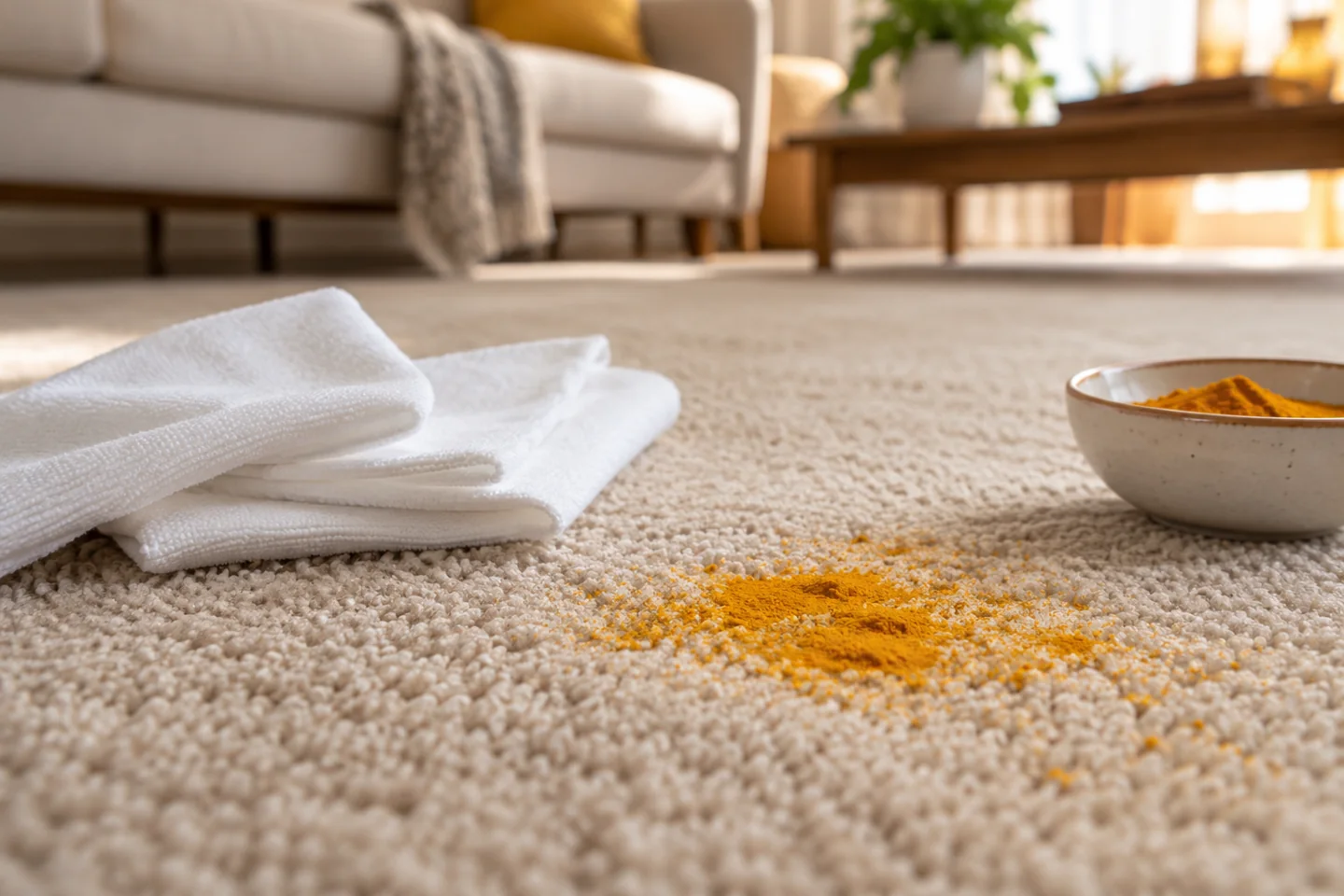
To deal with a turmeric stain on carpet, remove loose material gently, blot liquid without rubbing, and follow the carpet manufacturer’s approved spot-treatment process. Turmeric-colored food can leave a difficult mark, so do not promise that every stain will disappear. Avoid acetone, alcohol, bleach, heat, or repeated soaking unless a qualified carpet-care source specifically approves the exact material and method.
The first decision is what spilled: dry powder, a wet paste, an oily curry, or a cleaning mixture already applied to the stain. Those situations are different. A household dry vacuum is not a liquid extractor, and adding water to loose powder can spread the affected area.
Start with the form of the spill
| What spilled? | Useful first action | Avoid |
|---|---|---|
| Loose dry turmeric powder | Keep traffic away and remove loose material carefully by a carpet- and equipment-approved method | Scrubbing it into the pile or immediately wetting a larger area |
| Wet paste or sauce | Lift loose solids gently and blot liquid with a clean white absorbent cloth | Rubbing, spreading, or collecting it with a dry-only vacuum |
| Oily curry | Identify the carpet and seek a suitable treatment for both food residue and color | Assuming one detergent recipe handles every ingredient |
| Old or previously treated stain | Record what was used and ask for material-specific advice | Layering additional chemicals over an unknown treatment |
Step 1: protect the surrounding carpet
Keep shoes, pets, and cleaning tools from carrying the material farther. Remove the food container and any loose items without dragging them across the stain. Work from a position that does not press your knees or clothing into the spill.
Use clean cloths and a separate waste container. Change cloth sections as they collect color or liquid rather than moving the same dirty area across the carpet. Do not use a colored towel that could transfer dye.
For a large spill, valuable rug, wool, uncertain fiber, or delicate backing, contact a suitable carpet professional early. Repeated home treatment can make the later assessment more difficult.
Step 2: remove loose material without force
For wet food, carefully lift accessible solids without pressing them deeper into the fibers. Blot remaining liquid gently. Do not scrub with a stiff brush or use the edge of a powered vacuum head to scrape the area.
For dry powder, check the carpet and vacuum instructions before using suction. Fine powders can be unsuitable for some household machines or load filters quickly. Avoid a rotating head that spreads the material, and do not collect anything the appliance prohibits.
If you cannot remove the loose powder without spreading it or using an unsuitable tool, ask a professional for the appropriate method. The goal is containment, not aggressive extraction at any cost.
Step 3: identify the carpet before applying cleaner
Find the fiber, construction, care label, and any stain-treatment instructions. A synthetic fitted carpet and a handmade wool rug can need different chemistry and handling. Backing and installation matter too.
The Carpet and Rug Institute’s Spot Solver organizes treatment by the actual substance. Use a specific supported process where available and the carpet maker’s guidance where it is more restrictive.
Do not use a generic solvent because the stain looks stubborn. Acetone, concentrated alcohol, oxidizers, and other products can affect color, backing, adhesives, or finishes. A product being available at home does not establish carpet compatibility.
Step 4: use only an approved spot process
Follow the approved cleaner’s label, dilution, application, contact time, and removal instructions. Pretest where directed for color or texture change. A successful hidden test does not override a product prohibition.
Apply only the amount and method specified. More detergent or more water is not automatically better. Blot as directed rather than rubbing a broad wet patch into the pile.
CRI’s carpet maintenance guidance emphasizes suitable spot-cleaning products and methods. Do not mix cleaners, add essential oils, or combine vinegar and other ingredients in an improvised sequence.
Step 5: control residue and moisture
Follow the process for removing cleaning residue without over-wetting the backing or cushion. A carpet can look better while still containing excess moisture or detergent. Do not keep adding water because the cloth continues to show some yellow.
If recovery needs equipment, use a machine rated and approved for the carpet and task, or call a professional. An ordinary dry vacuum must not collect wash water, wet paste, or foam.
For excess cleaner, see soap residue in carpet. For a broader cleaning plan, read carpet cleaning techniques.
Step 6: let the area dry by the approved method
Use the carpet or cleaner instructions for drying and access. Do not apply a hair dryer, iron, steam mop, or other heat treatment to force a quick result. Heat and uncontrolled moisture can create additional problems.
Keep traffic away until the area reaches the appropriate condition. Do not cover a damp patch with a rug or return furniture in a way that traps moisture. Contact the cleaner if the area remains damp beyond the expected window.
Resume ordinary dry vacuuming only when the carpet and treatment permit it. See vacuuming after carpet cleaning for that decision.
When to stop home treatment
Stop if color transfers from the carpet itself, fibers change texture, the backing becomes wet, the stain spreads, or the approved process stops improving the result. Do not keep escalating concentration or abrasion.
A remaining yellow mark may need specialist assessment and may not be completely removable. Cleaning should not be described as guaranteed restoration. An honest limit is preferable to damaging a larger area in pursuit of a perfect result.
Prepare the product label, approximate spill time, food ingredients if known, and a list of every treatment already used. Photos before and after each permitted step can help a professional understand the change.
Questions for a carpet professional
- Does this fiber and backing tolerate the proposed treatment?
- Does the spill contain oil or other ingredients requiring a separate step?
- What result is realistic for the remaining color?
- How will residue and moisture be removed?
- What should I do before the visit and during drying?
- Could earlier chemicals affect the next treatment?
The CRI professional-cleaning checklist helps frame a useful conversation without treating every cleaner or process as equivalent.
Prevent another spread
Keep turmeric containers and food preparation on suitable hard surfaces, use a tray when carrying staining food, and clear spills promptly. Avoid carrying a contaminated cloth through the home or reusing it on another surface.
If the vacuum collected permitted dry material, maintain its collection system and filters by the manual. Do not use fragrance or wash a nonwashable filter to conceal an odor. See vacuum care.
Frequently asked questions
Can I use bleach?
Do not use it unless the exact carpet and treatment instructions explicitly permit the product and method. Bleach can alter color or material and is not a universal turmeric remedy.
Will vinegar or lemon juice always work?
No reliable universal result is established. Use the carpet-approved process rather than treating household acids as automatically safe.
Can I vacuum a wet turmeric stain?
Not with an ordinary dry vacuum. Use the appropriate approved cleanup method and equipment.
Contain first, then treat carefully
Remove loose material gently, identify the carpet, use a supported spot process, and stop before repeated treatment creates damage. A difficult remaining stain is a reason for specialist advice, not stronger improvised chemistry.

Katy James contributes vacuum-cleaner explainers and practical cleaning guidance at GlobVacs. Her published topics include robot-vacuum operation and vacuum airflow. Read her author profile and selected articles.