
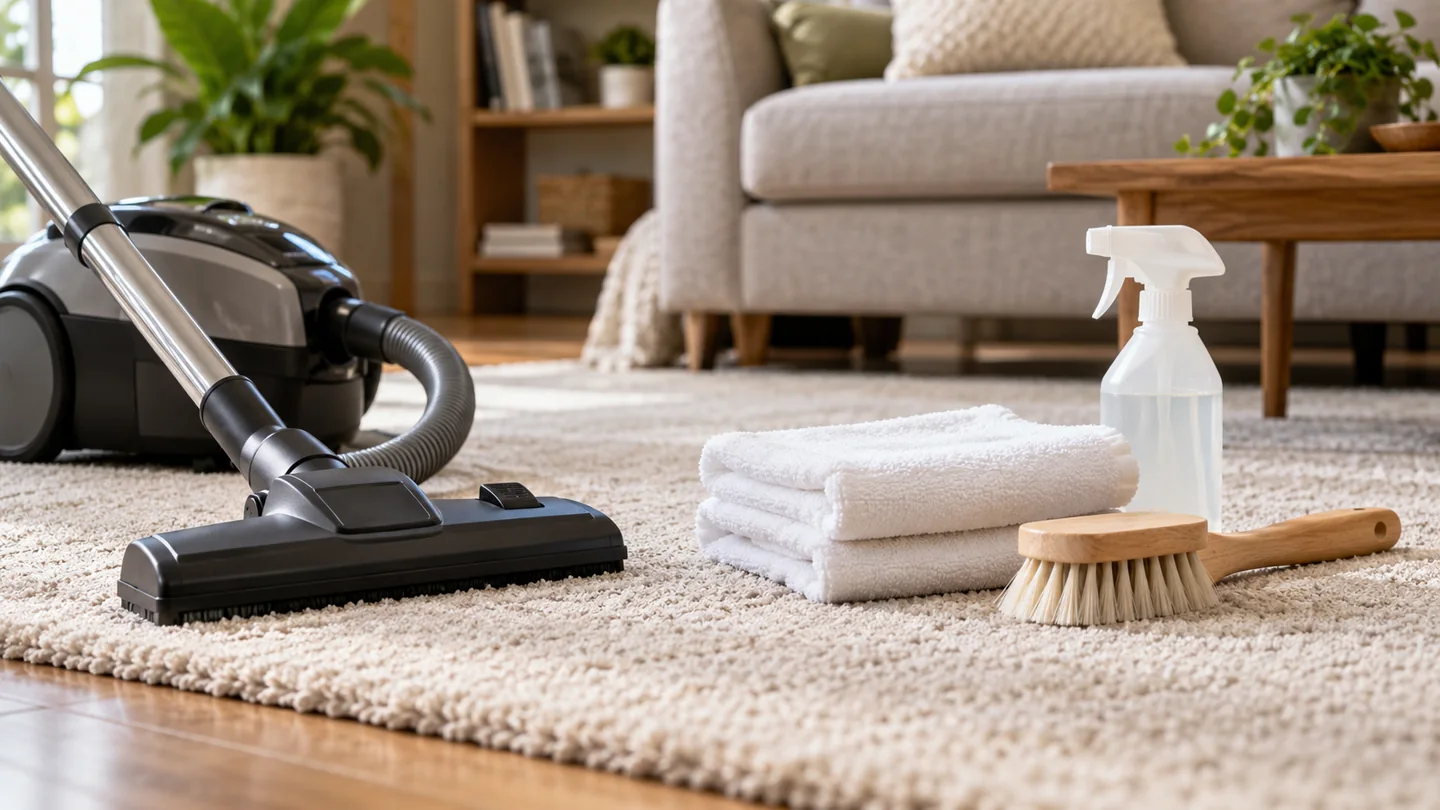
Good carpet care combines compatible vacuuming, prompt spill handling, the correct cleaning method for the carpet, and thorough drying after any permitted wet treatment. Identify the fiber, construction, backing, and manufacturer instructions before choosing a product or machine. More detergent, stronger agitation, or repeated soaking can make a problem worse.

This guide separates routine dry cleaning, localized stain work, periodic deeper cleaning, and water-damage situations. They need different equipment and decisions. An ordinary dry vacuum should not be used to recover liquid, and a household stain recipe is not a mold-remediation plan.
Start with the carpet’s identity
Find the product details, care sheet, and any warranty cleaning requirements. Wool, synthetic cut pile, looped constructions, long shag, and handmade rugs can have different tool and chemical restrictions.
Check the backing and installation too. A loose area rug and fitted carpet over cushion do not dry or move in the same way. Valuable, delicate, or uncertain materials are good reasons to ask the manufacturer or a suitable professional before experimenting.
The Carpet and Rug Institute’s maintenance resources provide a useful general reference. Apply the specific product instructions where they are more restrictive.
Choose the right response to the problem
| Problem | Useful first response | Avoid |
|---|---|---|
| Ordinary dry dirt and hair | Compatible vacuuming and tool maintenance | Unnecessary chemical treatment |
| Fresh liquid spill | Remove solids carefully and blot with a clean absorbent cloth | Rubbing, flooding, or dry-vacuum liquid pickup |
| Persistent stain | Identify the substance and use carpet-approved instructions | Mixing cleaners or escalating blindly |
| Cleaning-product residue | Check application and extraction with the product or provider | Adding more detergent |
| Mustiness, mold, or water damage | Address moisture and obtain appropriate assessment | Fragrance, powder, or repeated household vacuuming as a cure |
Vacuum for routine soil removal
Use the brush action, suction, and height settings the carpet maker permits. Give the head time to collect material with deliberate overlapping passes where appropriate. Concentrate on traffic routes before soil spreads farther into the room.
If the head is difficult to push, lifts the rug, stalls, or pulls fibers, stop and check compatibility. Maximum suction is not automatically the best setting. Delicate loops and long pile may need a different tool from robust short pile.
Maintain the bin or bag, required filters, intake, and roller. A tangled brush can keep moving across the carpet while collecting poorly. Use vacuum maintenance and frequency planning for those tasks.
Handle fresh spills without spreading them
Remove loose solids carefully without pushing them deeper. Blot liquid using a clean white absorbent cloth, working gently and changing to a clean section as needed. Do not scrub a widening wet patch into the pile.
Identify the spill before selecting a product. Oil, pigment, food, pet contamination, and an unknown chemical are not interchangeable stains. Follow the carpet manufacturer’s process and the cleaning product label.
Pretest a permitted cleaner in an inconspicuous area as directed. A test can reveal a color or texture change, but it does not approve a product the care sheet prohibits. Do not mix chemicals, add essential oils, or assume a natural ingredient is harmless.
For a pigment-heavy food stain, see turmeric stain handling. If the substance or carpet is uncertain, stop and seek professional advice before making the stain larger.
Keep detergent concentration under control
Use the amount and dilution specified by the product and equipment instructions. Extra detergent can leave residue and make rinsing more difficult. A stronger smell or more foam is not proof of a better clean.
If a treated patch becomes sticky, crunchy, or attracts dirt again, investigate residue and drying rather than adding another product. Repeated unplanned wet treatments can drive moisture into backing or cushion.
See removing soap residue from carpet and crunchy carpet troubleshooting for the separate diagnosis.
Understand deeper-cleaning methods
Hot-water extraction applies a controlled cleaning process and recovers liquid with suitable equipment. It is sometimes called steam cleaning, but it is not automatically the same as applying vapor from a household steam mop. Use the method the carpet maker allows.
Low-moisture, encapsulation, absorbent-compound, and other systems have their own chemistry, agitation, drying, and final removal instructions. They are not interchangeable names for sprinkling any powder and vacuuming it later.
A domestic extraction machine needs the correct solution, recovery procedure, passes, and drying conditions. Do not use an ordinary dry vacuum to collect wash water. For uncertain or demanding work, choose a qualified cleaner familiar with the material.
Questions to ask a professional cleaner
- Which method suits this carpet, backing, and installation?
- Will dry soil be removed before the deeper clean?
- Which products will be used, and how will residue be managed?
- What stains or damage may not be removable?
- How should the room be prepared and ventilated?
- When can furniture, people, pets, and ordinary dry vacuuming return?
- What should you do if the carpet remains damp or develops an odor?
The Carpet and Rug Institute’s professional-cleaning checklist provides a useful starting point. Keep the provider’s aftercare instructions and any warranty records.
Drying is part of the cleaning job
Drying time varies with the method, amount of moisture, carpet construction, cushion, airflow, temperature, and humidity. Do not assume every carpet is ready for a dry vacuum after the same number of hours.
Follow the provider’s instructions and avoid replacing furniture or rugs in a way that traps moisture. Use permitted ventilation and drying arrangements. If the carpet remains damp beyond the expected window, contact the cleaner rather than repeatedly walking over it or applying fragrance.
Our guide to vacuuming after carpet cleaning explains the readiness decision.
Pet odors need source control
Vacuuming can collect loose hair, but it does not necessarily remove contamination in backing, cushion, or the subfloor. Treat accidents using an appropriate carpet-compatible process and seek advice where contamination is extensive or recurring.
Do not mask a persistent odor by distributing baking soda or essential oils across the carpet. Fine powder may be unsuitable for the vacuum, and fragrance does not remove the source. Read baking soda and vacuum compatibility before using any powder.
Keep pets away during cleaning as the product instructions require and allow the area to reach the appropriate safe condition before access.
Mold and water damage are different from ordinary soil
Fix the moisture source first. Moldy porous carpet can be difficult to clean completely and may need removal. The EPA’s home mold-cleanup guidance specifically identifies carpet among porous materials that may need to be discarded.
Do not use an ordinary household vacuum or a fragrance treatment as a remediation plan. Sewage, contaminated floodwater, widespread growth, or uncertainty about hidden moisture calls for appropriate professional assessment.
Do not assume a surface that feels dry means the cushion or underlying materials are dry. A restoration assessment can be necessary after significant water exposure.
Prevent avoidable soil and wear
Use compatible entrance mats, remove tracked-in grit promptly, and keep food or plant spills from sitting. Follow furniture-moving and floor-protection instructions rather than dragging heavy items across the carpet.
Rotate tasks through a manageable schedule. Inspect traffic lanes, edges, and pet areas more closely than quiet corners. Keep deeper cleaning separate from routine vacuuming instead of calling every weekly pass a deep clean.
Frequently asked questions
Can I use vinegar and baking soda on every stain?
No. Follow the carpet and product instructions for the actual stain. Mixing household ingredients is not a universal cleaning method and can leave residue or damage material.
Does more foam mean better cleaning?
No. Use the prescribed concentration and recovery method. Excess foam or residue can interfere with the process.
How often should professional cleaning happen?
Use the carpet manufacturer’s requirements and the condition, traffic, spills, and household needs. A fixed interval is not appropriate for every installation.
Keep the process controlled
Identify the carpet and problem, use compatible tools and products, manage residue and moisture, and get help when the situation exceeds routine care. Careful decisions protect the material more reliably than aggressive cleaning or repeated home remedies.
Further reading

Katy James contributes vacuum-cleaner explainers and practical cleaning guidance at GlobVacs. Her published topics include robot-vacuum operation and vacuum airflow. Read her author profile and selected articles.