
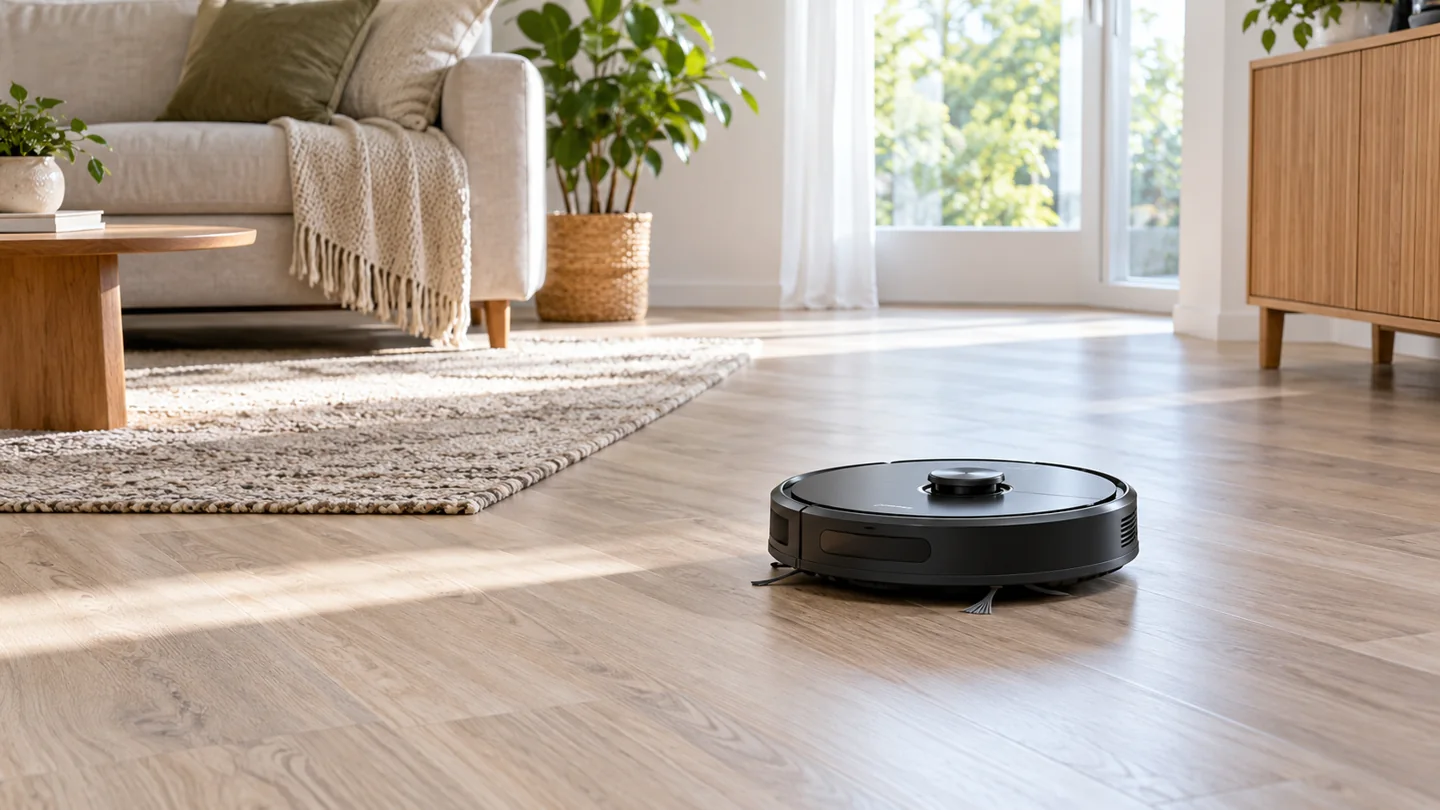
A robot vacuum can be appropriate for laminate only when its cleaning system meets the care instructions for your exact flooring. Check brush restrictions, wheel and underside condition, and the floor’s permitted cleaning methods. Do not assume soft rollers or rubber wheels guarantee a scratch-free result.

Dry pickup and robot mopping are separate decisions. Some laminate products allow limited damp cleaning under specified conditions; others have different restrictions. A waterproof label does not automatically approve a powered scrubber, steam, an unapproved cleaner, or prolonged water left at seams.
Start with the laminate product, not the robot’s marketing
Find the flooring brand, collection, and care sheet. Laminate products differ in construction, water-resistance claims, installation details, and warranty conditions. A general guide for “wood-look floors” may cover vinyl or engineered wood rather than your laminate.
Keep the care sheet with your records and compare it with the robot’s manual. If the two conflict, do not proceed on the assumption that the machine’s general hard-floor claim overrides the flooring restriction.
For example, Mohawk Home’s laminate care resources restrict rotating beater bars and certain powered cleaning equipment for the products covered. Read the actual document for your product rather than applying a broad laminate recommendation to every floor.
A compatibility checklist
| Question | What to confirm |
|---|---|
| Does the floor permit the brush system? | Whether powered rotary action is allowed and whether the robot can use a compliant mode |
| Are contact points clean and undamaged? | Wheels, caster, roller cover, side brushes, underside, and any dragged part |
| Is the installed floor sound? | No lifted edges, loose transitions, damaged seams, or unresolved moisture problem |
| Is wet cleaning permitted? | The exact moisture, tool, and cleaner requirements |
| Can the route finish safely? | Thresholds, rugs, furniture clearance, and protected unsafe areas |
Brush material alone does not establish safety
A rubber roller, soft bristles, or a polished-looking wheel can still carry trapped grit. A damaged cover can scrape. A robot can also repeat contact at the same transition or spin against an obstacle.
If the floor prohibits a powered rotary brush, check whether the robot genuinely supports brush-off operation. A quiet or hard-floor mode may only change suction. Do not remove a required assembly or modify the robot to create an improvised mode.
Ask the floor and robot manufacturers for clarification if the wording is unclear. A successful short test cannot cancel a written restriction or prove long-term compatibility.
Inspect grit and damage before the run
Pick up hard fragments manually and check the robot’s accessible contact points with power isolated. Entrances, shoes, pet routes, and areas near outdoor work can introduce grit that is easily missed among ordinary dust.
Remove debris using the manual’s procedure and check for cracks, a displaced roller cover, worn strips, or a caster that no longer turns freely. Do not run a damaged head across the floor to see whether it leaves a mark.
Stop for scraping, a new track, or repeated wheel spinning. Inspect the source before moving the robot into another room. More frequent runs are not helpful if the robot is dragging the same trapped particle.
Laminate and moisture: distinguish the allowed method
A floor may tolerate a specified damp-mop routine while still prohibiting standing water or certain equipment. Do not treat those instructions as contradictory. The amount, duration, method, and location of moisture exposure all matter to the manufacturer’s approved care process.
The Mohawk Home waterproof-laminate care document gives a product-family example: it allows a carefully controlled cleaning method while warning against pouring liquid directly onto the floor or leaving puddles. Follow your exact floor’s document.
Do not perform a water-puddle test to decide whether the floor is waterproof. Use product records and manufacturer advice. If a seam is swollen or an edge is lifted, address the damage before relying on automated wet cleaning.
Robot mopping requires separate approval
Before fitting a water tank or pad, confirm that the flooring allows the robot’s type of wet-cleaning action and that the robot allows the intended solution. A cleaner approved for manual use on laminate is not automatically approved inside the machine’s tank.
Watch for wet patches near seams, walls, transitions, and places where the robot pauses. A damp pad left parked on the same spot is a different exposure from a brief cleaning pass. Follow the dock’s protective and pad-removal instructions.
If the combined instructions do not establish compatibility, use dry pickup with an approved tool and a separate floor-approved cleaning method. Do not assume mopping must always be enabled because the robot offers it.
Prepare thresholds and rugs
Check transitions for loose strips or sharp lips. A robot repeatedly struggling at a doorway can move material or scrape its underside. Compare the full obstacle profile with the exact model’s capability.
Secure or exclude loose rugs only by methods compatible with the rug and floor. Some backing or adhesives can create their own problems. Do not cut fringe or alter fixed flooring as a cleaning shortcut.
Read robot threshold capability and threshold-ramp selection for those route decisions. A ramp does not override a floor or robot restriction.
Set up a supervised introduction
- Confirm the floor’s written care requirements and the robot’s operating configuration.
- Remove ordinary hazards, grit, cables, and loose objects.
- Inspect the robot’s contact points and required components.
- Begin with a small permitted dry-cleaning area.
- Watch turns, docking, thresholds, and low furniture.
- Inspect the result and underside before expanding the route.
- Assess wet cleaning separately, if both manufacturers permit it.
Keep unsuitable areas excluded. Do not let the robot repeat a problem because the app reports a normal completed job.
Maintain the machine and the floor together
Empty the bin at its limit, remove roller tangles, care for filters individually, and clean sensors using the manual. A self-emptying dock still needs inspection. Check wheel treads and caster areas for grit regularly.
For the floor, treat spills promptly and investigate sticky residue with the approved cleaner and method. Dry vacuuming alone may not remove a cleaning-product film or greasy spill.
Our guides to robot maintenance and Mohawk laminate cleaning provide the separate routines. For vinyl, use the vinyl-specific guide rather than assuming identical care rules.
Frequently asked questions
Are all robot wheels gentle enough for laminate?
No universal guarantee applies. Wheel condition, embedded grit, damaged parts, and the floor’s instructions matter. Inspect the complete underside.
Does a waterproof floor allow steam?
Not automatically. Follow the specific equipment restrictions. Water-resistance claims and approval for heat or steam are different questions.
Can I add vinegar to the robot tank?
Only use solutions explicitly allowed by the robot and floor manufacturers. Do not assume a homemade mixture is safe for internal components or the installed finish.
Let the care sheet decide compatibility
Choose a compliant cleaning system, keep contact points clean, and manage moisture by the exact product instructions. A robot can reduce routine work where it is appropriate, but its feature list cannot guarantee protection for every laminate floor.

Katy James contributes vacuum-cleaner explainers and practical cleaning guidance at GlobVacs. Her published topics include robot-vacuum operation and vacuum airflow. Read her author profile and selected articles.