
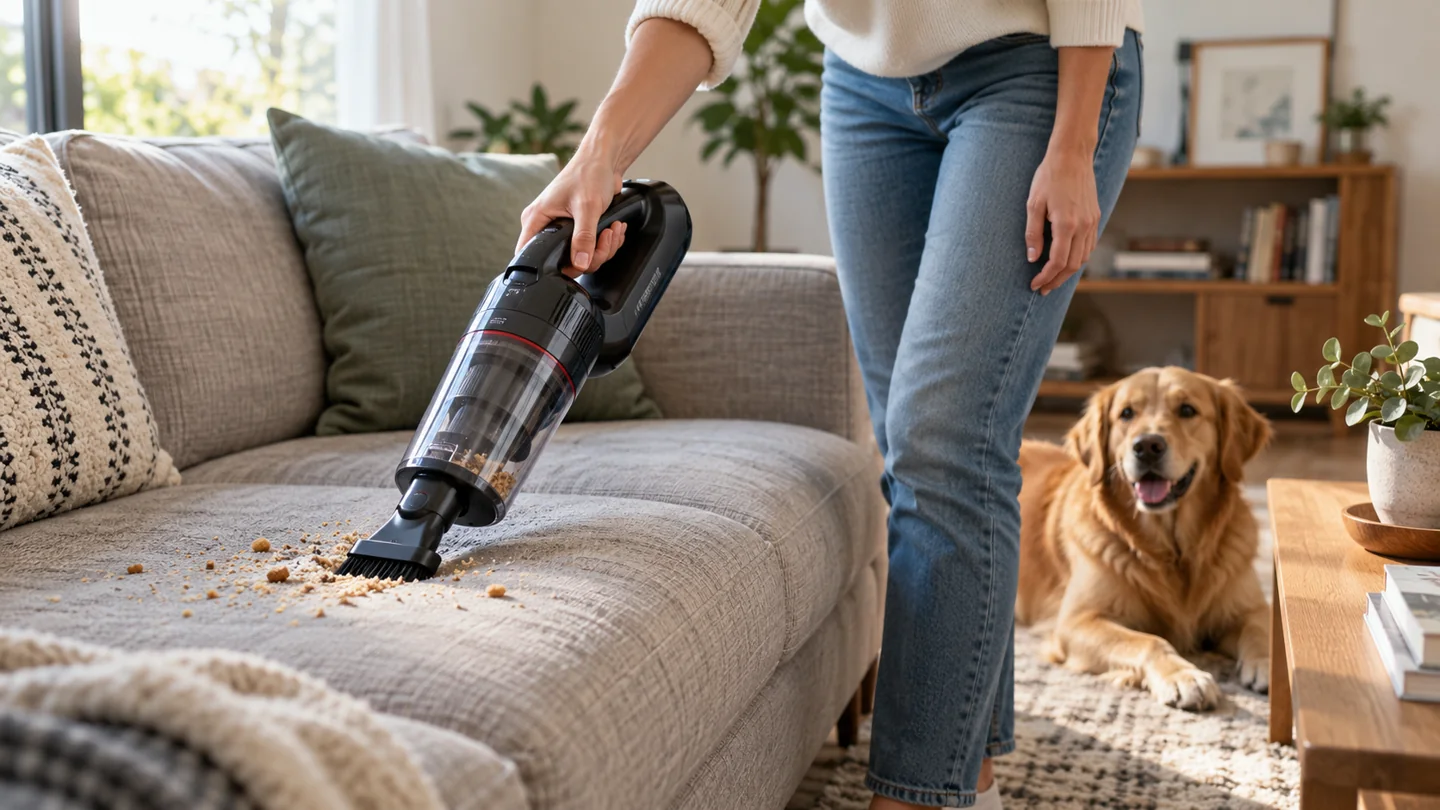
To use a car vacuum cleaner at home, first identify its power system. A rechargeable cordless vacuum may be suitable for indoor tasks using its approved charger. A car vacuum with a 12 V DC accessory plug cannot be connected directly to a household mains socket or made compatible with a passive travel adaptor.

Once power compatibility is established, check the materials the machine can collect and the tools it provides. A product intended for car interiors may suit small household jobs, but it is not automatically a replacement for a full-floor vacuum.
Identify which kind of car vacuum you own
| Power arrangement | What it usually means | What to verify |
|---|---|---|
| Vehicle accessory plug | The machine uses the specified vehicle DC supply | Voltage, current, approved source, connector, and any manufacturer-approved home-power option |
| Rechargeable battery | The machine operates from its battery | Approved charger, charging location, runtime, and indoor-use instructions |
| USB charging | USB supplies a charging system under specified conditions | Required charging supply and cable; whether operation during charging is allowed |
| Household mains plug | The appliance uses the labeled mains supply | Voltage, frequency, local plug suitability, and permitted use |
Use the rating label and exact manual. Similar-looking plugs and advertising terms such as “portable” do not establish electrical compatibility.
A 12 V vehicle plug is not a household power adaptor
A household socket supplies mains AC at a much higher voltage than a vehicle accessory circuit. A device that merely changes plug shape does not convert that supply into the correct DC output.
BLACK+DECKER’s 12 V DC car-vacuum listing is an example of a vehicle-powered product category. Its connector and intended power source differ from those of a rechargeable household handheld.
If the manufacturer offers an approved home power supply, follow its instructions. Otherwise ask support before buying a converter. Do not assume a small phone charger or a generic socket converter can supply the vacuum’s operating and starting requirements.
What must match in an approved power arrangement?
The output voltage, AC/DC type, current capacity, connector, polarity where applicable, protection, and intended operating environment all matter. A unit rated only by an attractive wattage headline may not meet the product’s requirements.
Do not cut off plugs, splice wires, open a mains supply, bypass a fuse, or use a loose battery-and-clips arrangement indoors. If no supported solution is available, use suitable household equipment rather than converting the car vacuum.
Stop if a connector becomes hot, a fuse operates, the supply trips, or the equipment smells abnormal. Do not fit a larger fuse or keep retrying an incompatible setup.
Rechargeable car vacuums may be simpler
A cordless handheld can often move between approved car and home tasks without a vehicle connection. Use only the specified battery and charger arrangement, charge in the recommended conditions, and inspect for damage.
Do not charge a wet, damaged, swollen, or abnormally hot battery. Do not assume the machine can run while plugged into a charger or USB cable. Charging input and motor operating power are different parts of the design.
BLACK+DECKER’s cordless handheld example illustrates a product described for multiple locations. That does not establish the same use permissions for every vacuum sold as a car model.
Choose realistic household tasks
A compact machine can be useful for a small amount of compatible dry crumbs, accessible upholstery, a stair tread, or a narrow crevice. Check whether the tool is gentle enough for the surface and whether its inlet can collect the material without blocking.
Do not use an ordinary dry car vacuum for liquids, wet food, pet waste, hot ash, chemical spills, or restricted fine powders. A “car” label does not imply workshop or hazardous-cleanup capability.
See our vacuum-type guide to decide whether a handheld, stick, canister, or another format better matches the task.
A practical indoor cleaning sequence
- Confirm power compatibility and the permitted materials.
- Check the collection container, filter fit, accessible airway, and attachment condition.
- Pick up large objects manually rather than forcing them through a small inlet.
- Test the tool gently on an inconspicuous area of a delicate surface.
- Work in manageable sections without pressing so hard that the opening seals completely.
- Stop for abnormal heat, noise, odor, dust leakage, or reduced pickup.
- Empty and maintain the machine according to the manual after the task.
Do not use the nozzle against eyes, skin, hair, or an animal. Keep small loose objects, cables, and fabric edges away from powered or suction openings.
If you are cleaning the car at home
Work with the vehicle safely parked and follow its instructions for accessory-socket use. Do not run an engine in a garage or other enclosed space to power cleaning equipment. Manage cords and doors so they do not crush the cable or create a trip hazard.
Remove loose items and mats, then use vehicle-compatible tools for seats, floor areas, and accessible crevices. Avoid disturbing seat wiring, safety-system components, controls, screens, or delicate trim. Do not move or remove seats beyond the vehicle’s approved procedures.
Wet mats and spills need a separate compatible process. Do not place damp components back in the vehicle or assume a dry handheld will extract moisture from carpet.
Maintain pickup before blaming the power source
A full container, loaded filter, blockage, low battery, or damaged seal can reduce cleaning performance. Follow the manufacturer’s sequence rather than modifying the electrical supply to make the motor run harder.
Our maintenance guide covers the main components. For odor or abnormal heat, see burning-smell diagnosis and stop use where appropriate.
Can a travel adaptor make a 12 V vacuum work at home?
No. Changing plug shape does not provide the correct DC power conversion.
Are all cordless vacuums weaker than corded ones?
No universal rule applies. Compare actual pickup, tools, runtime, capacity, and test conditions.
Can I use a car vacuum for every room?
Only within its permitted uses and practical capabilities. Small capacity, narrow tools, runtime, and handling may make it inefficient for a whole-home route.
Work through two different car-vacuum examples
A cordless car handheld with its approved household charger can have a straightforward indoor charging route if the instructions permit it. A 12V corded automotive vacuum has a different supply requirement. A travel plug adapter does not convert household mains into the required DC output.
For the corded model, use only an arrangement approved for that appliance and the required electrical specifications. Do not improvise with a cable, loose battery or an adapter chosen solely because the socket fits. If support cannot establish a suitable supply, choose a household machine for the home job.
After power compatibility is resolved, assess reach and capacity. A car handheld can be practical for a chair seam or local crumbs but awkward for an entire room. A floor-cleaning head and upright working posture may matter more than whether the machine was originally marketed for a vehicle.
Identify the job the smaller tool can complete
Measure the gap and consider the complete hand-and-appliance body, not just the nozzle tip. A hose can reach places where a rigid handheld cannot fit, while a very narrow tool may be slow over a large surface.
Use a permitted dry tool and inspect it before moving onto delicate finishes. Automotive branding does not approve liquid pickup, hazardous debris or use directly on a person or animal. Choose a complete suitable setup for the task rather than stretching a limited format beyond its instructions.
Further reading

Abi Khan is the founder and a content writer at GlobVacs. His published work covers vacuum-cleaner buying guides, product comparisons and practical maintenance advice. Read his author profile and selected articles.