
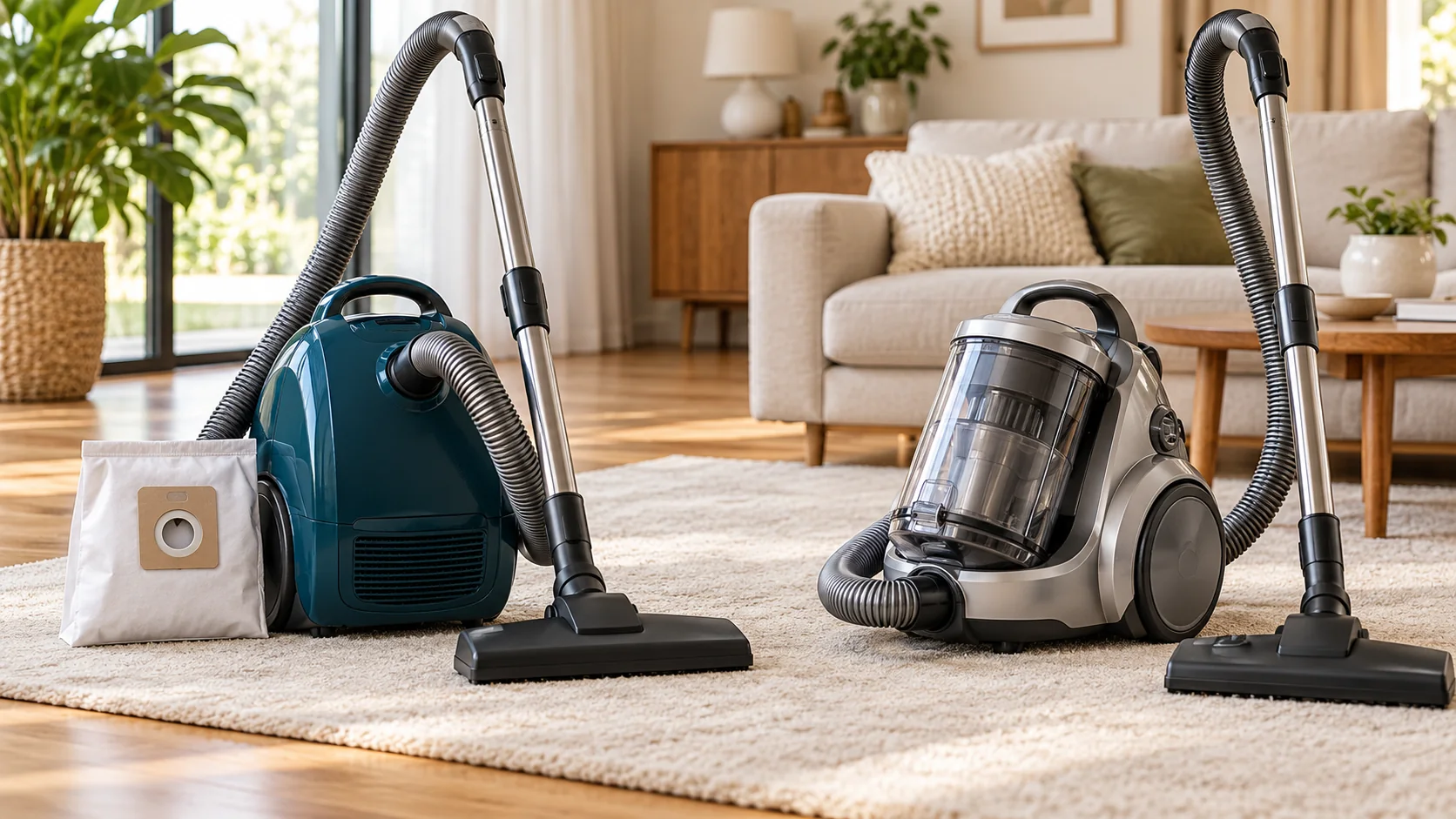
Bagged vs bagless vacuums is a decision about what happens to dirt after it leaves your floor. A bagged vacuum collects debris in a replaceable bag; a bagless vacuum stores it in a reusable container. Both designs can clean well. The better choice depends on how you want to dispose of dust, the maintenance you will actually do, and the cost of keeping the machine supplied over time.
Choose a bagged model if you would rather remove a closed package of dirt than tip loose dust into the trash. Choose bagless if avoiding replacement bags matters more to you and you are comfortable emptying the bin and caring for its filters. Neither collection system compensates for a floor head that is wrong for your carpet or hard flooring.
Last updated: October 19, 2026. This is a research-based comparison of collection systems, not a claim that we tested every vacuum mentioned.
The differences that affect everyday cleaning
| What matters | Bagged vacuum | Bagless vacuum |
|---|---|---|
| Dirt disposal | Remove and replace the bag; some designs close the opening automatically | Empty a reusable container; hair and dust may need help coming out |
| Recurring supplies | Correct replacement bags plus the model’s required filters | Required filters and other wear parts; no main collection bags |
| Contact with collected dirt | Can be reduced with a well-designed closing bag | Depends on the bin opening, debris, and emptying technique |
| Seeing what you collected | Usually less visible without opening the machine | A clear bin makes the collected debris easy to see |
| Cleaning performance | Depends on the complete vacuum, floor head, airflow, and maintenance | Depends on the complete vacuum, floor head, airflow, and maintenance |
| Main ownership habit | Keep suitable bags available and replace them when required | Empty before the fill line and maintain the bin, separator, and filters as instructed |
The most useful comparison is between complete machines that suit your floors. A bagged canister with a basic suction head and a bagless upright with a powered carpet brush are different in more ways than their dust containers.
Emptying is where the choice becomes personal
Think about where you will empty the vacuum. A small kitchen trash can under a counter presents a different experience from a large outdoor bin. So does a container filled with loose powder compared with one holding mostly dry pet hair.
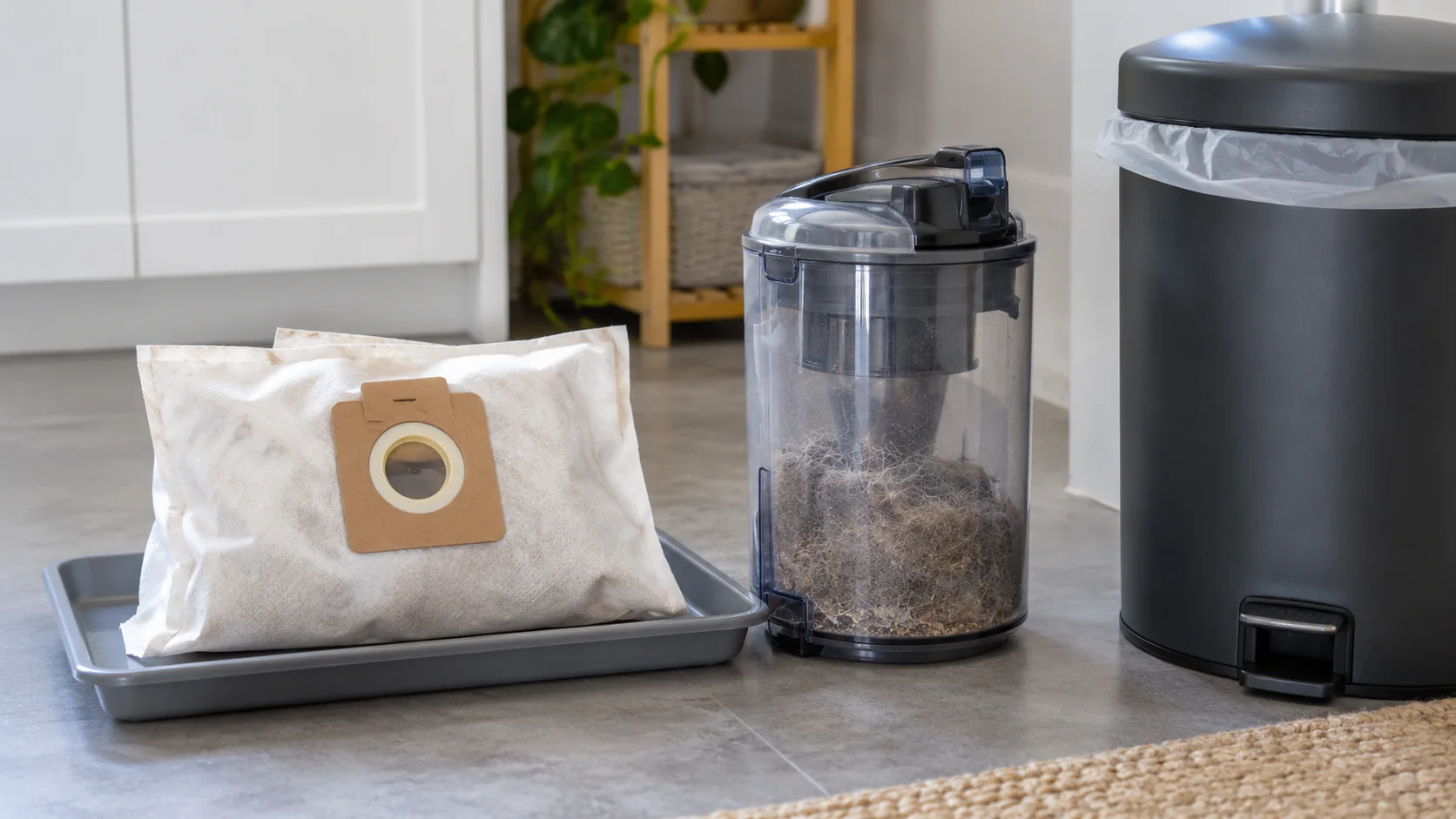
A closing dust bag keeps much of the collected material contained while you carry it to the trash. That can be convenient when you dislike touching dirty parts or do not have a suitable place to empty an open container. The closure design matters: a bag that seals its opening is more useful here than a bag that leaves its inlet exposed.
For example, Miele explains how the collar on its AirClean FilterBags closes when the vacuum is opened. That is a feature of that bag system, rather than a promise that every bagged vacuum empties in exactly the same way.
Bagless disposal is more variable. A bottom-opening bin can be straightforward when the contents fall out freely. A tightly packed ring of fur around a separator can take more effort. Before buying, watch the manufacturer’s emptying demonstration and look at the actual route the debris takes out of the container.
Ask yourself whether you can open the bin inside your trash receptacle without knocking it against the rim. Check whether the lid is easy to close afterward and whether the release button sits where you might press it accidentally while carrying the machine.
These details are less impressive than a suction claim, but you will encounter them every time the vacuum fills.
Filtration depends on the whole machine
The bagged-versus-bagless label does not tell you whether a vacuum has an effective sealed filtration system. Both formats can include high-efficiency exhaust filters. Both can also perform poorly if a seal is damaged, a filter is missing, or the dirt container is fitted incorrectly.
Look for a clear description of the air path and filtration package on the exact model. A HEPA filter specification describes the filter; it does not, on its own, establish that every joint in the appliance is sealed. Likewise, an odor-control filter and a particle filter perform different jobs.
Bagless machines should not be dismissed as a single low-filtration group. Miele’s bagless range uses several filtration stages, illustrating why the design of a particular machine matters more than a broad category assumption.
There are also two separate moments to consider: dust containment while vacuuming and contact with dust when disposing of it. A machine may filter its exhaust effectively yet require you to empty an open bin afterward. If dust disposal is your main concern, evaluate that task directly.
Does one type have stronger suction?
You cannot reliably choose a cleaning winner from the container type alone. Dirt pickup involves airflow through the head, how the nozzle meets the surface, brush action where appropriate, and the condition of the machine.
A well-maintained bagless vacuum can be a good match for a particular floor. So can a bagged vacuum. A clogged filter, blocked hose, or overfilled container can undermine either one. Electrical input figures also do not tell you how much debris will be removed from your rug in a pass.
Compare suitability before comparing slogans. For carpet, inspect the floor head, height or suction controls, and the carpet maker’s restrictions. For hard flooring, consider brush control, wheels, and how the head admits larger debris. Our vacuum buying guides organize choices around those practical jobs.
Maintenance is different, not absent
With a bagged vacuum
You replace the collection bag when the machine’s instructions or indicator call for it. You may also need to replace or maintain motor-protection and exhaust filters. The bag compartment, hose, and floor head still deserve attention if debris escapes or airflow drops.
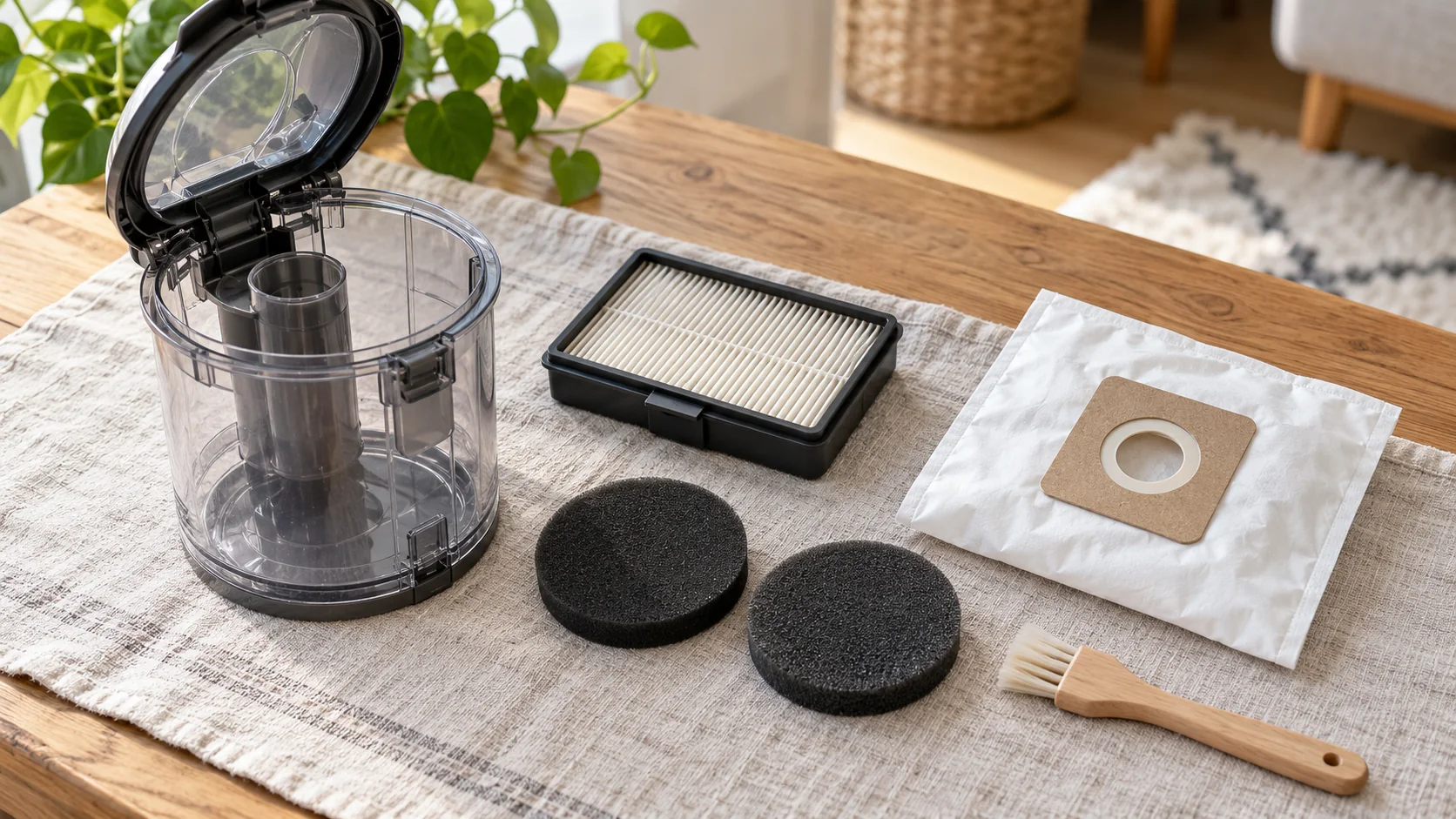
Keep the correct bag type in stock. A bag that almost fits can be a poor bargain if its collar does not seat properly. Check the model compatibility, fitting instructions, and whether a filter is included in the replacement pack instead of assuming every package contains the same supplies.
Fine dust can load a bag before it appears physically full. Miele’s support guidance describes how fine material can block the bag’s pores. Follow the appliance’s pickup restrictions; a household vacuum is not automatically suitable for renovation debris because it uses a bag.
With a bagless vacuum
Empty before the maximum fill level, rather than using the last available space as a target. Inspect the inlet and separator for trapped hair. Clean the container and filters only in the way the manual permits; not every component can be washed.
Washable does not mean permanently maintenance-free. A filter may need drying time, periodic replacement, or cleaning that cannot be done by rinsing it. Reassemble all parts correctly before using the machine again. Use the maintenance schedule for your particular vacuum rather than a replacement interval that applies to a different model.
The honest question is which routine you are more likely to maintain. Some people happily wash filters but forget to order bags. Others want to replace a bag and avoid cleaning a reusable dirt chamber.
Which works better with a shedding dog or cat?
Pet hair makes collection capacity and emptying more noticeable, but it does not produce a universal winner.
With a bagged vacuum, bulky fur can use up bag space quickly. You gain a contained disposal method, but your replacement-bag consumption may rise during shedding season. With bagless, repeated bin emptying does not consume a new collection bag each time, although compressed fur can be awkward to release from some containers.
Brush maintenance is a separate issue. Hair can collect around the roller and its ends in either format. Check whether you can reach those areas and whether the upholstery tool suits your sofa. A large bin is little help if the floor head leaves embedded hair behind.
If a pet household is your main use case, see our vacuums for Husky hair and upright vs canister vacuums for pet hair. Those guides address the cleaning tools and handling choices alongside the collection system.
Compare ownership cost with your own numbers
A bagless vacuum avoids the cost of main collection bags. That does not establish which complete machine will cost less over several years. Purchase price, filters, repair parts, and how often you clean all affect the result.
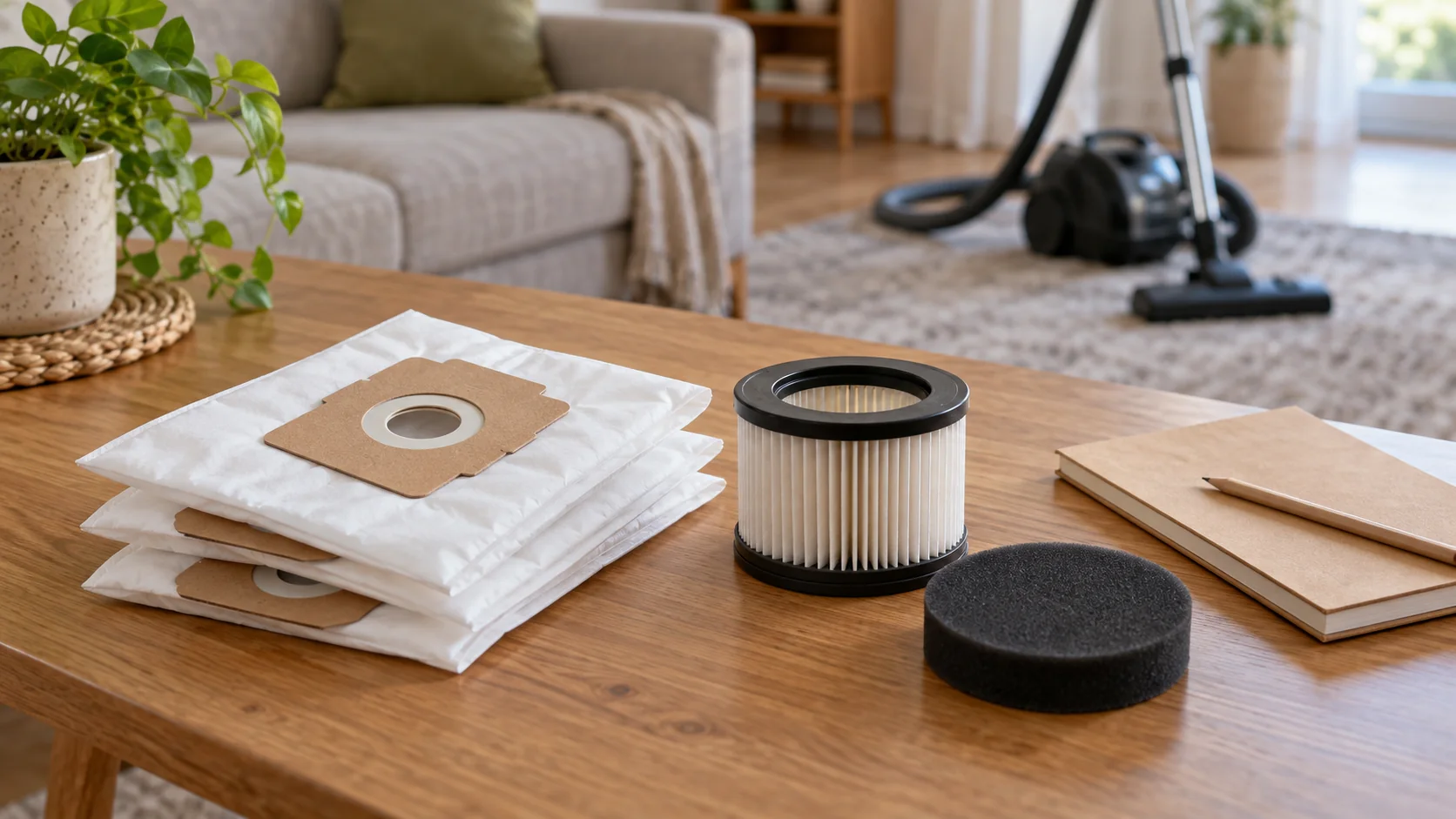
Use this simple calculation for each model:
Five-year planned cost = purchase price + five years of collection supplies + planned filter replacements + other known replacement costs.
Here is a hypothetical example, using invented prices to demonstrate the calculation rather than quote a product:
| Cost over five years | Example bagged vacuum | Example bagless vacuum |
|---|---|---|
| Purchase price | $250 | $220 |
| Collection bags | Six per year at $5 each: $150 | $0 |
| Planned filter replacements | $60 | $100 |
| Total in this example | $460 | $320 |
This example excludes electricity, repairs, shipping, and the value of your time. Change the bag consumption or starting price and the difference changes too. It shows how to compare costs, not what a typical household is guaranteed to spend.
Check whether bags and filters are sold locally, whether the correct version is easy to identify, and how much a useful quantity costs to ship. A cheap machine becomes less convenient if its supplies are difficult to obtain.
Storage, weight, and floor coverage are separate decisions
Bagged does not necessarily mean canister, and bagless does not necessarily mean cordless. Uprights and canisters can use different collection systems. Battery power introduces another set of questions about charging and replacement batteries.
Judge storage using the assembled machine and its accessories. A canister may need room for its body, hose, wand, and heads. A cordless stick may require wall or stand space near an outlet. An upright may stand in a narrow closet but still be awkward to lift between floors.
If you are deciding how you want to clean rather than how you want to empty the dirt, our robot vacuum vs cordless vacuum comparison addresses a different and equally useful choice.
Four household situations that make the decision clearer
You dislike dealing with loose dust
Start by examining bagged models with a well-designed closing bag. You may accept recurring bag purchases in exchange for an emptying process you find easier to manage. Still compare the complete filtration system and the tools you need.
Your pets fill the container repeatedly
Bagless may appeal because another emptying does not consume another bag. Try to assess whether long hair falls out cleanly. For bagged, estimate how quickly your household could use its available capacity and include that in the supply budget.
You clean a small room occasionally
A suitable compact vacuum of either type can make sense. Do not pay for a large body or complicated maintenance arrangement simply because one collection format is described as superior. Ease of storage may decide the purchase.
You want the simplest ongoing routine
Write out the actual steps for the two shortlisted models. Include bag fitting, filter cleaning, drying, bin emptying, and brush access. The shorter or more comfortable routine for you may be worth more than a small difference in purchase price.
Questions to settle before you buy
Can a bagless vacuum be good at containing dust?
Yes. Evaluate the exact machine’s filtration, seals, and emptying design. The absence of a collection bag does not prove poor filtration, just as the presence of a bag does not prove that the appliance is fully sealed.
Can you reuse a disposable vacuum bag?
Only use bags as their manufacturer intends. Cutting open or emptying a disposable bag for reuse can damage its structure or closure. If reusable collection is a priority, choose a machine designed around it.
Is a bagged vacuum always larger?
No. Body style and model design determine size. Compare assembled dimensions, hose storage, and the space required for accessories rather than using the collection system as a size guide.
Does bagless mean you never buy replacement filters?
No. Read the model’s maintenance instructions. Some filters are washable, some are replaceable, and some systems use a combination. Cleaning and replacement requirements can also change with use.
Choose the emptying routine you can live with
For a household that values contained disposal, a suitable bagged vacuum is a sensible starting point. For a household that prefers reusable collection and accepts regular bin and filter care, bagless can be equally practical.
Shortlist by floor compatibility first, then compare disposal, supplies, and maintenance. That order gives you a vacuum that both cleans the home and remains manageable after the floor is finished.

Katy James contributes vacuum-cleaner explainers and practical cleaning guidance at GlobVacs. Her published topics include robot-vacuum operation and vacuum airflow. Read her author profile and selected articles.