
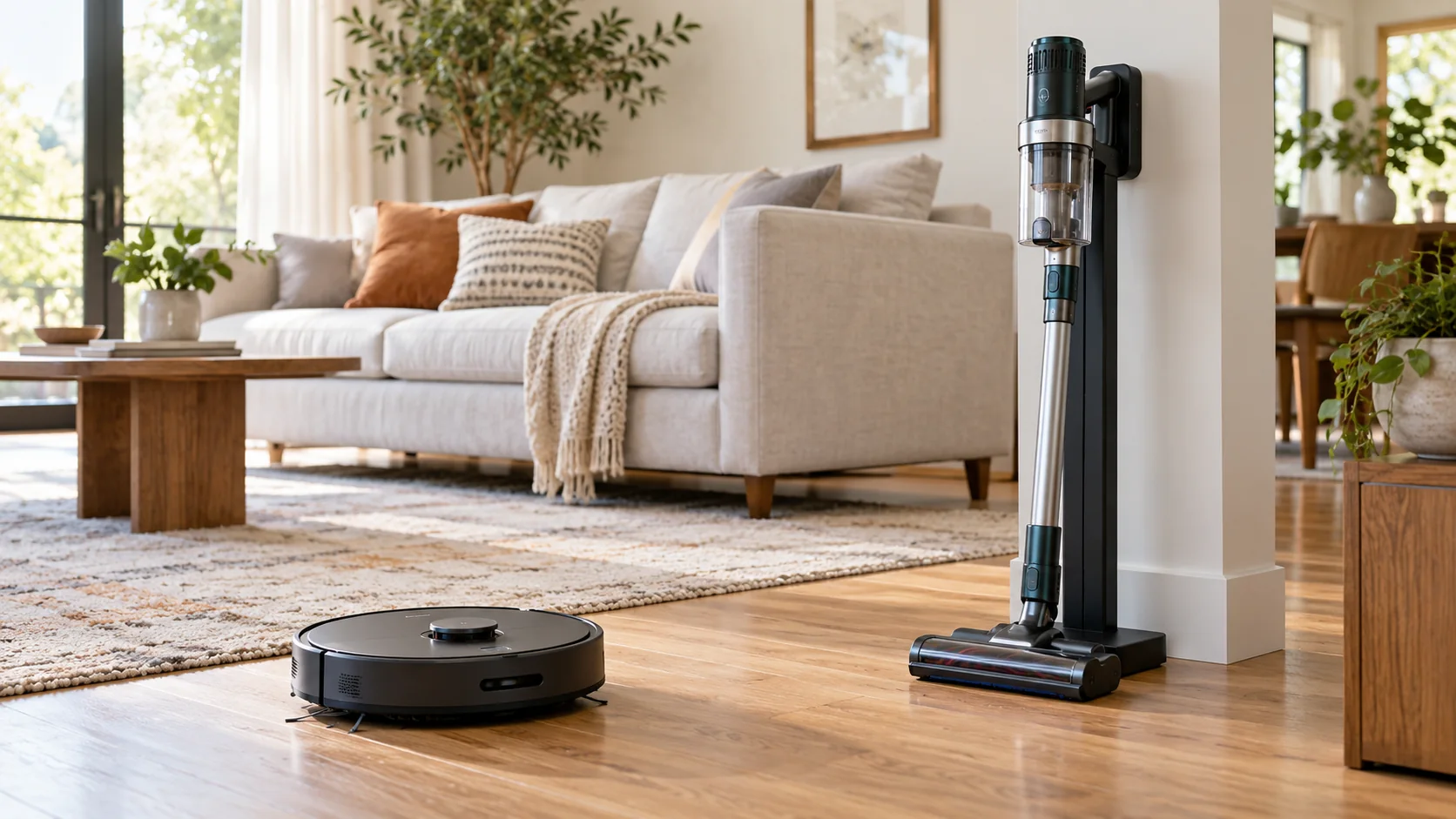
Robot vacuum vs cordless vacuum is a choice between delegating routine floor cleaning and controlling the job yourself. A robot can repeatedly clean the accessible floor while you do something else. A cordless stick gives you direct control over crumbs, corners, stairs, upholstery, and other places a floor-cleaning robot cannot normally reach.
If this will be your only vacuum, a suitable cordless model is usually the more versatile starting point. If you already have a capable manual vacuum and want to reduce repetitive floor work, a robot can be a valuable addition. The best first purchase depends on what equipment you already own and which cleaning task you most want to stop doing.
Last updated: October 19, 2026. This is a comparison of cleaning routines and product designs, supported by manufacturer guidance. It does not present invented pickup measurements or time-saving test results.
The difference is who moves the cleaning head
A cordless stick is a manual vacuum powered by a rechargeable battery. You guide it to the debris and decide where to make another pass. Many models convert to a handheld arrangement, but the actual tools and supported uses vary.
A robot combines its cleaning system, wheels, sensors, and battery in a machine that travels across the floor. Its reach is limited by the space it can enter, surfaces it can traverse, and areas its controls allow it to clean.
That distinction matters more than which appliance has the longer feature list. A robot may be excellent at collecting loose debris under a bed yet leave you needing another tool for the stairs. A versatile cordless can cover both, but you have to perform the cleaning.
| Job | Robot vacuum in autonomous floor mode | Cordless stick with suitable tools |
|---|---|---|
| Regular accessible-floor cleaning | Can repeat a routine with limited active guidance | You guide each pass |
| A small spill of dry crumbs | Can clean the area if it can reach it and you can target it | Quick, direct spot cleaning |
| Stairs | Needs a separate cleaning method | Handheld or appropriate stair-tool configuration may help |
| Sofas and car seats | Usually outside its floor-cleaning role | Suitable upholstery or handheld tools can cover these |
| Under low furniture | Depends on the robot’s full height and access route | Depends on head clearance and how far the wand can reach |
| Cluttered rooms | Needs a usable route; obstacle features have limits | You can move objects and clean around them directly |
| Charging | Must have access to its supported charging arrangement | Needs a suitable charger or dock and storage space |
Hybrid products can combine formats. If a particular machine includes a detachable manual unit, assess that unit and its tools separately rather than assuming the autonomous robot does every job.
Buy a cordless first when versatility is the missing piece
Think about everything you expect your first vacuum to clean. A list that includes a carpeted staircase, sofa cushions, the car, and floor edges points toward a suitable manual machine.
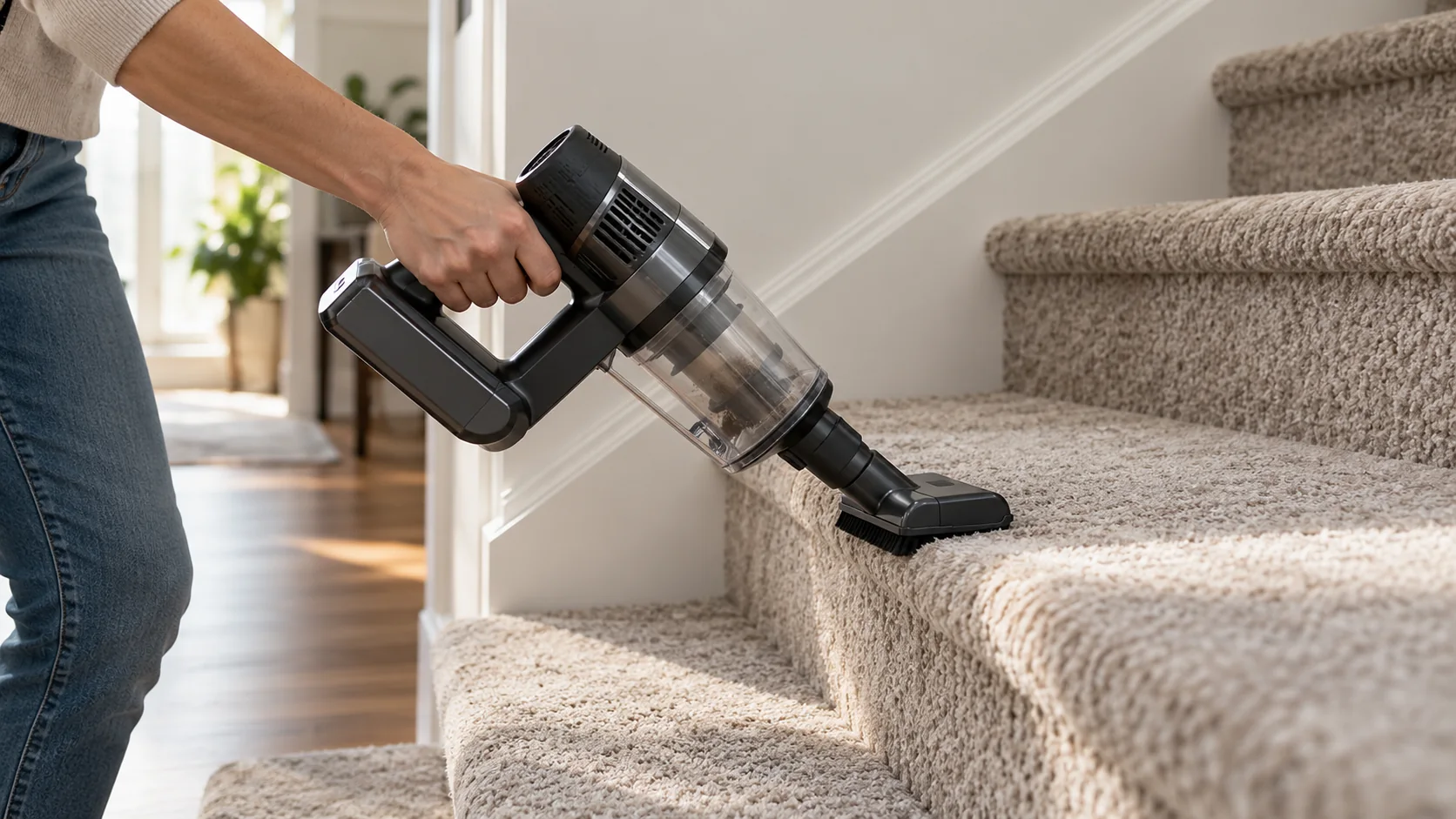
A cordless stick can be easy to take out for a small job. You can lift a chair, remove a cushion, change tools, and finish the place that needs attention. That immediate control is useful when mess is concentrated in a few awkward spots rather than spread across a large open floor.
The compromises are active effort, available battery time, and the amount of weight you hold. A model that looks light on a specification sheet may feel tiring when used overhead or with a small furniture tool. Check the handle, trigger or on/off control, and handheld balance where possible.
Do not assume cordless is the only alternative to a robot. A corded upright or canister may suit long cleaning sessions or particular carpets. Our upright vs canister comparison for pet hair considers those layouts in more detail.
Buy a robot first when routine floor work dominates
A robot makes more sense when your main frustration is repeatedly collecting loose dirt from an accessible floor. If you already have another way to clean furniture and stairs, delegation may be more valuable than adding another manual vacuum.
The home needs to support the routine. There must be room for the robot to move and an appropriate location for its dock. Door thresholds, furniture clearance, rug edges, and areas it should avoid can all change how much useful floor it reaches.
If most of the floor is accessible and you can keep it prepared, the robot can help prevent loose debris from building up between manual sessions. That is a practical reason to buy one. It is different from expecting a machine to remove every kind of dirt from every part of the home without help.
For readers who prefer local buttons or a remote, our non-Wi-Fi robot vacuum guide covers that group. Our Wi-Fi vs non-Wi-Fi comparison explains which control differences matter.
Carpet changes the calculation
On carpet, collection performance depends on the head or brush system, airflow, surface compatibility, and maintenance. A longer autonomous run does not prove a robot removes the same embedded debris as a suitable manual vacuum. Equally, a cordless label does not prove strong carpet pickup.
Look at the carpet manufacturer’s care instructions and the appliance’s supported surfaces. Deep pile, light rugs, tassels, and looped constructions can make a generic recommendation unreliable. Check whether a manual head is comfortable to push and whether the robot can traverse the carpet without repeatedly stopping.
The Carpet and Rug Institute’s cleaning guidance puts emphasis on a suitable vacuum and regular care. If delicate looped carpet is your concern, start with our Berber carpet guide before selecting either format.
For a carpet-heavy home with no other vacuum, prioritize dependable manual coverage. A robot can still be a useful companion, but it should earn its place through the accessible area it can maintain.
On hard floors, measure access and control
Hard floors can make a robot appealing because loose dust and crumbs may be spread through the same routes every day. Check how well the proposed machine can reach the places that matter: under the dining table, along the kitchen units, and around the bed.
A cordless gives you direct control around those places. You can reposition the head when debris sits beside a chair leg or fit a crevice tool to a narrow gap. That may be quicker for a specific mess, even if a robot is more convenient for the wider floor.
Neither format is automatically harmless to the finish. Trapped grit, damaged wheels, or unsuitable brushes deserve attention. Our vinyl-floor guide and tile-floor guide help connect the purchase to the surface.
Also distinguish dry vacuuming from wet floor washing. A standard cordless dry vacuum should not collect liquids. A robot with a mop does not make every floor suitable for wet cleaning. Check the exact appliance and flooring instructions.
Pet households usually have two different jobs
The first job is collecting loose fur from the floor before it spreads through the home. A robot can contribute here when the floor is prepared and the machine is maintained.
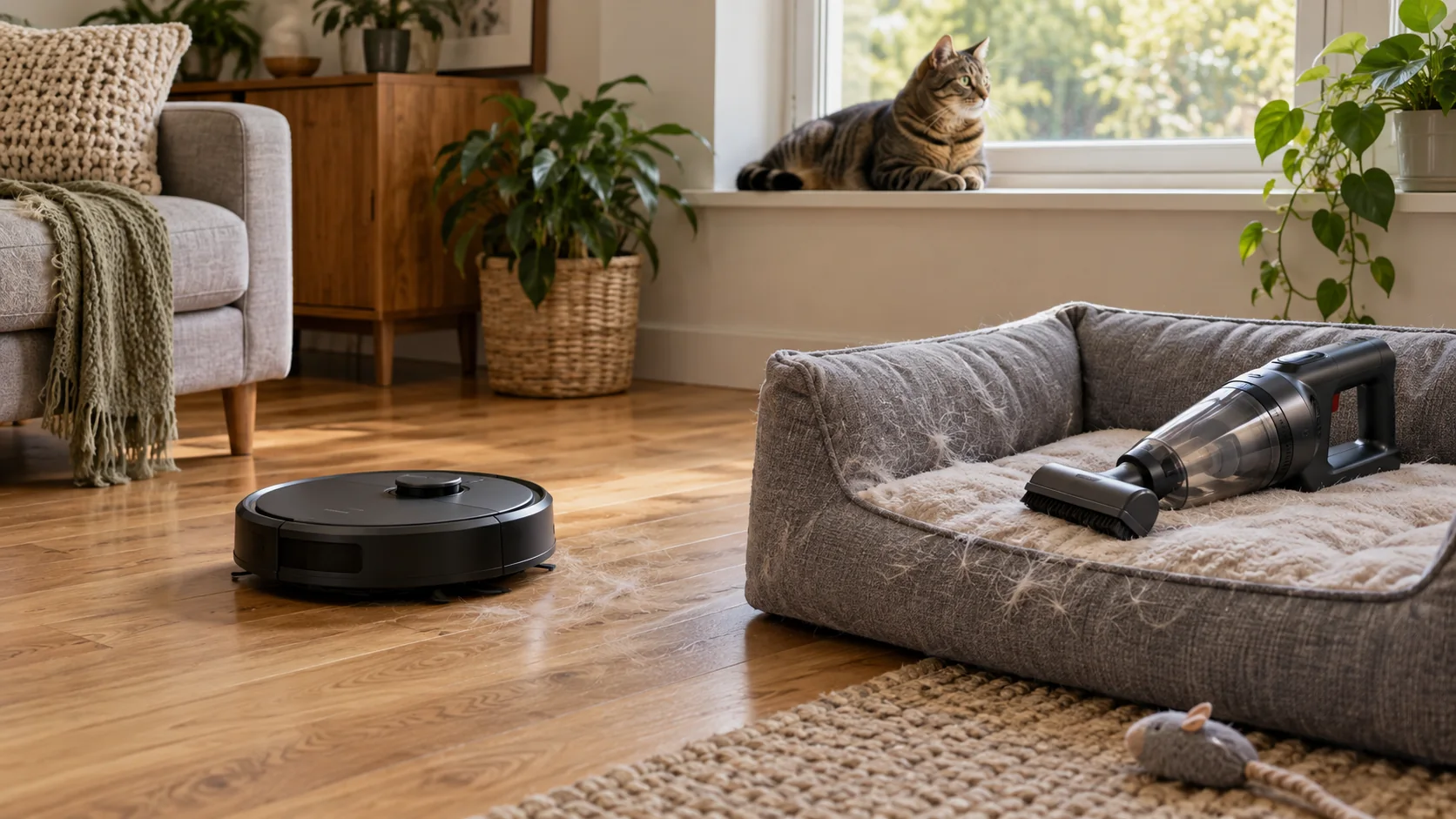
The second is removing hair from fabric, stair treads, corners, and other concentrated areas. A manual vacuum with the right tools gives you control over these places. A sofa is a strong reason to keep a suitable upholstery tool in the cleaning kit, even if you run a robot regularly.
Both formats need brush inspection. Hair can collect at roller ends and around moving parts; a self-emptying dock does not clean every component of the robot. Roborock’s Qrevo S manual includes maintenance for the robot’s brushes and wheels, illustrating the work that remains after automation.
If shedding is the main reason for buying, map the problem by surface. Our Husky-hair vacuum guide includes both floor-maintenance and manual-cleaning roles.
Compare active effort, not just running time
An appliance running for an hour does not necessarily create an hour of work for you. A robot may run while you are doing something else. A cordless may clean a small mess in a few minutes, all of which require your attention.
For a useful comparison, count the hands-on steps around each one:
- Robot: clear the floor, start or schedule the job, resolve interruptions, empty or service the collection system, and maintain the machine.
- Cordless: collect the vacuum, guide the cleaning, change tools as needed, empty the bin, maintain it, and return it to charge.
Then consider how frequently those steps occur in your home. A room full of small toys may require substantial preparation for every robot run. An open living area may need almost none. A cordless stored close to the kitchen can be very convenient for a localized spill.
The useful question is how much effort the purchase removes from your actual week. Manufacturer runtime is not a direct measure of that saving.
Battery claims need context
Maximum cordless runtime is usually conditional. The power setting, floor head, surface, and other factors can change the time available. Read the footnote beside the number and compare it with the cleaning configuration you plan to use.
For example, Dyson lists up to 60 minutes for the V15 Detect Absolute and says actual runtime varies with mode, dust level, floor type, and attachments. That is not a promise of an hour at maximum power with every tool.
A robot’s quoted runtime also does not tell you how much of your particular home it will clean. Its route, chosen settings, rug interactions, and need to recharge affect completion. Check whether the exact model supports returning to finish a job rather than assuming that feature comes with every dock.
For either format, look at replacement-battery availability and the manufacturer’s replacement process. A rechargeable appliance is an ownership commitment beyond its first charge.
Storage and dock placement can decide the purchase
A robot needs a usable home base. If the dock must sit in a narrow walkway or behind furniture that blocks access, the machine may become less convenient than you expected. Follow the stated clearances for the exact dock.
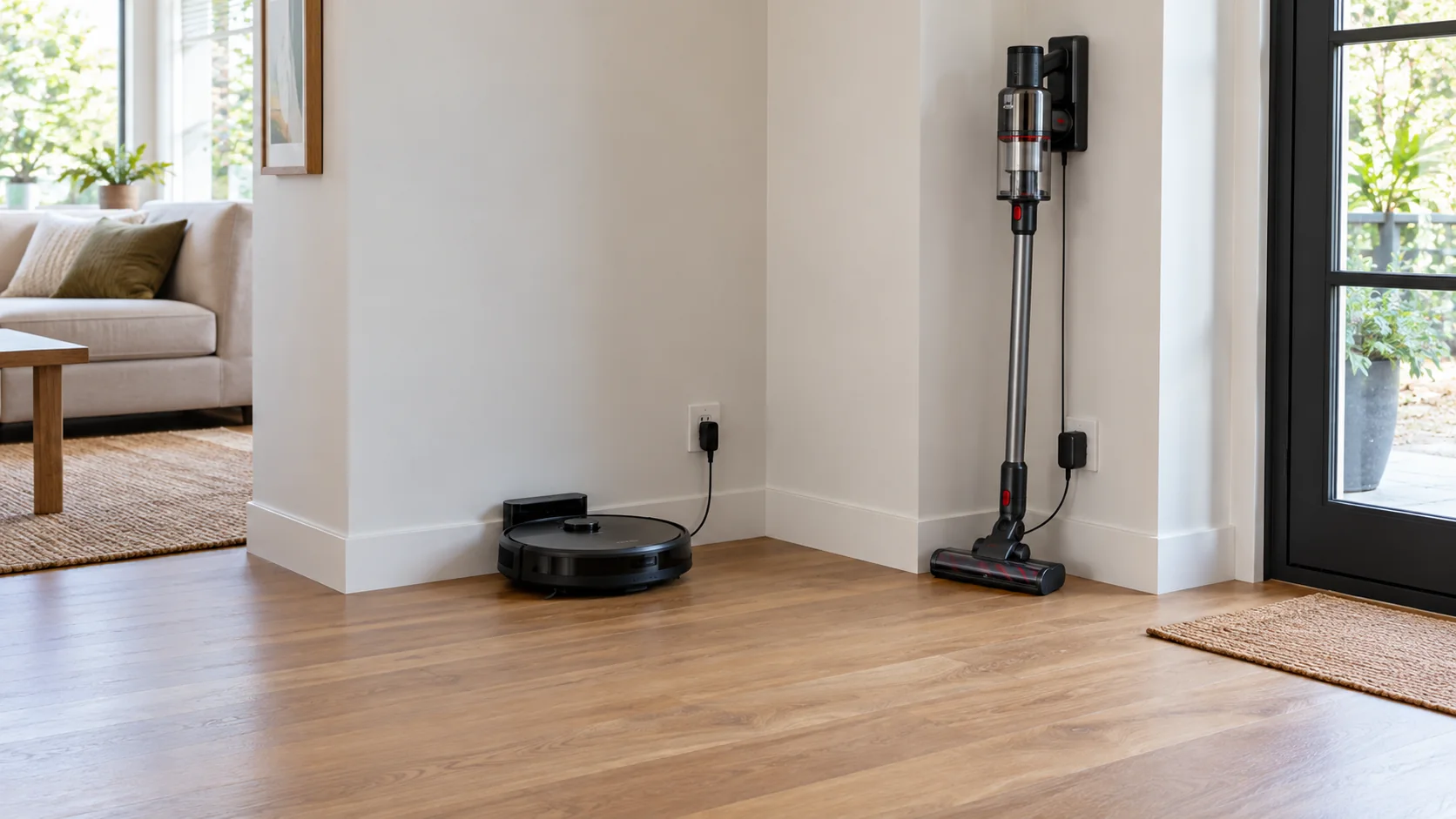
Large self-emptying or floor-washing stations need more space than a basic charging base. Some also add water handling or other maintenance. Measure the complete station and the space required to remove bags or tanks, rather than considering only the robot’s diameter.
A cordless needs a secure place to stand, hang, or sit while charging, plus storage for its useful tools. Check whether the vacuum can be charged without a permanently mounted wall dock if you rent or cannot drill into the wall.
In a small flat, an accessible storage location can make the manual vacuum more useful than a technically impressive robot with nowhere sensible to live.
What to include in the ownership budget
Compare the purchase price with expected supplies for the specific products. A robot may use brushes, filters, dock bags, mop pads, or other consumables. A cordless may need filters, brush parts, and eventually a battery. The actual list varies.
For robots with a self-emptying base, distinguish the onboard bin from the dock’s collection system. A bagless robot can still empty into a disposable bag in its station. Our bagged vs bagless guide explains the disposal trade-offs.
Price the package you will use, including any important tool or accessory sold separately. A low starting price is less meaningful if the missing upholstery tool is central to your cleaning routine.
A practical three-day decision exercise
Before buying, make a brief note of the cleaning interruptions you encounter over three ordinary days. Record the place, debris, and why it was inconvenient.
If the notes mainly describe the same open floor getting dusty again, a robot could address the repetition. If they describe crumbs in tight corners, fur on chairs, car seats, and stair treads, a versatile manual vacuum addresses more of the list.
This small exercise also helps you avoid buying an appliance for an imagined routine. A robot cannot reduce work in rooms it rarely enters, and a cordless cannot save effort if its uncomfortable handling makes you avoid using it.
Common buying questions
Can a robot replace a cordless vacuum completely?
It can cover enough floor work for some households, especially when another cleaning method handles the remaining surfaces. As the only vacuum in a home with stairs and upholstery, an ordinary floor-cleaning robot leaves important tasks unresolved.
Is cordless always better for small apartments?
No. A simple layout with accessible flooring can suit a robot. Storage, clutter, floor compatibility, and the need to clean furniture are more useful deciding factors than apartment size alone.
Does a larger suction number prove better cleaning?
No. Pressure, air watts, electrical watts, and other figures are not interchangeable. Even measurements using the same unit may come from different test conditions. Compare relevant pickup evidence and the complete cleaning system.
Do I need both machines?
Only if they solve different useful jobs in your home. A robot for routine floors and a manual vacuum for furniture and targeted cleaning can be a practical combination. Buying both is unnecessary if one suitable appliance already covers your needs comfortably.
Choose the appliance that closes the biggest gap
If you lack a versatile vacuum, start with a manual model whose tools, handling, and battery arrangement cover the home. If manual coverage is already sorted and repetitive floor work is the problem, put a suitable robot on the shortlist.
The goal is a cleaner home with a routine you can sustain. Choose the machine by the work it will do each week, and judge the extra features by how much of that work they actually simplify.

Abi Khan is the founder and a content writer at GlobVacs. His published work covers vacuum-cleaner buying guides, product comparisons and practical maintenance advice. Read his author profile and selected articles.