
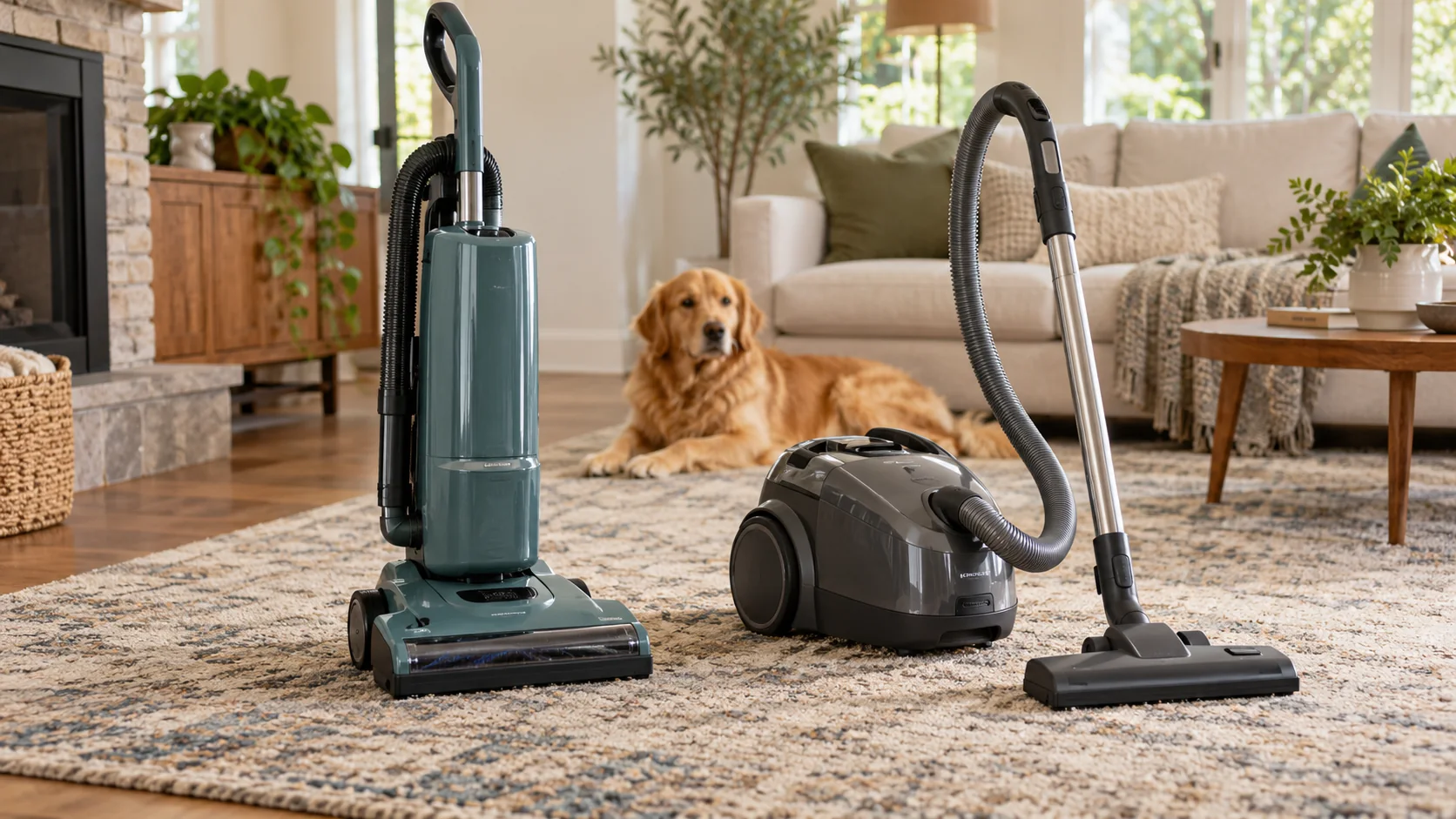
Upright vs canister vacuums for pet hair becomes a much easier decision when you identify where the hair is hardest to remove. An upright can be convenient for long stretches of carpet. A canister can offer flexible reach around furniture and above the floor. In either format, the floor head and upholstery tools matter more than the word “pet” on the box.
For a mostly carpeted home on one level, start by comparing suitable uprights. For mixed floors, awkward furniture, and frequent tool changes, include canisters with the right heads. If your house has both deep carpet and hairy sofas, compare the whole cleaning kit rather than choosing a body style first and hoping its accessories will cope.
Last updated: October 19, 2026. The recommendations below are based on product design and manufacturer guidance, not a controlled pet-hair pickup test.
How the two formats change the job
An upright combines the main body and floor head into one appliance that you steer together. Many models also have a hose and attachments. Some let you detach part of the body for stairs or upholstery.
A canister separates the motor and collection body from the wand and floor head. You guide the head while the body follows on its wheels. That arrangement can make it easier to change tools and reach into spaces, but you also have a hose and trailing body to manage.
Neither format is automatically light. With an upright, consider what you push across the floor and lift between levels. With a canister, consider the wand in your hand, the resistance of the hose, and the body you carry upstairs. A single total-weight figure does not capture all those experiences.
| Cleaning situation | Upright | Canister |
|---|---|---|
| Large carpeted rooms | Convenient all-in-one handling; compare head controls and carpet compatibility | Can work well with a suitable powered or turbo head; manage the trailing body |
| Several floor types | Needs appropriate head settings or tools | Separate floor heads can suit different surfaces, but require changes |
| Hair on sofas | Depends on hose reach and the actual upholstery attachment | Flexible hose-and-tool arrangement; inspect the included furniture tool |
| Staircases | Full body can be awkward; detachable-pod designs may help | Can offer useful reach; body must be positioned securely |
| Under beds and furniture | Clearance depends on body shape and how the head pivots | Low-profile wand and head can help; measure actual clearance |
| Storage | Often stands as one unit; allow room for tools | Body, hose, wand, and heads all need a place |
Start with the hair problem you actually have
Loose fur rolling across tile is a different cleaning problem from short hair woven into a sofa. Long hair wrapped around a brush is another problem again. A vacuum may handle one well and still require extra work on another.
Walk through your home and identify the three places that create the most effort. That might be the living-room carpet, the dog’s preferred seat, and the stairs. You can then compare what each shortlisted machine would require you to do in those exact places.
For a heavy-shedding household, our best vacuums for Husky hair shows several different cleaning formats. The breed name is less important than how much fur accumulates and which surfaces hold it.
Carpet: compare the head before the body
A canister sold with a straight-suction combination head is not the same proposition as a canister with an electrically powered carpet head. A small air-driven turbine tool is not the same as an electric brush motor, either.
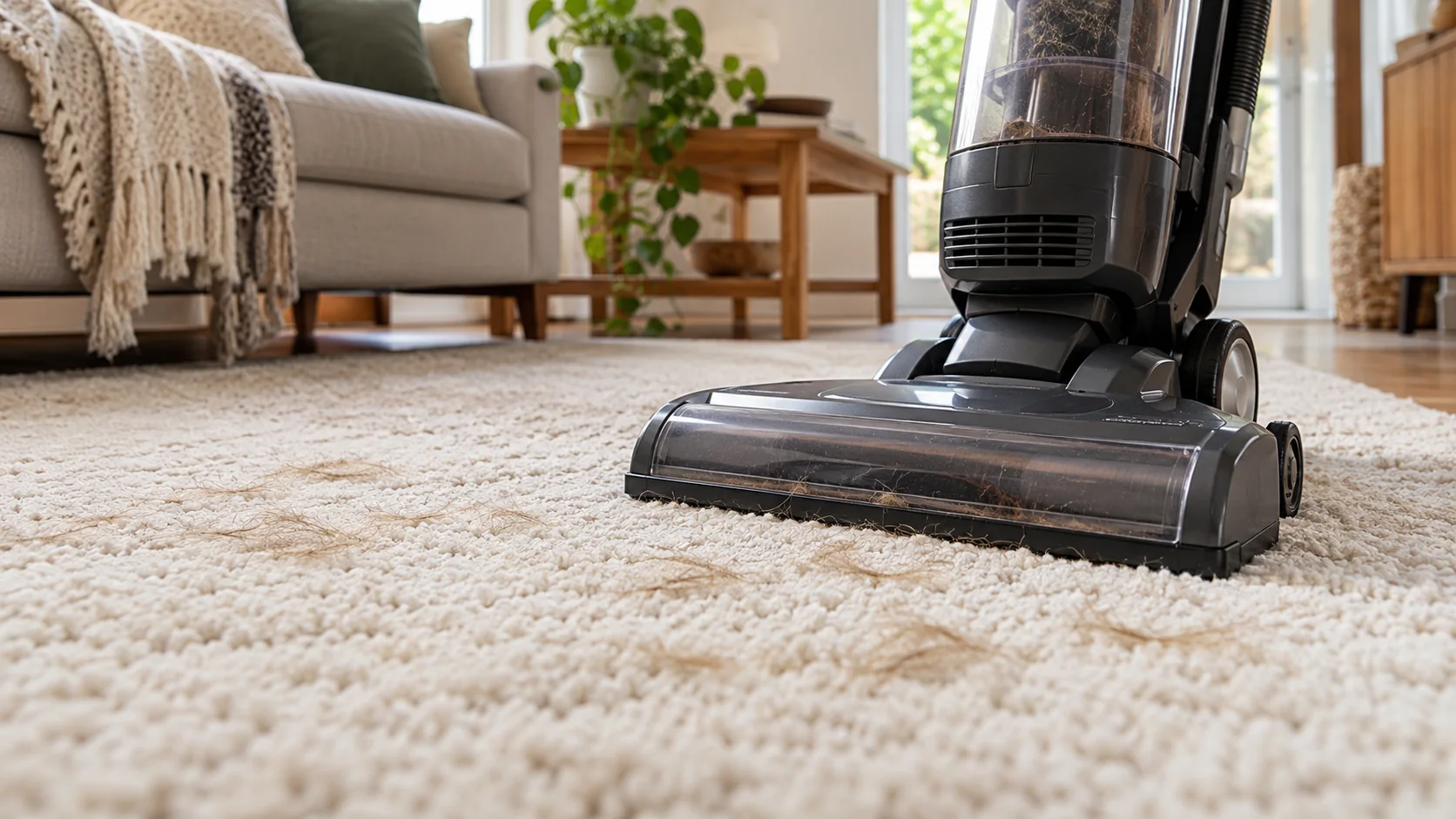
Straight-suction tools rely on airflow and their contact surfaces. Turbo brushes use the airflow to turn a brush. Electrically driven heads have their own powered brush action. Those designs can behave differently as conditions change, so compare the actual head and its intended surfaces.
Miele’s pet-vacuum guidance distinguishes several brush systems. Its range is a useful reminder that a canister’s capabilities depend heavily on the tools supplied with it. You cannot assume every model from the same brand includes the same carpet equipment.
For an upright, inspect the brush setting, suction adjustment, and any height controls. An appliance that is difficult to push or whose brush is unsuitable for your carpet is a poor match even if the product description repeatedly mentions pets.
Carpet compatibility comes first with looped, delicate, or unusual constructions. The Carpet and Rug Institute’s maintenance guidance recommends checking carpet-specific cleaning requirements. Our Berber carpet buying guide also discusses why aggressive brushing is not automatically the answer.
Hard floors: the gentler head may be more useful
On hard flooring, you want to collect fur and grit without pushing debris ahead or scattering it. Inspect how the head lets debris enter, how it meets the floor, and whether its rotating brush can be switched off when appropriate.
A canister with a suitable hard-floor brush can be pleasant to guide around chair legs and into corners. The trade-off is finding room for the canister body and managing the hose while moving between objects.
An upright may offer a bare-floor setting that avoids a head change. For example, Shark documents brushroll shutoff on the NV360. That is a useful control, but it does not establish compatibility with every floor finish or delicate rug.
If your home has vinyl plank, read the flooring maker’s care instructions alongside our vinyl-floor vacuum guide. The same caution applies to grit trapped in wheels or under a head, regardless of body style.
Sofas and pet beds: inspect the furniture tool
Pet hair often makes the sofa the deciding surface. An excellent floor head does little for the back cushion if the only supplied attachment is a narrow crevice nozzle.
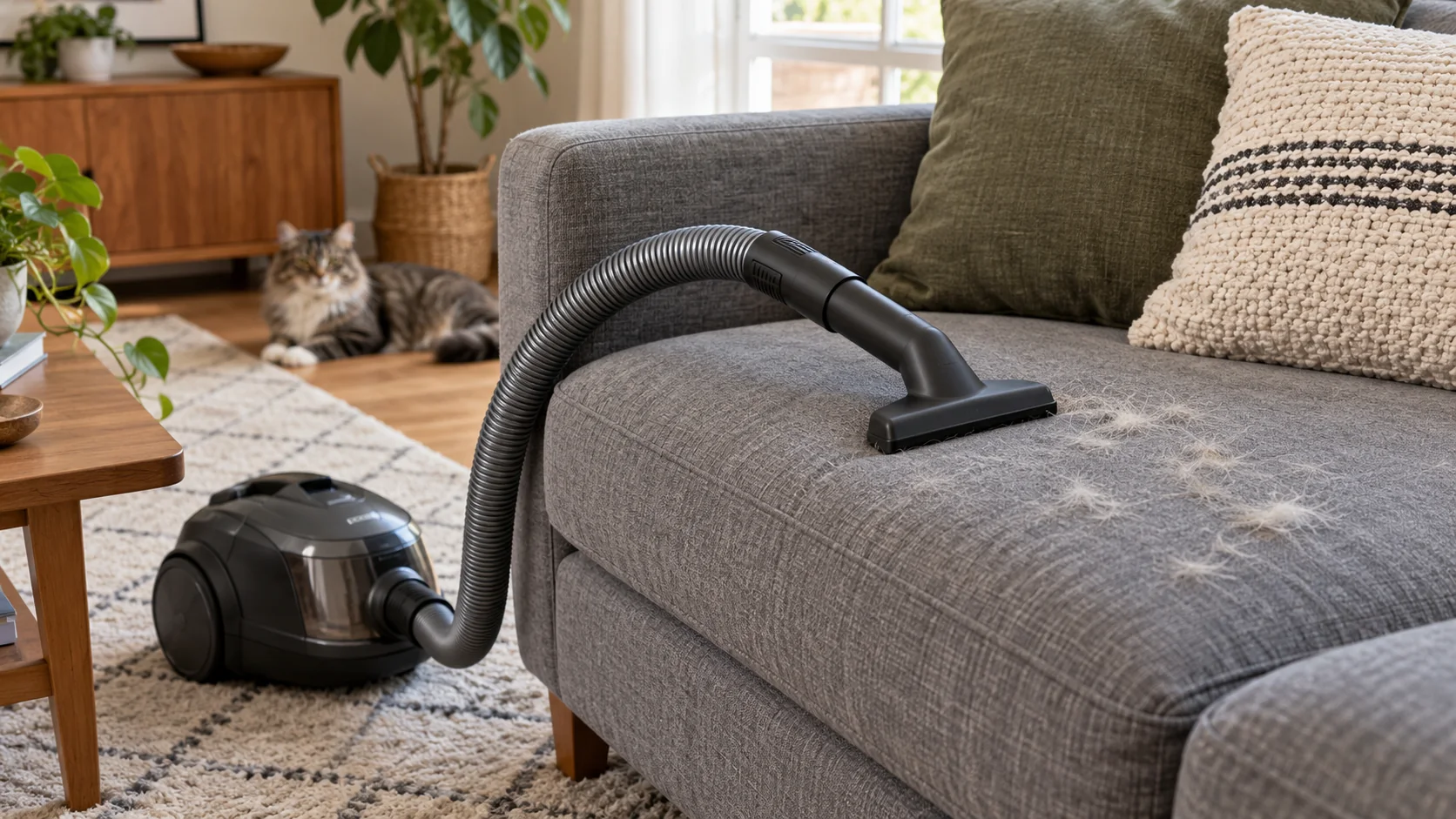
Compare whether the kit includes a plain upholstery tool, an air-driven pet brush, or a motorized mini head. Then check the fabric’s cleaning instructions. A rotating brush is not suitable for every cover, trim, or loose thread.
A canister’s flexible hose can make repeated furniture work convenient because you are not holding the motor body at the end of the tool. An upright with a well-positioned hose or detachable pod can achieve a similar practical benefit. Test how readily the hose reaches the far end of a sofa without pulling the body toward you.
The accessory’s maintenance design also matters. A small pet brush can collect hair around its roller just as a floor head does. Look for access to the rotating parts and clear manufacturer instructions for removing wrapped fibers.
Keep vacuum cleaning and animal grooming separate. Ordinary furniture attachments are for surfaces, not for use directly on your pet.
Stairs: reach is useful only when the body is secure
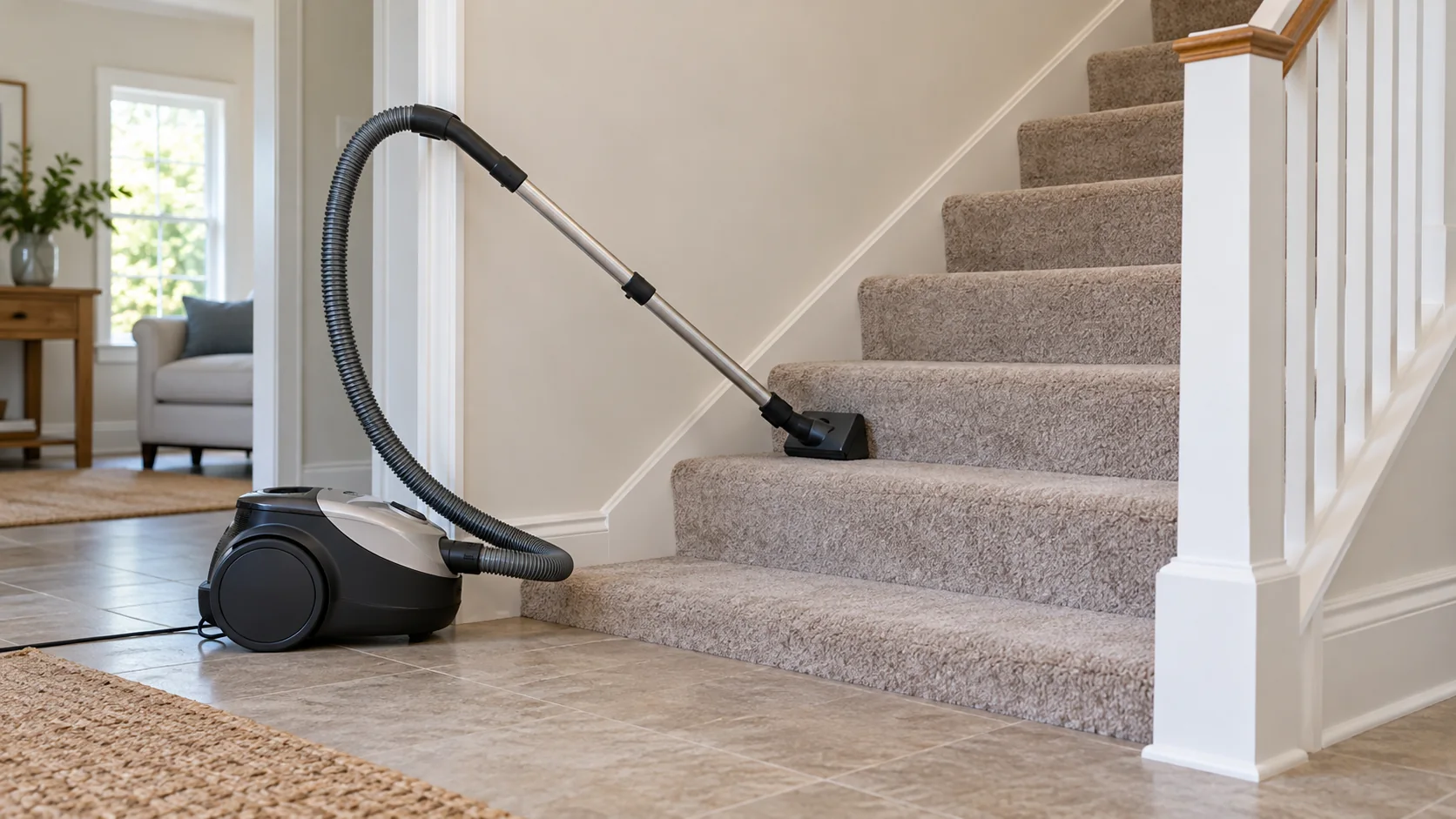
On a staircase, think about where the machine sits during the job. A long hose can be helpful, but tugging a body toward a step edge creates an avoidable problem. Follow the vacuum’s positioning instructions and keep the appliance stable.
A detachable upright pod can reduce the amount of machine you carry while using a hose tool. That does not necessarily make the floor head work as a powered attachment when detached. “Lift-Away” and “Powered Lift-Away” are different descriptions; inspect the exact product’s supported modes.
A canister can offer a comfortable wand and hose arrangement, but the body still needs a suitable place to sit or be carried. Wide landings and open treads are different from a narrow turning staircase. Picture your actual route instead of using a product photo on a broad display staircase as the deciding evidence.
For either style, check how many steps you can reach without stretching the hose and how easily you can change to the furniture or crevice tool. The easiest machine is the one you can position, control, and move safely throughout your staircase.
Hair wrap is a maintenance issue in both formats
An upright is not automatically more prone to wrapping, and a canister is not automatically free of it. The brush design, hair length, bearing protection, and cleaning access are more useful details.
Ask how you would remove hair from the head. Does the manufacturer provide a removable roller, access panel, or another cleaning method? Can you reach the ends where fur tends to gather? Is the replacement brush or belt sold for that exact head?
Anti-tangle features may reduce a familiar annoyance, but they do not make inspection unnecessary. A head that is straightforward to maintain can be a better ownership choice than one with a stronger marketing claim and awkward access.
If hair remains on the carpet, check the setup before repeatedly increasing effort. A full container, blocked inlet, dirty filter, or unsuitable head setting can make another pass unproductive. Our guide to removing embedded dog hair from carpet addresses that cleaning routine in more detail.
Capacity and disposal are separate from upright or canister
Do not assume a canister is bagged or an upright is bagless. Compare the actual collection arrangement and usable capacity of the models you are considering.
Large volumes of fur can fill either system. A roomy bag or bin may reduce interruptions, but only if the inlet and internal layout handle the material without a blockage. Compare where the maximum fill line sits and what the manual says about emptying or replacing the collection medium.
For bagged machines, include replacement bags in the running cost. For bagless machines, assess how easily a mass of hair falls out of the container. Our bagged vs bagless comparison covers disposal and filtration without treating either body style as the answer.
How much will you have to carry and store?
A canister may feel easy at the handle because the main body stays on the floor. That benefit changes when you reach a flight of stairs or need to pack it into a cupboard. Check the carry handle and how the wand and hose park when the vacuum is stored.
An upright keeps more of the equipment in one standing unit. That can suit a narrow closet and straightforward room-to-room cleaning. A bulky body can still limit how far its floor head reaches beneath furniture.
Make three measurements before buying: the space under your lowest important piece of furniture, the storage space available, and any tight gap the body must pass through. Compare assembled dimensions and tool clearances, rather than confusing the cleaning-path width with the width of the entire head.
If possible, try the machine’s handling in person. Moving a vacuum a few feet on a shop floor will not establish pet-hair pickup, but it can reveal an uncomfortable handle or awkward tool release.
Three homes, three sensible starting points
Mostly carpet downstairs, one large dog, few stairs
Start with an upright that has a suitable carpet head, manageable push resistance, and an upholstery tool you will use. The single-unit format can make long runs through open rooms convenient. Compare a powered-head canister if you prefer guiding a separate wand.
Hard floors with rugs, cats on the furniture
Include a canister with an appropriate hard-floor head and a useful furniture attachment. Confirm that its carpet tool suits the rugs. An upright with flexible hose cleaning can still work, but check the inconvenience of switching between floor and sofa tasks.
Several levels and narrow stairs
Prioritize carrying and stable positioning over the format label. Compare a detachable-pod upright with a manageable canister, then consider whether storing a second suitable vacuum on another floor would reduce more effort than changing formats.
These are starting points for a shortlist, not test results or promises that every product in a format behaves the same way.
Questions pet owners often ask
Is a canister weaker because its hose is longer?
You cannot judge usable pickup from hose length alone. Evaluate the complete system and the floor head. A well-designed canister with the right equipment can be a suitable primary vacuum for a pet household.
Does a HEPA filter remove hair from the sofa?
Hair pickup at the surface depends on the nozzle, airflow, and any appropriate brush action. Filtration addresses what happens to particles in the vacuum’s air path. The two jobs should not be confused.
Is a “pet” model worth paying more for?
It can be if the extra cost buys a tool, head, or maintenance feature that addresses your problem. Compare the contents of the package. A pet label by itself does not demonstrate a performance advantage.
Should I replace my current vacuum because it struggles with shedding?
First check its approved maintenance steps, airflow, container level, and head configuration. If the basic design does not suit the surfaces you need to clean, then a different machine may be justified. A preventable blockage is a different problem from unsuitable equipment.
Match the machine to your hardest surface
Choose an upright when convenient carpet cleaning in a largely open area is your priority and its hose tools cover the rest of the home. Choose a canister when flexible reach and the ability to use different heads solve more of your daily problems.
Before paying, confirm the exact carpet head, furniture tool, disposal system, and replacement supplies included. For a pet household, that complete package is more meaningful than a format winner chosen without seeing your floors.

Abi Khan is the founder and a content writer at GlobVacs. His published work covers vacuum-cleaner buying guides, product comparisons and practical maintenance advice. Read his author profile and selected articles.