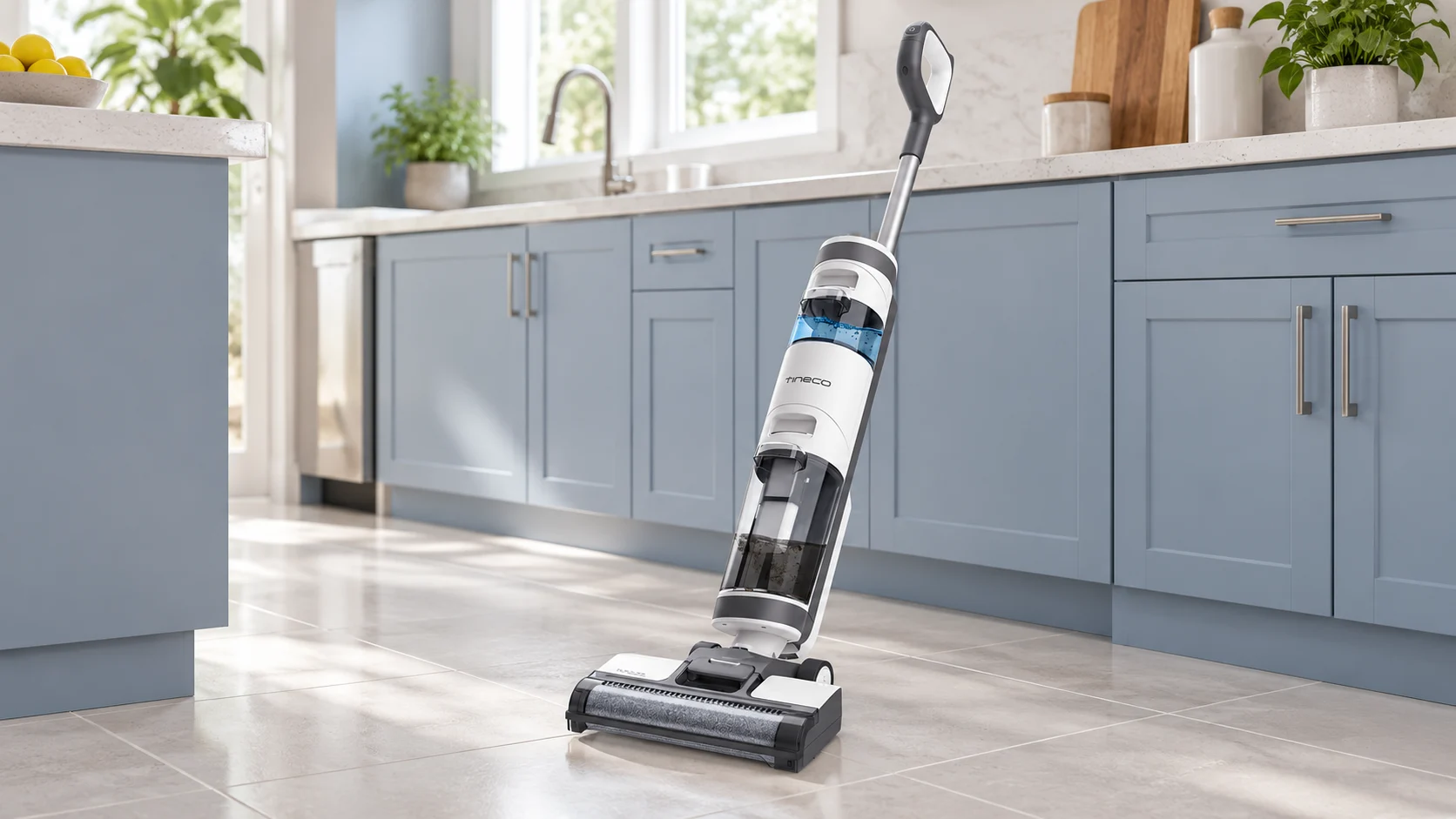
The Tineco iFLOOR 3 is a cordless wet/dry hard-floor washer that collects suitable small debris while washing compatible sealed flooring. It is a different appliance from a dry stick vacuum: it uses separate clean- and dirty-water tanks and a damp roller. Its main value is reducing the steps in a hard-floor washing routine, provided the owner is willing to clean and dry the machine afterward.
Review basis: This assessment uses manufacturer information and model-specific buying analysis. Advertised suction and runtime figures are not independent pickup or battery test results.

Quick verdict: who should buy the Tineco iFLOOR 3?
The iFLOOR 3 makes sense for a home with compatible sealed hard floors and frequent small everyday messes. It is not a carpet washer, upholstery vacuum or replacement for every dry-vacuum task. Choose it when washing is the chore you want to simplify, while allowing time for dirty-water disposal, roller care and drying after each job.
Key features and model details
- Cordless wet/dry washer for compatible sealed hard floors
- Vacuum-and-wash workflow with a roller
- Advertised maximum runtime up to 25 minutes under specified conditions
- Separate clean- and dirty-water tanks
- Original iFLOOR 3 nominal tanks: 0.6 L clean and 0.5 L dirty
- Normal and Max operation; follow the exact manual
- Self-cleaning cycle helps rinse the roller and internal path
Pros
- Combines appropriate small-debris pickup and washing
- Separate clean and dirty water
- Cordless access across a suitable hard-floor area
- Self-cleaning cycle assists the aftercare routine
- Useful for frequent small floor messes
- Reusable roller can be maintained between jobs
Cons
- Tanks, filter and roller still need manual cleaning and drying
Which floors and jobs the iFLOOR 3 suits
Tineco identifies non-carpeted sealed surfaces such as suitable tile, vinyl and sealed wood for this type of use. The floor manufacturer’s rules still take priority: water-resistant marketing does not mean every seam or finish tolerates repeated wet cleaning. Avoid damaged, unsealed or moisture-sensitive flooring unless its maker permits the method.
The iFLOOR 3 is not intended for stairs, upholstery or carpet washing. It also should not be described as a dry all-purpose stick with a second carpet head. If the main job is cleaning rugs, sofa cushions or a car interior, a different vacuum format is needed.
How washing and debris recovery work together
The roller applies and agitates the permitted cleaning liquid while the suction path recovers dirty water and suitable small debris. That can simplify routine kitchen and living-area maintenance compared with dry vacuuming followed by a separate mop, but it does not guarantee every mess disappears in one pass.
Pick up larger objects by hand and deal separately with materials that should not enter the machine. Dried food may need slower passes or approved pretreatment. Avoid promising that every sticky stain or grout line will be scrubbed clean; the roller, liquid and surface contact impose limits.

The two tanks have different roles
The original iFLOOR 3 uses a clean-water tank and a separate dirty-water tank. They should not be combined into a claim that the machine has a 1.5-liter collection bin. Fill each only as directed and empty the dirty tank when required, even if battery time remains.
A larger room can be limited by water capacity or the need to rinse a dirty roller before the battery runs out. Check the condition of the seals, tank lid and dirty-water detection parts. Correct seating matters: a poorly fitted tank can interrupt recovery and leave the floor wetter than expected.
Normal, Max and the advertised 25-minute runtime
Tineco advertises up to 25 minutes for the original iFLOOR 3 under the specified conditions. Max operation, cleaning demands and battery age affect the available session. That figure is not a controlled guarantee that a particular house can be washed on one charge.
Plan the route around the dirtiest areas and the tank limits. A careful return-period check should include the complete job: filling, washing, dirty-water emptying and aftercare. The practical time saved is the whole routine, not just how long the motor runs across an empty room.
Moisture recovery is not an instant-dry guarantee
A water-recovery claim describes performance under test conditions; it does not mean every floor is immediately dry or every joint is protected from moisture. Surface texture, speed, cleaning mode and the state of the roller and recovery path all affect the residue left behind.
Inspect the floor after initial passes and allow it to dry before normal use. Do not over-wet an area to compensate for a dirty roller or blocked recovery path. If a surface stays unusually wet, stop and check the tanks, seals, filter and head using the manual’s troubleshooting procedure.
Self-cleaning still leaves an aftercare job
The self-cleaning cycle helps rinse the roller and internal cleaning path while the machine is positioned as instructed. It does not empty the dirty-water tank for you or remove the need to inspect the roller and cover. Automatic rinsing and complete automatic maintenance are different functions.
After the job, dispose of dirty water appropriately, remove trapped debris and clean the tank components, roller and cover as directed. Let permitted washable parts dry fully before storage. Leaving dirty water or a wet soiled roller sealed inside the machine can create odor and undermine the convenience of the next session.
Battery, charging base and storage
The original iFLOOR 3 battery should not be described as a user-swappable pack for endless room-to-room operation. Use the intended charging base and supplied charging equipment, and allow the charge time specified for the exact unit. Recharging is a separate step from the self-cleaning cycle.
Store the washer upright in its intended location and keep its charging area dry. Avoid laying a water-filled machine flat or assuming it has the low-furniture reach of a separate dry stick. Check the permitted tilt and handle position in the manual before trying to reach under a bed.
Filter care, solution and recurring costs
Use the solution and dilution permitted by Tineco and the floor maker. Substituting a foaming household cleaner can change recovery and leave residue, so do not assume any detergent that smells pleasant is suitable. Keep clean and dirty tanks separate when servicing them.
The roller, filter and cleaning solution are part of the ownership cost. Check replacements for the original iFLOOR 3 rather than assuming every Breeze or FLOOR ONE part fits. Follow component-specific washing and drying instructions. A spare compatible roller or filter can be useful if the regular part is still drying before the next job.
iFLOOR 3, Breeze and FLOOR ONE S3 are different products
The names refer to different products and packages. Do not claim that the original iFLOOR 3 has FLOOR ONE dirt-sensing functions, a different model’s tank size or an automatically longer warranty. Confirm the exact suffix and supplied accessories when comparing offers.
The original review’s LED-headlight and three-suction-level claims should not be treated as established iFLOOR 3 features. Its relevant function is hard-floor washing with the documented controls and self-cleaning routine. Compare actual replacement support, battery condition and total aftercare instead of using a shared brand name as a specification.
Who should choose a dry vacuum instead
A mostly carpeted home, frequent stair cleaning or a need to reach upholstery favors a dry vacuum. A washer cannot replace those tasks merely because it uses suction. Even on hard floors, some owners may prefer a dry stick for quick crumbs when they do not want to fill and service water tanks.
The strongest case for iFLOOR 3 is a recurring washing task on a compatible floor. Consider whether the time saved during washing outweighs cleaning the dirty tank and roller. Ask about the condition of those parts, battery and recovery system when buying used or older stock, and verify the actual seller’s return and warranty terms.
Alternatives and the buying decision
For dry pickup across hard floors and suitable carpet, compare the Dyson V8 or Eureka NEC180. They serve a different role and do not wash floors. The existing Breeze and FLOOR ONE S3 purchase options should be checked for their exact model features, tank arrangement and parts compatibility rather than assumed superior or inferior from unverified numbers.
Related reading and purchase options
Further reading: suction power.
Further reading: battery life.
Check the exact model, included tools, condition and current seller terms: Tineco iFLOOR 3 Breeze.
Check the exact model, included tools, condition and current seller terms: Tineco FLOOR one S3 Vacuum.
Check the exact model, included tools, condition and current seller terms: Tineco iFLOOR 3.
Related guides and reviews
Our vinyl-floor vacuum buying guide connects the floor-care choices. For the appliance-format decision, read whether vacuum-mop combinations suit your routine. The reviews hub links the related models.
Frequently asked questions
Can the iFLOOR 3 wash carpet or clean upholstery?
No. Assess it as a washer for compatible sealed hard floors, not a carpet or furniture cleaner.
Does self-cleaning remove all maintenance?
No. Empty and clean the dirty tank, inspect the head and roller, and dry components as directed after use.
Can I swap the battery to keep washing indefinitely?
Do not assume a user-swappable battery on the original iFLOOR 3. Follow its charging and service instructions.
Final verdict
The iFLOOR 3 makes sense for a home with compatible sealed hard floors and frequent small everyday messes. It is not a carpet washer, upholstery vacuum or replacement for every dry-vacuum task. Choose it when washing is the chore you want to simplify, while allowing time for dirty-water disposal, roller care and drying after each job.
Sources and review method
Tineco’s original iFLOOR 3 support and FAQ material was used for floor compatibility, runtime and the washing/aftercare distinction. Tineco iFLOOR 3 manufacturer FAQs; Tineco iFLOOR 3 owner support. Specifications and bundles can differ by region or production revision; match the rating label and supplied manual to the exact unit.

Abi Khan is the founder and a content writer at GlobVacs. His published work covers vacuum-cleaner buying guides, product comparisons and practical maintenance advice. Read his author profile and selected articles.