
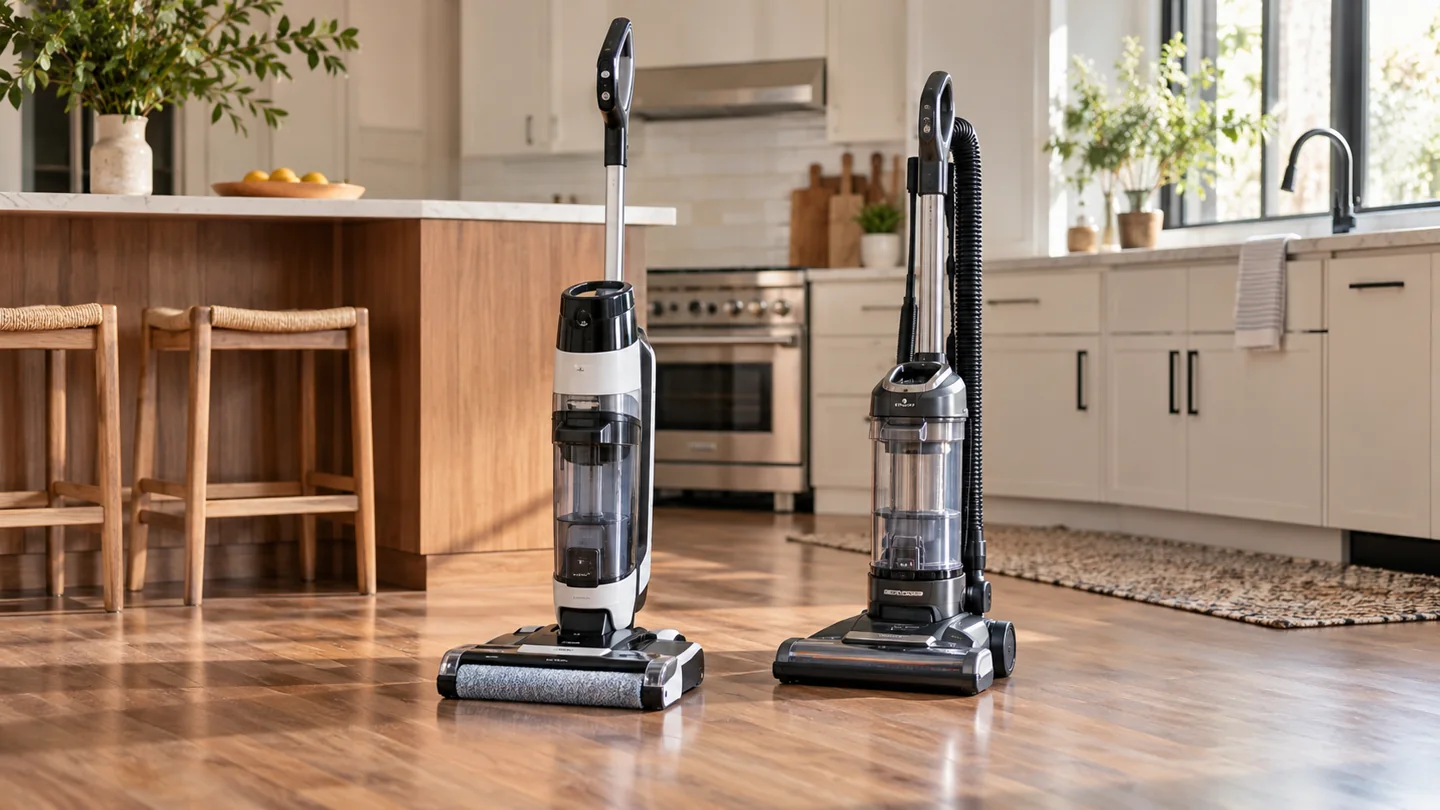
A vacuum-mop combo can be worthwhile when it handles a repeated compatible-floor task more conveniently than your current routine. It is less compelling if your floors prohibit its cleaning action, most of your work is carpet or upholstery, or the required tank, pad, and roller aftercare outweighs the time saved.

First identify which kind of combo you mean. A manually steered wet floor cleaner, a robot with a damp pad, and a robot with a washing station perform different jobs. Do not apply one category’s carpet handling, liquid pickup, controls, or self-cleaning features to all of them.
Three common formats
| Format | Typical role | Questions to ask |
|---|---|---|
| Manual wet floor cleaner | Powered washing and recovery of suitable debris and dirty water on approved floors | Surface compatibility, maneuvering, edge reach, tanks, and aftercare |
| Robot vacuum with mop attachment | Automated loose-debris collection and supported pad cleaning | Water control, carpet protection, route, pad handling, and actual stain result |
| Robot with multifunction station | Automated cleaning with selected dock emptying, washing, or drying functions | Station maintenance, tanks, bags, access, consumables, and noise |
Features vary within each format. A wet cleaner does not automatically work as a dry handheld, and a robot mop is not automatically a liquid-spill extractor.
When a combo can remove useful work
Consider the mess you clean repeatedly. A compatible hard-floor room with ordinary crumbs and washable residue may suit a machine designed to collect and wash in the same routine. A robot can help maintain an accessible route where that form of mopping is permitted.
The benefit is practical rather than automatic. Include preparation, filling, cleaning passes, emptying, washing parts, drying, and storage. A shorter floor-cleaning stage can still come with aftercare that matters for a small job.
Try to identify the specific chore the machine replaces. “Two functions” is less useful than knowing whether it saves you a regular kitchen cleanup or simply duplicates tools you already find easy to use.
Floor compatibility comes before convenience
Check the exact installed flooring product and the machine’s manual. “Sealed hard floor” is not a universal approval for every powered brush, solution, moisture exposure, or steam function.
BISSELL’s hard-floor recommendation guide advises checking the flooring manufacturer. A floor’s own restrictions can change the answer even when a machine is marketed for that broad material category.
For specific combinations, read CrossWave use on vinyl plank and robot use on laminate. Do not override a restriction because an inconspicuous test looks fine.
Carpet and rugs need a separate plan
Some manual machines have a supported area-rug mode; others are for hard floors only. That does not automatically make them substitutes for a carpet vacuum or extraction cleaner. Check what the manufacturer actually claims.
For robot hybrids, establish whether pads must be removed, whether no-mop areas are supported, or whether a lifting function suits the pile. A pad that lifts a small distance may still contact a thick rug.
Do not assume every combo detects carpet and switches to dry-only cleaning. Read the exact model’s behavior and keep incompatible rugs excluded. See robot cleaning on carpet for the pickup question.
Compare cleaning performance by the task
Loose hair, crumbs, dried residue, greasy film, and a sticky spill are different challenges. A robot that maintains light everyday soil may not remove a dried patch without manual attention. A manual wet cleaner may collect a suitable mess efficiently but leave edges or tight spaces for another tool.
Inspect what remains after a normal permitted clean. Do not use hazardous powders, sharp fragments, hot material, pet accidents, or chemicals to create a demonstration. Follow the machine’s material restrictions.
Words such as powerful, smart, and self-cleaning do not establish equivalent performance across products. Look for relevant evidence and a practical return-period trial.
Aftercare is part of every wet-cleaning routine
Dirty tanks, rollers, pads, trays, filters, and accessible suction paths need the model’s specified care. Leaving dirty water or a wet pad between sessions can produce odor and make the next clean less pleasant.
A self-cleaning cycle may rinse a path or roller while still requiring manual removal, inspection, washing, and drying of designated components. Do not interpret the feature as permission to leave all dirty parts assembled indefinitely.
Tineco’s iFLOOR 3 FAQ is a model-specific example of a wet floor cleaner’s operating and care requirements. Use the relevant manual for your own machine rather than transferring another product’s detergent or drying instructions.
Count ownership costs honestly
| Cost or effort | What to include |
|---|---|
| Purchase | Exact model, station, included tools, condition, and seller terms |
| Consumables | Approved solution, pads, rollers, filters, dock bags, and other model-specific items |
| Battery and repair | Availability and cost of compatible serviceable parts |
| Storage | Dock footprint, tank access, drying area, and safe charging |
| Time | Preparation, active cleaning, rescue, aftercare, and remaining manual work |
| Other equipment | Tools still needed for stairs, upholstery, carpet, and excluded areas |
Do not assume buying one combined machine always costs less than two separate tools. The useful comparison is the complete routine and support outlook for the exact products you are considering.
Noise and physical effort vary
A robot can remove steering effort during a successful run, but tank lifting, pad handling, and maintenance still remain. A manual wet cleaner may need pushing, turning, carrying, and frequent tank access. Test those tasks if strength or mobility is a concern.
Noise can come from the cleaner and from its dock. Auto-emptying or drying may be more noticeable than normal travel. Do not assume every combo is quieter than every traditional vacuum.
Measure the storage and service space before buying. A large station hidden in a cramped cupboard can be difficult to maintain even if the robot itself is small.
Do not assume health or environmental advantages
A particle filter does not establish disinfection, complete odor removal, or guaranteed allergy relief. A mop passing over the floor is not a validated sanitizing process unless the exact product and method support a specific claim.
Likewise, lower electrical power at one stage does not establish lower overall energy or environmental impact. Frequency, station functions, consumables, water, product life, and remaining manual work all matter. Our guide to robot electricity use explains a practical measurement approach.
A useful return-period trial
- Confirm the floor and machine instructions permit the combination.
- Choose the repeated ordinary task you want the machine to replace.
- Record preparation, cleaning, and aftercare time.
- Inspect edges, remaining residue, damp patches, and missed areas.
- Check handling, carrying, tank access, and storage.
- Identify the manual equipment you still need.
- Decide whether the useful work saved justifies the cost and routine.
Do not keep a machine solely because its feature list is impressive if the everyday task remains awkward.
Frequently asked questions
Can one combo replace every vacuum and mop?
Not generally. Stairs, upholstery, unsuitable rugs, narrow gaps, and particular spills can need other tools. See robot and manual vacuum roles.
Can I add my usual floor cleaner?
Only if the machine instructions permit it and the flooring guidance agrees. Do not put an unapproved homemade mixture into a tank.
Is self-cleaning enough?
Follow the full aftercare procedure. A cycle may reduce part of the work without replacing manual emptying, washing, inspection, and drying.
Worth it when the routine fits
A combo earns its place by cleaning compatible surfaces effectively and leaving a manageable aftercare routine. Choose it for a specific repeated job, account for the work that remains, and assess the complete ownership cost.
Further reading

Abi Khan is the founder and a content writer at GlobVacs. His published work covers vacuum-cleaner buying guides, product comparisons and practical maintenance advice. Read his author profile and selected articles.