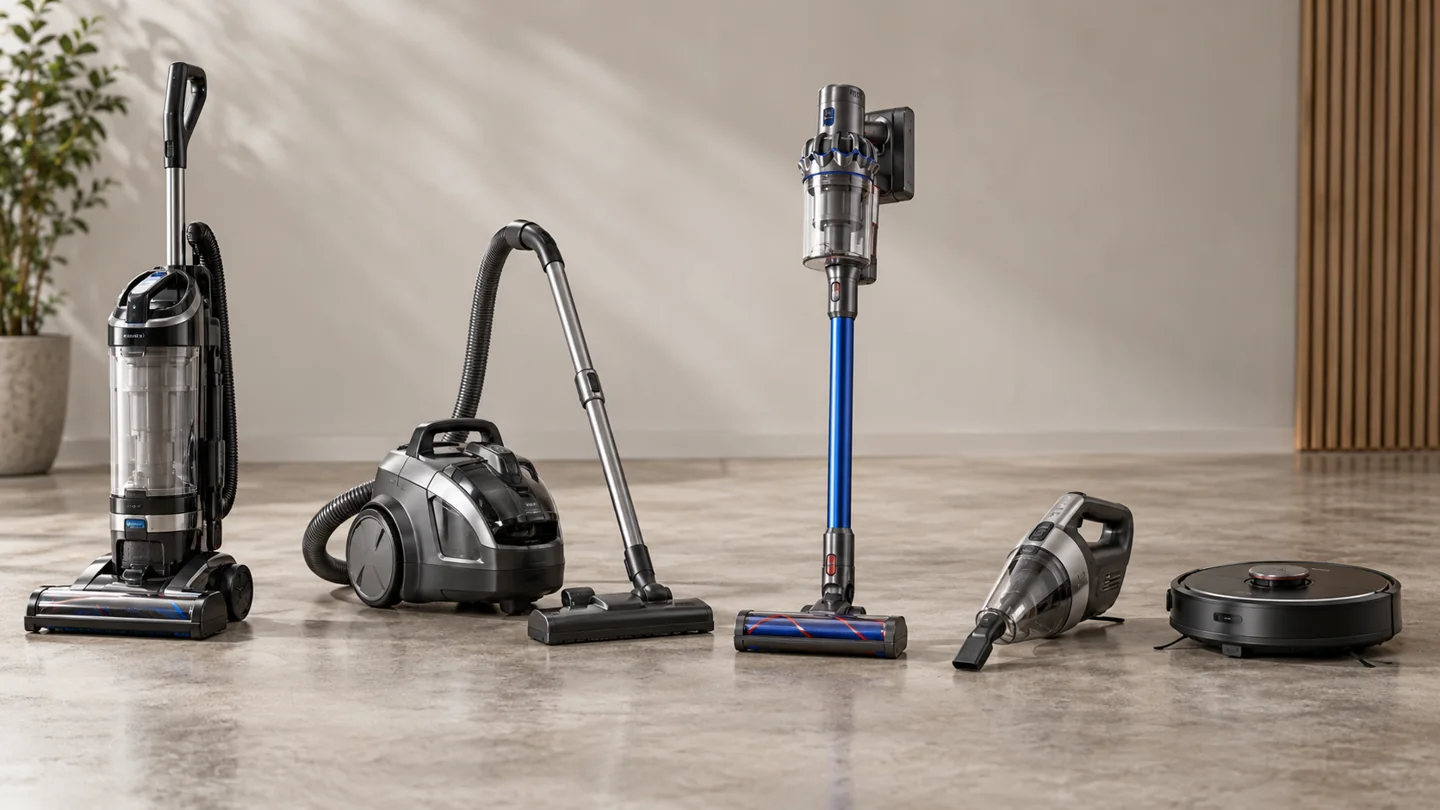
The main types of vacuum cleaners include uprights, canisters, sticks, handhelds, robots, central systems, and wet/dry machines. Choose by the work you need to complete, the surfaces involved, handling, storage, and maintenance. The format alone does not establish suction, filtration, noise, or cleaning quality.

Several labels describe different things. “Upright” describes a physical layout, “bagless” describes collection, and “cordless” describes power. A machine can belong to all three categories at once.
Compare the main formats
| Type | Useful role | Potential advantages | Questions or limitations |
|---|---|---|---|
| Upright | Routine floor cleaning, often with a powered head | Integrated floor-cleaning arrangement; some provide hoses or lift-away sections | Weight, stairs, under-furniture access, and brush compatibility vary |
| Canister | Floors plus hose-and-tool tasks | Can separate body weight from the wand | Body movement, hose storage, and powered-head availability matter |
| Stick | Convenient floor cleaning and quick access | Compact layout; some convert to handheld use | Hand weight, capacity, runtime, and support during storage vary |
| Handheld | Small spills, upholstery, stairs, and cars | Easy access to localized tasks | Tool reach and collection capacity may limit larger jobs |
| Robot | Repeated cleaning of accessible floors | Can reduce active floor-cleaning time | Preparation, route access, maintenance, and manual tasks remain |
| Central system | Whole-home cleaning through installed inlets | Collection unit is separate from the handheld cleaning tools | Installation, hose handling, service access, and system condition matter |
| Wet/dry | Approved utility pickup tasks | May collect specified dry material or liquids in the right configuration | Filter setup and prohibited materials must be checked |
Uprights: evaluate the head and the handling
An upright places much of the machine in an assembly moved over the floor. Many have a powered brush, but tool choices and brush controls differ. Some are designed mainly for carpet, while others provide a compatible hard-floor mode or separate tools.
Test how the machine turns, reclines, reaches under furniture, and moves between rooms. For stairs, check whether a hose or detachable section genuinely reaches the work without placing the machine precariously.
A machine being upright does not guarantee easy handling. Weight distribution, head resistance, grip, cord management, and storage can matter more than the headline weight.
Canisters: separate body and cleaning tool
A canister connects the main collection unit to a hose, wand, and head. That can suit mixed tasks, including floors and above-floor work. Check whether the floorhead is suction-only, air-driven, or electrically powered and whether it suits the flooring.
Consider where the body will sit on stairs, how it follows around furniture, and whether the hose and wand store neatly. Canisters are not universally quieter, cheaper, or easier than uprights; compare the actual models.
Sticks and handhelds: convenience with specific limits
Sticks may be cordless or corded. Cordless models offer freedom from a trailing mains cord but require charging and a runtime assessment relevant to the chosen setting and head. Some top-mounted designs put appreciable weight in the hand.


Handhelds can be useful for chairs, small spills, and cars. Check tool reach, inlet size, emptying, and the permitted debris. A small machine is not automatically appropriate for fine powders or wet messes.
For vehicle equipment, see using a car vacuum at home. A 12 V vehicle plug is not interchangeable with a household mains connection.
Robots: recurring floor maintenance
Robot vacuums combine pickup with movement, sensing, and task control. Some navigate without stored room maps; others use mapping and supported boundaries. Dock features, mopping, local controls, and app requirements vary.
iRobot’s explanation of cleaning methods illustrates that navigation differs by model. Check actual coverage and job behavior rather than assuming every robot cleans in the same pattern.
A robot cannot climb conventional stairs to clean them or automatically handle every furniture and upholstery task. Our replacement checklist helps decide what manual work remains.
Central systems: assess the installation
A central system uses installed pipework and inlets connected to a collection unit. The user still handles a hose and cleaning tools, unless a particular installation provides another arrangement. Performance depends on the unit, piping, tools, seals, and maintenance.
Consider installation cost, inlet placement, hose storage, service access, and the condition of an existing system. A remote motor does not make the cleaning task silent, and installation is a separate decision from buying a portable vacuum.
Wet/dry machines and wet floor cleaners are different
A utility wet/dry vacuum may permit specified liquid recovery with the correct configuration. A carpet extractor applies and recovers cleaning solution. A hard-floor vacuum-mop has another operating and care process. These categories are not interchangeable.
RIDGID’s wet/dry product and manual resources show why configuration and model instructions matter. “Wet/dry” does not mean safe for fuel, chemical waste, hazardous dust, or every foaming liquid.
Use our vacuum-mop guide to assess routine wet floor cleaning separately.
Bagged, bagless, and filtration are another layer
Both bagged and bagless machines exist in several physical formats. Compare emptying, consumables, filter care, capacity, and availability of parts. Neither collection method automatically determines price or whole-machine particle retention.
See bagged versus bagless and HEPA filtration for those decisions. Do not treat a filter label as approval for prohibited cleanup.
Choose by a task list
- List floors, rugs, stairs, upholstery, cars, and any specialist tasks.
- Check flooring restrictions before choosing heads or brush action.
- Assess lifting, pushing, grip, and access using realistic tasks.
- Check storage, charging, consumables, and maintenance access.
- Compare useful runtime and capacity with the route you intend to clean.
- Decide whether one machine or complementary tools fit the workload better.
Our floor-type hub is the next step for surface compatibility. Choose the format that completes your tasks comfortably rather than relying on category stereotypes.
Further reading

Abi Khan is the founder and a content writer at GlobVacs. His published work covers vacuum-cleaner buying guides, product comparisons and practical maintenance advice. Read his author profile and selected articles.