
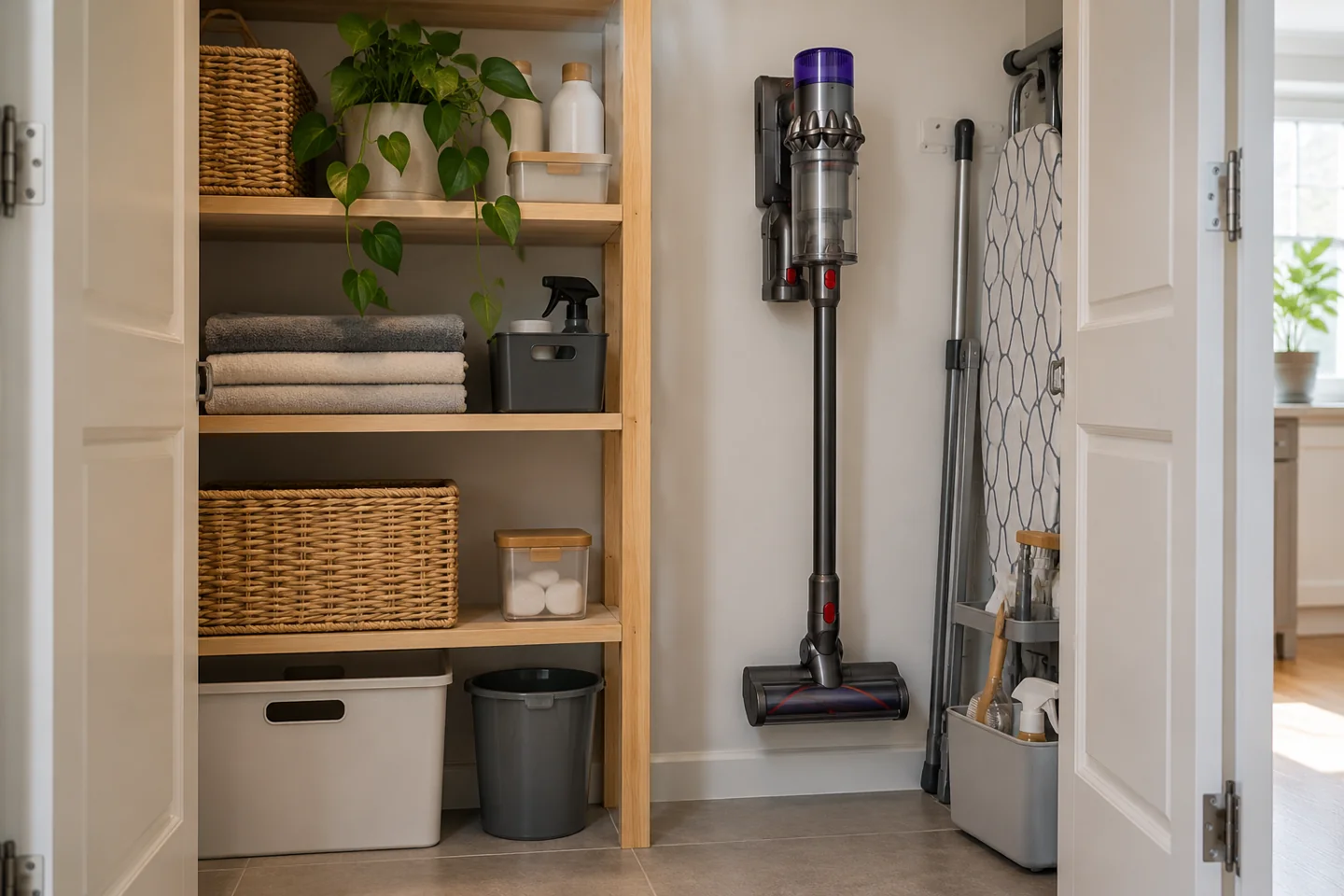
Store a vacuum cleaner in a dry, stable, accessible location that meets the model’s storage and charging instructions. Measure the complete machine, hose, tools, cable, and any dock before choosing a cupboard or wall mount. A location that makes the vacuum difficult to retrieve can turn a useful appliance into something you avoid using.

Separate ordinary storage from active charging and long-term inactivity. A corded canister in a cupboard, a cordless stick on a powered wall dock, and a robot waiting to leave its station have different requirements. There is no universal cupboard size, hook rating, or garage-storage rule for all of them.
Choose by the vacuum’s format
| Vacuum type | Possible storage approach | What to check |
|---|---|---|
| Upright | Stable floor space in a cupboard or utility area | Handle position, base footprint, cord storage, and tipping risk |
| Canister | Floor or suitably rated shelf space with gentle hose routing | Body weight, hose bends, tool parking, and lifting access |
| Cordless stick | Manufacturer-compatible dock, stand, or permitted floor arrangement | Wall support, charging conditions, electrical access, and top-heavy balance |
| Handheld | Stable shelf or approved charging base | Temperature, loose accessories, and safe retrieval |
| Robot | Correctly placed operating dock or documented long-term storage | Approach clearance, service access, stairs, and water |
| Wet-cleaning appliance | Specified tray or storage position after required cleaning and drying | Dirty water, pads, rollers, airflow, and floor protection |
1. A household cupboard or utility closet
A dry cupboard near the main cleaning area can make storage convenient. Measure door clearance as well as the interior. Include the handle, wheels, hose, tools, and any permitted parked position.
Keep the machine where it can be removed without lifting heavy boxes first. Avoid crushing the cable beneath other items or forcing a hose into a sharp bend. Store compatible tools together in a way that does not strain their clips.
Do not pack a charging appliance into a tightly enclosed space unless the instructions permit that arrangement. Charging clearance and airflow can differ from switched-off storage.
2. A manufacturer-compatible wall dock
A wall dock can save floor space for a suitable stick vacuum, but the wall and fixings need to support the intended assembly. Follow the mounting height, fixing, cable-route, and loading instructions for the exact dock.
Do not hang a vacuum from a random hook, hose, trigger, or handle unless designed for it. The appliance’s weight and leverage matter, and a generic “15-pound hook” is not a complete installation specification.
For an example of model-specific documentation, the Dyson V8 owner’s manual covers its supported setup and care. Use the matching manual for your product, and seek suitable installation help if the wall construction or hidden services are uncertain.
3. A freestanding storage arrangement
Use a stand designed and rated for the machine, or the storage position the manufacturer permits. Some sticks are top-heavy and should not be balanced against a wall. A machine standing briefly during cleaning is not necessarily designed for unattended freestanding storage.
Keep the stand away from a door swing, children’s play space, and a route where it will be knocked. Do not rely on a charging cable to hold the machine upright.
Check that fitting tools does not destabilize the stand. Store heavy accessories where they do not create an awkward high center of gravity.
4. A dry laundry or utility-room area
This can place equipment near cleaning supplies, but keep it clear of splashes, leaks, dryer heat, chemical containers, and moving laundry appliances. Do not put a charger directly below a likely drip point.
Keep hoses and cords out of walking routes and away from hot surfaces. Leave access to electrical outlets and required shutoff points. Do not store the vacuum where it blocks a door or essential equipment.
A wet-cleaning appliance needs its own aftercare routine. Empty dirty tanks and dry designated parts as instructed before storage; do not leave a dirty wet roller pressed against a sensitive floor.
5. A garage only when conditions are suitable
A garage can provide space, but temperature, dampness, dust, chemicals, and vehicle movement can make it unsuitable. Check the vacuum and battery storage limits, especially in climates where an unconditioned garage becomes very hot.
Do not assume wrapping a machine in a tarp makes the environment acceptable. A cover can trap moisture or obstruct charging airflow. Use only a storage arrangement compatible with the appliance instructions.
Keep the vacuum away from fuel, solvents, sharp tools, and places where a vehicle or stored item can crush its cable or body. An indoor appliance should not automatically be treated as garage-rated equipment.
6. Under-bed storage only for a permitted configuration
This may suit a compact disconnected machine that the manual allows to lie in that position. Measure the opening and consider whether retrieval requires uncomfortable reaching or lifting.
Do not force a bin, tank, head, or hose into an orientation the product does not support. Empty and maintain components as instructed first. Keep stored equipment away from children’s play areas and loose fabrics.
Charging underneath furniture is a separate question. Check clearance, temperature, cable routing, and the manufacturer’s rules rather than assuming a storage fit is approval to charge there.
7. A robot’s operating dock
A robot needs an accessible floor-level route and the dock clearance specified for its model. It is not simply stored wherever the round body fits. Auto-empty and water-handling stations also need service access and permitted airflow.
iRobot’s dock-placement guidance provides a product-family example. Our guide to discreet Roomba placement evaluates hidden locations without treating closed boxes or toy chests as default charging areas.
For extended inactivity, follow the exact battery and storage-mode procedure. Do not leave a scheduled robot inside a closed cupboard.
8. Central-vacuum tools and retractable systems
A central-vacuum system typically has a separate power unit and accessories; the whole appliance does not simply slide into a wall inlet. Store conventional hoses and tools using their intended supports without crushing or sharply bending them.
If the system has a purpose-designed retractable hose, follow its retraction and storage instructions. Do not push an ordinary hose into an inlet or wall cavity.
Keep accessory storage distinct from access required for servicing the power unit. Do not block ventilation or maintenance panels with household storage.
Before putting any vacuum away
- Switch off and follow its normal shutdown or docking procedure.
- Check the bin or bag level and remove accessible tangles as needed.
- Clean and dry wet components according to the model instructions.
- Inspect the cord, charger, hose, and visible damage.
- Arrange cables without crushing, sharp bends, or tension.
- Make sure the stored machine is stable and easy to retrieve.
The CPSC home electrical-safety checklist explains why crushed or damaged cords deserve attention. Stop using damaged electrical equipment rather than hiding the problem inside storage.
See vacuum maintenance for preparation and vacuum types when comparing storage needs before buying.
Hair around nearby office-chair casters is another storage-area nuisance: it can restrict the wheels even after the floor looks clean. Follow our guide to removing hair from chair wheels without pulling against the wheel mechanism.
Frequently asked questions
Can I store a cordless vacuum in a hot car?
Follow its temperature limits. A vehicle can become unsuitable for the battery and appliance. Do not assume compact size makes permanent car storage appropriate.
Should every vacuum be hung up?
No. Use a supported dock or storage method for the exact machine. Do not suspend it from an unapproved component.
Does a small cupboard always work?
Measure the complete assembly and distinguish storage from charging. Access, stability, airflow, and safe cable routing matter as well as dimensions.
Make access part of the decision
A good storage location protects the machine and makes the next clean easy to begin. Match the arrangement to the vacuum’s design and instructions rather than choosing the most hidden space available.
Further reading
How does a vacuum cleaner work?

Katy James contributes vacuum-cleaner explainers and practical cleaning guidance at GlobVacs. Her published topics include robot-vacuum operation and vacuum airflow. Read her author profile and selected articles.