
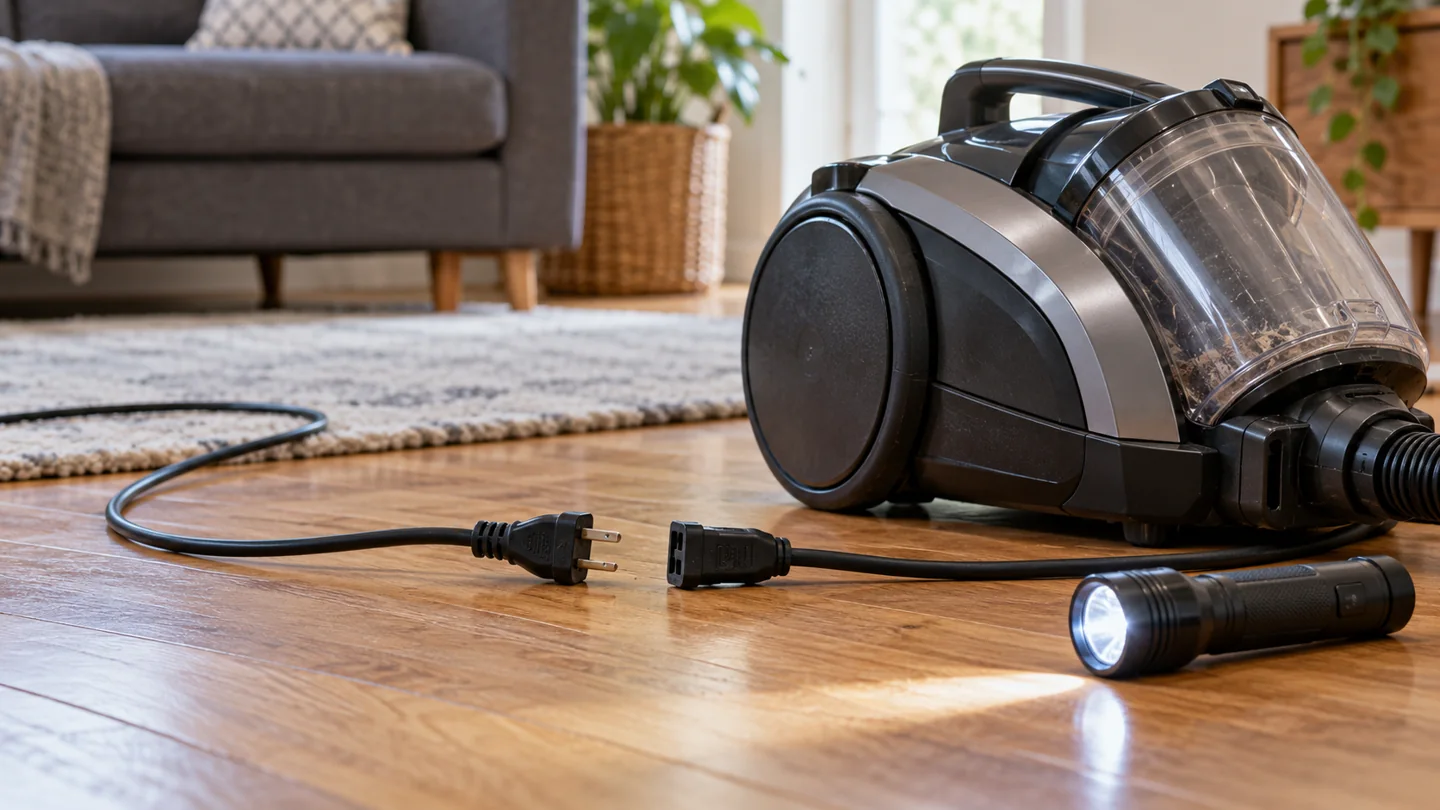
A brief static discharge is one possible reason a vacuum shocks you, but an electrical fault must not be dismissed as static. Stop using the appliance if the sensation is persistent, repeats from the same powered component, occurs with damaged wiring or moisture, or is accompanied by heat, smoke, sparking, or a burning smell. Disconnect power only if it is safe and arrange an appropriate assessment.

You cannot establish electrical safety from an online description of how a shock feels. This guide explains the difference between static buildup and fault warning signs, what you can inspect without opening electrical components, and what information to give the manufacturer or electrician.
Static discharge and electrical faults are different problems
Static charge can build as materials contact and separate, including while particles move through a hose or a cleaning head travels over carpet. A discharge may occur when charge transfers between the user and another surface. Dry conditions and the materials involved can influence the experience.
By contrast, damaged insulation, a faulty electrical component, moisture, or a problem with the supply connection can create an electrical hazard. A machine that still runs normally has not thereby passed a safety check. Do not keep touching it to see whether the sensation happens again.
Some manufacturers document static behavior for particular models. Miele’s guidance on a statically charged wand describes friction-related charge and a model-specific discharge feature on many of its handles. That feature is not an instruction to add a metal strip or grounding wire to another appliance.
When to stop and get the equipment checked
| Observation | Appropriate next step |
|---|---|
| Cut, crushed, melted, or loose supply cord or plug | Stop using the vacuum and arrange proper repair or replacement |
| Shock with a damp surface, wet appliance, or liquid pickup in a dry-only machine | Stop use and seek assessment; do not restart after simply drying the outside |
| Tingling or repeated shocks from a powered part | Treat it as a possible electrical fault rather than assuming static |
| Sparking, smoke, burning odor, or unusual heat | Stop immediately; respond to any active fire or emergency |
| Damaged or overheating outlet | Do not use it; contact a qualified electrician |
| A brief discharge associated with carpet or the wand, with no obvious damage | Check the model’s static guidance; seek support if uncertain or the issue persists |
The U.S. Consumer Product Safety Commission’s wiring hazard guide explains why damaged cords and plugs require attention. Do not cover a damaged mains cable with tape and treat it as repaired. Do not remove a grounding pin, alter a polarized plug, or bypass an electrical protection device.
What you can check safely
Once the appliance is switched off and safely disconnected, look at its accessible external parts. Check the cord along its length for crushing, cuts, exposed conductors, or damage near entry points. Look at the plug and charger for visible damage. Do not flex damaged areas while the machine is energized.
Record whether the issue occurred while vacuuming carpet, holding the hose, touching the body, connecting the charger, or using a particular outlet. Note whether the machine had been exposed to water or had recently been repaired. These observations can help a professional decide what needs testing.
Do not open the motor, charger, battery pack, electrical handle, or outlet to investigate. If the power connection itself is unsafe to approach, do not reach for it through smoke or water. Seek appropriate emergency or electrical assistance.
Why a full bag is not a complete explanation
A full collection bag, blocked filter, or tangled brush needs maintenance, but it does not automatically explain an electrical shock. Replacing a bag is not an electrical safety test. The same applies to clearing a hose: improved pickup does not establish that damaged wiring has become safe.
Earlier advice sometimes attributes shocks to electricity “stored in old dust bags” or suggests that routine filter cleaning resolves every cause. That is misleading. Keep ordinary cleaning maintenance separate from diagnosing a possible electrical fault.
Maintain the vacuum for its intended performance using the vacuum-cleaning guide and its model manual. Where a shock remains unexplained, get support before returning it to service.
Managing documented static without improvising
If the manufacturer identifies the behavior as static for your exact model and there is no unresolved fault, follow its documented instructions. These may refer to a built-in handle feature, permitted operating conditions, or a specific compatible accessory. Instructions for one product family should not be generalized to every vacuum.
Do not spray water, fabric softener, furniture polish, or an antistatic mixture into the hose, motor, filters, or electrical connections. A product that can be applied to a particular exterior surface is not automatically suitable for internal components or every floor finish.
Do not attach an improvised grounding chain, wire, foil, or metal contact. The vacuum’s electrical safety design includes its insulation, wiring, enclosure, and approved connections. Home modifications can undermine those protections.
Also check whether the material being collected is permitted. Fine renovation dust, flour, hazardous particles, or other unusual material may be inappropriate for a household machine even if a manufacturer uses those materials to explain static physics. An explanation of charge buildup is not approval to vacuum that material.
Consider the complete cleaning setup
Record extension cords, adaptors, powered attachments, and replacement chargers used at the time. Use only a setup permitted by the appliance instructions and rated for the task. A connector fitting physically does not prove electrical compatibility.
If a cordless vacuum produces a sensation while attached to its charger, stop using that charging setup and contact support. Do not assume battery power eliminates all electrical or charging hazards. A damaged battery also needs its own handling instructions.
For a machine that has begun smoking or emitting an unusual odor, use the more specific guidance in why a vacuum may smoke and burning-smell troubleshooting. Do not keep testing it during normal cleaning.
Information to give support
- The exact vacuum model and serial number, plus any powered attachment or charger model.
- The component you touched and whether the appliance was running, charging, or switched off.
- The floor type and whether the area, appliance, or your hands were damp.
- Any visible cord damage, odor, heat, sparking, or protective-device trip.
- Any recent repairs, replacement parts, liquid pickup, or unusual debris.
Ask whether the reported behavior matches the model’s documented static behavior or whether electrical testing is needed. An appliance repairer can assess the vacuum; an electrician may need to assess the outlet or fixed wiring. Do not substitute a carpet-cleaning service for an electrical safety assessment.
Frequently asked questions
Does a tiny shock always mean static?
No. The apparent size of the sensation is not a reliable diagnostic test. Consider the circumstances and stop using equipment with fault warning signs or an unexplained repeated sensation.
Should I try another outlet?
Do not use another outlet to test an appliance with a suspected electrical fault, damaged cable, smoke, or other warning signs. Ask support or an appropriate professional how it should be assessed.
Will cleaning the filter fix it?
Filter maintenance can improve airflow where a filter is loaded, but it does not repair damaged electrical insulation or confirm safety. Only wash filters that the manual identifies as washable.
What if someone is injured?
Seek medical advice after a suspected electrical injury, and use emergency services for serious symptoms or immediate danger. Do not touch someone who is still in contact with an energized source; keep yourself away from the hazard and call for help.
Keep the distinction clear
Static is a documented phenomenon in some vacuuming situations. An electrical fault is a different possibility that needs appropriate assessment. Use manufacturer guidance for the exact model and do not let routine cleaning or improvised modifications stand in for checking an unexplained shock.
Further reading
Can a vacuum pull your eye out?

Katy James contributes vacuum-cleaner explainers and practical cleaning guidance at GlobVacs. Her published topics include robot-vacuum operation and vacuum airflow. Read her author profile and selected articles.