
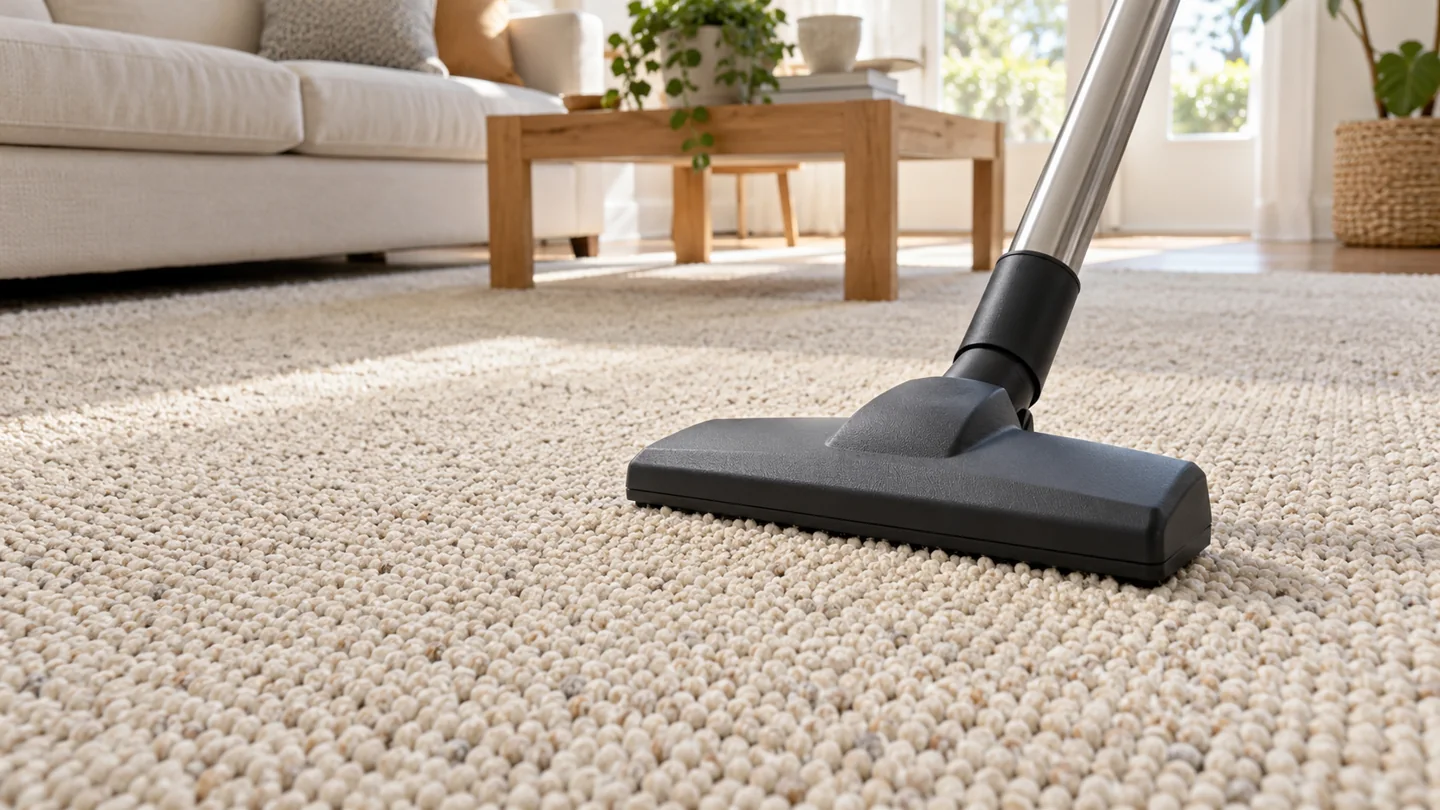
Regular compatible vacuuming helps Berber-style carpet stay free of loose soil and hair and supports its appearance between deeper cleaning tasks. The benefit depends on using a head and brush action suitable for the actual fiber and construction. Do not assume every carpet described as Berber is identical or that aggressive brushing is necessary.

Vacuuming does not guarantee a dust-mite-free, allergen-free, or stain-proof carpet. It is a routine soil-removal method, not a disinfection or restoration process. This guide focuses on the useful maintenance benefits and how to obtain them without pulling loops or spreading a wet spill.
Identify what “Berber” means for your carpet
The term is used in different ways, often associated with looped construction or a flecked appearance. Find the actual product’s fiber, pile, and care document rather than choosing a vacuum solely from the style name.
Wool, synthetic fibers, tight loops, larger loops, and mixed constructions can have different sensitivities. A brush appropriate for one carpet may fuzz or pull another. Product-specific instructions take priority over a general Berber cleaning tip.
Shaw’s carpet-vacuuming guidance notes that some thick loop-pile, wool, and wool-blend constructions can be sensitive to brushing. Check the exact carpet rather than treating that as a rule for every looped product.
What regular vacuuming can reasonably do
| Benefit | How it helps | Limit |
|---|---|---|
| Remove loose soil | Collects ordinary dry material before further traffic works it into the carpet | Does not remove every embedded particle |
| Reduce visible hair and crumbs | Keeps busy areas more presentable between other cleaning | Some woven-in hair may need another approved method |
| Support appearance | Prevents avoidable accumulation from becoming the normal condition | Does not reverse wear, fading, damage, or a permanent stain |
| Make maintenance more manageable | Smaller regular tasks can prevent a larger loose-debris cleanup | Does not replace required periodic professional care |
1. Remove abrasive debris before traffic spreads it
Entrance grit and ordinary soil can move through the home on shoes and paws. Targeting busy routes helps collect material while it is accessible rather than waiting until the whole carpet looks dirty.
This is a maintenance benefit, not a promise of a specific increase in lifespan. Fiber, installation, traffic, sunlight, spills, and furniture also affect the carpet. No number of extra service years is established here.
The Carpet and Rug Institute’s explanation of vacuuming discusses soil removal as part of protecting carpet fibers. Combine that principle with the tool restrictions for your own carpet.
2. Keep hair and crumbs from becoming a larger task
Check the places where debris returns first: a dining route, sofa area, pet bed, or entrance. A targeted pass may be more useful than giving every quiet corner the same attention.
Hair can wrap around a roller rather than reaching the bin. Inspect the head with power isolated and remove tangles by the manual’s method. A machine that travels across the carpet is not necessarily collecting effectively.
Do not use an aggressive scraping tool or force a rotating brush across a sensitive looped surface to chase the last strand. Use another approved method if the normal head is unsuitable.
3. Maintain appearance without promising restoration
Regular soil removal can keep the carpet looking more cared for, but dullness has more than one cause. Residue, pile distortion, wear, staining, or lighting can affect appearance. Repeated vacuuming will not repair missing or pulled yarn.
If a patch looks different immediately after a spill treatment, check the cleaning product and drying rather than assuming it needs a stronger brush. A crunchy or tacky feel may need a residue investigation.
Read crunchy-carpet troubleshooting and soap-residue removal for those separate problems.
Choose the right head and settings
Look for the carpet maker’s requirements for suction, brush operation, and height adjustment. Some products need suction-only cleaning or a brush lifted clear of the pile. Do not assume maximum agitation is necessary for good care.
Check how your vacuum actually behaves. A hard-floor mode may not stop the roller. A height dial may adjust the nozzle differently from an electronic suction control. Read the exact manual and use a compatible head.
Our Berber-carpet vacuum buying guide organizes those equipment questions. Product selection should begin with the carpet’s requirements rather than one large motor specification.
A practical vacuuming sequence
- Check the care instructions and inspect for loose loops or damaged edges.
- Pick up larger objects, cords, and unsuitable material.
- Inspect the vacuum’s head, collection level, and required components.
- Select the permitted tool and settings.
- Use deliberate passes without pressing or forcing the head.
- Stop if fibers catch, the head drags, or the brush stalls.
- Inspect the result and maintain the tool afterward.
Keep fringe and loose yarn away from the intake. Do not pull a snag to remove it or trim material without appropriate carpet-care advice. A damaged loop needs a repair decision, not more suction.
Set frequency by traffic and carpet requirements
Follow the manufacturer’s schedule and check busy areas more often. Pets, visitors, outdoor work, and wet weather can change how quickly ordinary soil accumulates. A quiet room may not need the same touch-up frequency as the main hallway.
Use the frequency-planning guide for the broader routine. If debris remains immediately after cleaning, fix the pickup or access issue before simply adding more sessions.
Dust, allergies, and pests: keep expectations realistic
A suitable filtered vacuum can collect some settled particles. It does not make the carpet allergen-free or guarantee relief for a person with asthma. Filtration, housing seals, dust disturbance, emptying, and other environmental controls matter.
Do not claim that routine vacuuming reliably destroys every dust-mite egg or breaks every pest lifecycle. A specific infestation needs identification and appropriate guidance. Avoid turning ordinary carpet maintenance into a medical or pest-control guarantee.
For general filtration terminology, read HEPA filtration in vacuums. Follow professional health advice for the individual rather than relying on a cleaning-product claim.
Spills and moisture need a separate process
Do not use a household dry vacuum to remove a liquid spill. Blot appropriately, identify the substance, and follow the carpet’s approved spot-cleaning method. Avoid scrubbing, over-wetting, or mixing products.
Vacuuming can resume when the carpet and cleaning process permit it, using ordinary dry equipment only after appropriate drying. Persistent dampness, mustiness, or significant water exposure needs assessment.
See carpet cleaning techniques for stain handling, deeper cleaning, and drying decisions.
Can a robot maintain Berber carpet?
Only where the carpet and robot instructions agree and the machine moves and cleans effectively without catching loops. Check the exact brush behavior, pile limits, fringe, and any mopping setup.
A successful edge crossing is not enough. Inspect the route and pickup under supervision, and keep a suitable manual tool for excluded areas. Our robot-on-carpet guide explains the evaluation.
Natural-fiber rugs can shed in ways that differ from a fitted synthetic carpet. Our jute-rug shedding guide explains what to inspect when loose fibers increase during vacuuming.
Frequently asked questions
Is every Berber carpet wool?
No. Identify the actual fiber and construction from the product information. The style name alone is not enough to choose a cleaning method.
Will vacuuming remove stains?
It removes suitable loose debris, but a stain may need a separate approved process. Do not collect liquid with a dry-only vacuum.
Should I use a rotating brush?
Use only the action the carpet maker permits. Some looped or wool constructions need gentler or suction-only care.
Protect the loops while removing ordinary soil
The useful benefit comes from regular compatible cleaning, not aggressive brushing or broad health promises. Identify the carpet, choose the right tool, and keep spills, residue, and damage on their own appropriate care paths.

Katy James contributes vacuum-cleaner explainers and practical cleaning guidance at GlobVacs. Her published topics include robot-vacuum operation and vacuum airflow. Read her author profile and selected articles.