
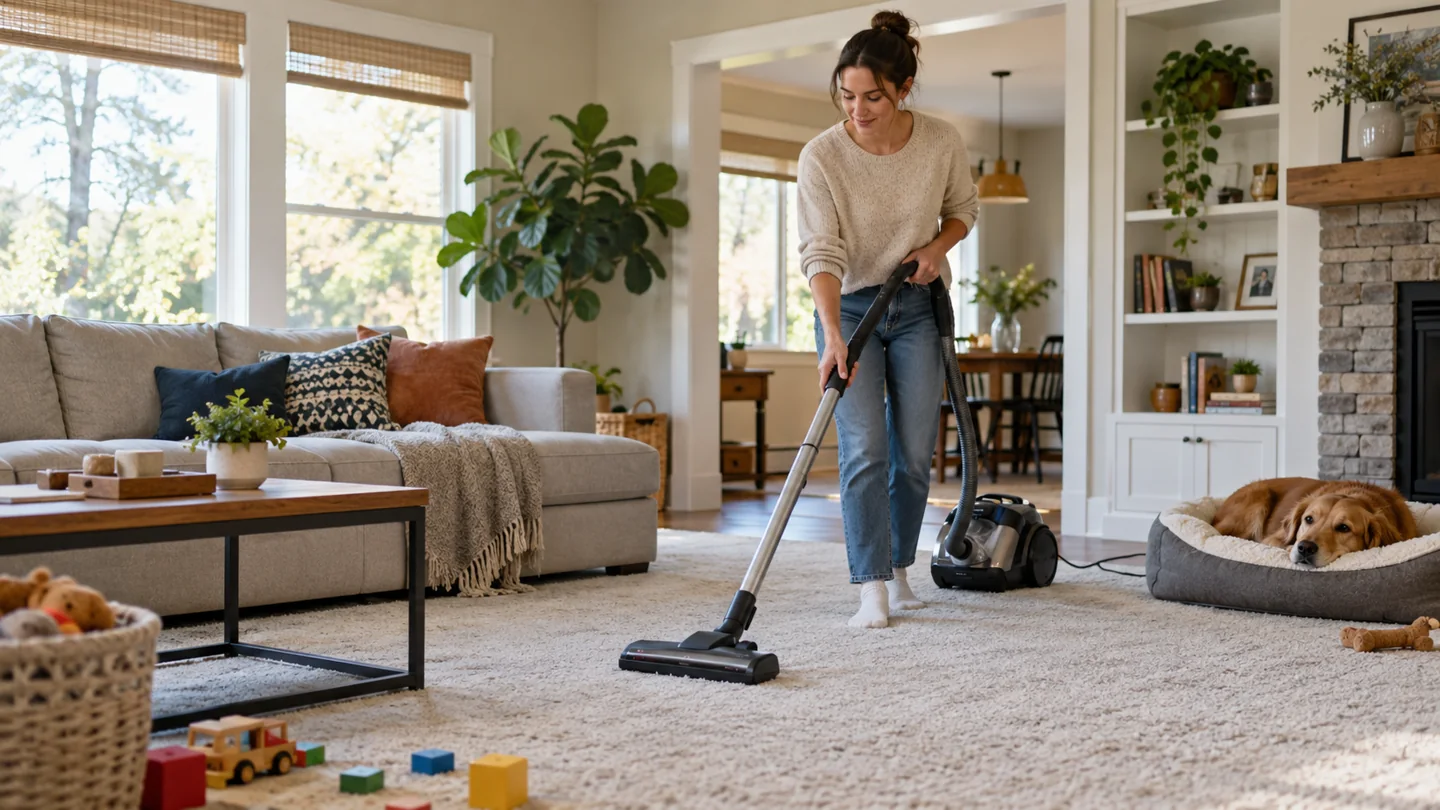
Vacuum according to how quickly each area collects dirt, hair, and grit, using your flooring manufacturer’s care instructions as the baseline. A regular weekly whole-home route can be a starting point for many households, with more frequent attention to busy entrances, food areas, and pet zones. Quiet rooms may need less work than the main walkway.
There is no single interval that keeps every home clean, prevents every allergy symptom, or replaces all deeper cleaning. A useful schedule separates quick targeted pickup from a more thorough room rotation and adjusts to what you actually observe between sessions.
A practical starting schedule
| Area | Starting approach to adapt | Reason to adjust |
|---|---|---|
| Entrance and main walkway | Check frequently and remove visible grit promptly | Weather, outdoor work, footwear, and pet traffic |
| Normally used carpeted rooms | A regular planned route, often weekly as a starting point | Carpet instructions, visible debris, use, and household needs |
| Pet sleeping and favorite areas | Target loose hair as it accumulates | Shedding, bedding care, and what the tool can reach |
| Quiet spare rooms | Include in a less frequent rotation and inspect before use | Dust, visitors, open windows, and actual use |
| Stairs and upholstery | A planned manual-tool rotation | Traffic, fabric instructions, and visible debris |
| After a suitable ordinary dry spill | Prompt targeted pickup | Use another method for liquid, sticky residue, or prohibited material |
These are planning examples rather than universal minimums. If your carpet warranty or care sheet specifies a routine, incorporate it. Do not let a calendar override a visible mess or a surface restriction.
Carpet: prioritize traffic lanes
Dirt can be worked into carpet by repeated foot traffic. Entrances, hallways, and the route around furniture may need attention before the quieter middle of a room. Choose a compatible head and use deliberate passes rather than rushing across the whole area.
The Carpet and Rug Institute’s care guide emphasizes regular maintenance and attention to busy areas. It does not mean every carpet should receive the same brush setting or one fixed number of passes.
If the nozzle drags, the rug lifts, or fibers catch, check the permitted settings and tool. More frequent use of an unsuitable brush is not better care. See carpet cleaning techniques for the broader routine.
Hard floors: respond to grit and residue differently
Loose grit, crumbs, and hair may call for frequent small cleanups. Use the floor-approved head and inspect wheels and the underside for trapped particles. Some wood, laminate, and vinyl care documents restrict powered brushes.
Sticky residue, grease, or a liquid spill usually needs a separate approved method. Vacuuming more often does not necessarily remove a product film or dried spill. Identify the material and floor before choosing a cleaner.
Our floor-by-floor vacuuming guide helps choose a compatible approach. For small suitable dry messes, compare vacuuming, sweeping, and dust mopping.
Pets: clean the environment, not the animal with a household nozzle
Pet hair often collects along furniture, bedding, and regular resting routes. Add those places to the schedule rather than vacuuming every empty room more often. Launder washable bedding and groom the animal using appropriate pet-care methods.
Do not use a household vacuum nozzle on a pet’s skin, face, or coat. Keep the animal comfortable and safely away from moving brushes. A pet’s fear of the machine also needs a practical room sequence or professional behavior advice.
For relevant household planning, see dogs and vacuum fear and cats and vacuum fear. Unusual shedding or skin changes need veterinary attention rather than a more aggressive vacuum routine.
Allergies and asthma: avoid medical promises
Vacuuming can help remove some settled material, but it can also disturb dust. Filtration, housing seals, technique, emptying, and the broader home environment matter. A daily schedule does not guarantee symptom control.
The EPA’s asthma-trigger guidance includes using a HEPA-filtered vacuum for relevant surfaces and advises people with asthma or allergies to leave the area during vacuuming. Follow the person’s healthcare plan rather than replacing it with a cleaning interval.
If a specific trigger is a concern, seek advice appropriate to that person and situation. Do not claim vacuuming disinfects the room or eliminates all allergens.
Mattresses, upholstery, and curtains need their own care labels
Do not prescribe one mattress-vacuuming interval for every material. Follow the mattress maker’s instructions for the cover, foam, components, and any electrical features. Use a permitted attachment and avoid adding powder or fragrance without approval.
For sofas and curtains, check fabric care and attachment compatibility. A gentle tool and appropriate suction can matter more than frequency. Stop if the fabric is pulled into the nozzle or trim catches.
Include those tasks in a rotation you can manage. Ordinary vacuuming does not replace laundering removable covers or professional cleaning where the label requires it.
A floor robot does not clean ordinary stair treads as part of its route. Use suitable manual equipment and keep the body and cable from obstructing the steps. Do not balance a heavy vacuum where it can fall.
Under furniture, use a compatible low-reach tool or move items safely. A robot exclusion zone prevents entrapment but leaves a space to clean another way. Add that area to the rotation rather than assuming the map means it was covered.
Do not move heavy or unstable furniture alone just to meet a schedule. Accessibility and safe handling are part of a sustainable cleaning plan.
A two-week method for finding your frequency
- List the rooms and surfaces. Note flooring care requirements and tools.
- Identify fast-returning debris. Mark entrance, food, and pet areas.
- Choose a manageable baseline. Combine a regular room route with targeted touch-ups.
- Inspect before the next session. Record where debris has already accumulated.
- Adjust one area. Increase or reduce frequency based on the observed result.
- Keep separate tasks visible. Include upholstery, stairs, spills, and periodic approved deeper cleaning.
This avoids treating the whole home as one uniform cleaning zone. It can also reveal a pickup problem: if debris remains immediately after vacuuming, maintenance or tool choice may need attention before frequency changes.
Keep the vacuum ready for the schedule
Empty the collection system at its limit, inspect roller tangles, maintain filters by their individual instructions, and check accessible blockages. A full or poorly assembled machine can repeat ineffective passes.
Use the vacuum-maintenance guide. For robot-specific planning, see how often to run a robot; its charging, route, and dock considerations are additional factors.
Frequently asked questions
Is daily vacuuming necessary?
Some busy areas may benefit from daily suitable pickup, but every room does not automatically need it. Base the routine on debris, traffic, surface instructions, and household needs.
Can I vacuum immediately after carpet cleaning?
Follow the cleaning provider’s instructions and wait until the carpet is appropriately dry before using an ordinary dry vacuum. See post-cleaning vacuum timing.
Will frequent vacuuming remove a stain?
Not necessarily. Loose debris collection and stain treatment are different tasks. For a specific spill, use the carpet-approved process; our turmeric stain guide addresses one difficult example.
Use a responsive routine
Clean busy areas before debris spreads, rotate quieter spaces sensibly, and use compatible equipment. A schedule should help you notice and remove ordinary buildup without turning every room into an identical daily chore.

Katy James contributes vacuum-cleaner explainers and practical cleaning guidance at GlobVacs. Her published topics include robot-vacuum operation and vacuum airflow. Read her author profile and selected articles.