
Vacuuming can kill a spider through physical injury during collection, but it does not guarantee death in every case. A household vacuum is also not a safe live-capture device. If your aim is humane removal, do not assume that using low suction or a crevice tool prevents injury.
The practical question is what you need to achieve: remove an identified harmless spider, deal with a possible hazardous species, clear webs, or investigate repeated sightings. Those situations call for different handling rather than a single claim about the power of suction.
What may happen during collection
A spider can strike the tool, travel through bends in the hose, collide with debris, and enter a collection system. The route differs between machines. A motor rating or advertised pressure figure does not tell you what happened to a particular animal.
UC IPM’s guidance on widow spiders and their relatives includes vacuuming among control methods and notes that soft-bodied spiders often do not survive it. That is more useful than an unsupported assertion that all spiders are either indestructible or killed instantly.
There is no reason to conduct a home test to find out whether the spider survived. Treat collection and disposal as controlled cleaning, avoid direct contact, and do not reach inside the hose or debris.
Why stronger suction is not a survival calculator
Different species, sizes, attachments, hoses, collection systems, and existing debris create different conditions. Comparing two suction numbers cannot establish a survival percentage. A larger machine is not automatically a more appropriate pest-management tool.
Airflow also matters to pickup, while advertised pressure may be measured under a restriction. Neither measurement directly describes an animal’s injury. Our suction-measurement guide explains what these equipment figures actually mean.
Do not run the vacuum for an extra arbitrary period in the hope that it will sterilize the bin. The machine does not provide a validated pest-killing treatment cycle.
A vacuum cleaner is not a vacuum chamber
The word “vacuum” can be misleading. Household cleaners move air through a collection and filtration system; they do not expose the contents to outer space or remove all oxygen. Dust bags are not normally airtight laboratory chambers.
Filters retain particles while air continues through the machine. After shutdown there is no powered airflow barrier. If you are concerned about a surviving spider returning, see whether spiders can crawl out of a vacuum for containment advice.
If you want the spider to survive
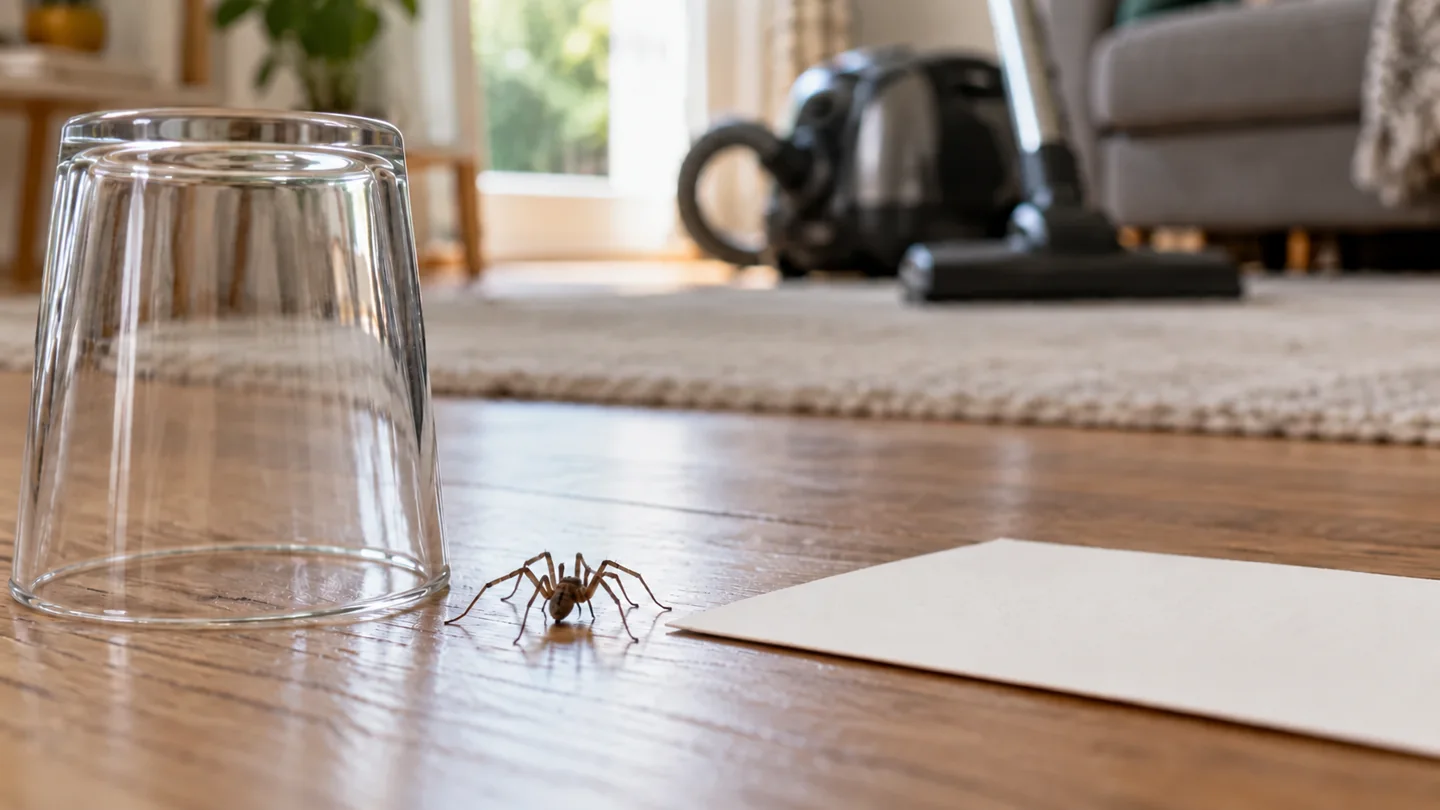
Choose a suitable capture-and-removal method instead of vacuuming. For a known harmless spider, a purpose-made noncontact catcher or a suitable container method may be an option if you can use it safely. Keep your hands away and avoid climbing unsafely to reach it.
Do not handle an unknown spider or assume it is harmless from size or color alone. If identification is uncertain, the spider is in an awkward location, or someone is particularly vulnerable, ask an appropriate local expert. Release advice can depend on species and location.
A less powerful vacuum is not a dependable compromise between removal and humane handling. It may still injure the spider, fail to collect it, or leave you uncertain about where it went.
If vacuuming is the chosen removal method
- Check that the location and material are suitable for ordinary vacuuming. Avoid electrical equipment, unsafe overhead reaches, and chemical residues.
- Use a compatible attachment without placing hands near the spider.
- Keep children and pets away from the task.
- After collection, isolate power before opening accessible components.
- Remove the bag or empty the bin according to the manual, containing the collected material rather than scattering it.
- Check normal assembly and maintenance before using the vacuum elsewhere.
If there is a potentially dangerous spider in the machine, do not improvise handling. Seek advice on containment. Do not spray pesticide into the vacuum or pour in water to kill it.
Webs and egg sacs require careful expectations
Removing visible webs can improve housekeeping and help reveal new activity. It does not prove all spiders have gone. An egg sac or a concealed spider may remain somewhere that the tool did not reach.
Do not assume that vacuuming eggs reliably destroys them. Contain collected material and follow local pest guidance for the species involved. A filter-efficiency claim is not evidence that an entire pest population has been eliminated.
For other insects, the bug-collection guide explains why different pests need different follow-up. An ant trail, a bed-bug problem, and a single spider are not interchangeable cleaning jobs.
When repeated spiders deserve a broader inspection
Check screens, gaps around doors, cluttered storage, and areas where insects gather. Reducing suitable hiding places and access can be more effective than repeatedly treating individual sightings. Avoid storing items so densely that you cannot inspect or clean around them.
Document locations and frequency rather than judging the problem from one alarming encounter. Local extension services or pest professionals can help identify the species and decide whether treatment is needed. Routine use of chemicals is not automatically necessary for every spider sighting.
Cleaning after a pest treatment is a separate decision
If pesticide has been applied, do not vacuum simply because the spider appears dead. Ask where residues or bait need to remain, when cleaning is allowed, and what equipment is appropriate. Follow the actual label and service instructions.
Our after-pest-control guide replaces blanket waiting periods with product- and area-specific questions. Normal vacuum maintenance cannot establish that a chemically contaminated machine is safe.
Common questions
Does a crevice tool protect the spider?
No reliable guarantee supports that claim. It changes access and airflow, but collection can still cause injury.
Should I add powder to kill a spider in the bin?
No. Do not introduce powders or chemicals to a vacuum as an improvised pest treatment. Use controlled disposal and appropriate pest guidance.
Is vacuuming the only reasonable removal option?
No. Identification, safe noncontact removal, exclusion, and professional help are all relevant options, depending on the situation and your goals.
Further reading

Abi Khan is the founder and a content writer at GlobVacs. His published work covers vacuum-cleaner buying guides, product comparisons and practical maintenance advice. Read his author profile and selected articles.