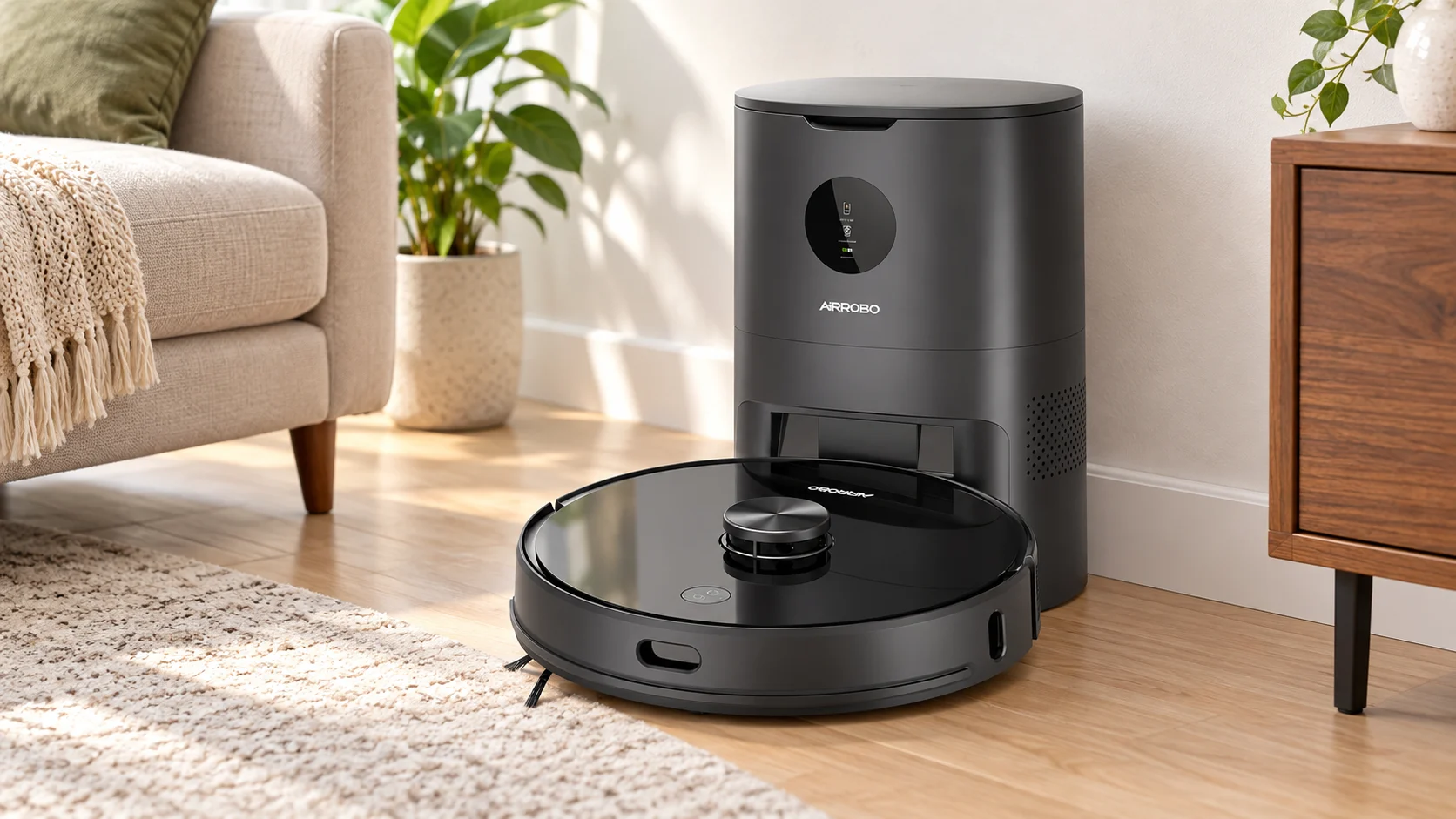
The AIRROBO T10+ pairs a LiDAR-guided robot with an automatic dirt-disposal base. It also offers a water-tank and mop-cloth system for maintenance wiping on appropriate hard floors. Its appeal is the combination of planned routes and less frequent manual bin emptying, but the base does not turn it into a robot that washes its own mop or handles every floor hazard.
Review basis: This assessment uses manufacturer information and model-specific buying analysis. Advertised suction and runtime figures are not independent pickup or battery test results.

Quick verdict: who should buy the AIRROBO T10+?
The T10+ is worth considering when mapped room cleaning and automatic dust disposal solve a repeated chore in your home. Allow space for the base and budget for compatible bags, brushes and filters. Mopping remains a light, manually maintained function; buyers wanting active stain scrubbing or automatic mop washing need a different class of system.
Key features and model details
- Manufacturer-rated maximum robot suction of 2,700 Pa
- Automatic dust-disposal base with replaceable collection bags
- Advertised runtime up to 250 minutes under specified conditions
- Recharge-and-resume support
- Electronically controlled mop-water delivery
- App adjustment of water flow; keep the mop away from carpet
Pros
- LiDAR supports planned room coverage
- App mapping and exclusion controls
- Auto-empty base reduces routine bin handling
- Supported voice controls through connected services
Cons
- Dock bags and replacement parts add ownership costs
- Cables and small objects still require floor preparation
- Manufacturer-rated maximum robot suction of 2,700 Pa
What the self-empty base does
The base transfers dry debris out of the robot after a cleaning job. This reduces the number of times you open the small onboard bin, which is useful when pet hair would otherwise demand attention after every run. It does not remove wound hair from the brush or clean a loaded filter.
Manufacturer claims about weeks of hands-free cleaning depend on how much debris your home produces. A shedding pet, large floor area or frequent sessions can fill a bag much sooner. Check the bag and evacuation passage rather than treating a calendar claim as a guaranteed replacement interval.
LiDAR mapping and everyday boundaries
The T10+ uses LiDAR to support organized navigation and app-based room control. This makes selective jobs more practical than on a reactive robot: cleaning an accessible kitchen can be more useful than launching a full-house session after every meal.
Mapping is separate from small-object recognition. The robot may still catch charging cables, rug fringe or loose fabric. Cliff sensors also have a separate role from the LiDAR scanner. Keep them clean, follow the manual around drops and supervise the first route. No map setting can make a physically blocked passage accessible.

Cleaning hard floors, carpet and pet hair
On hard floors, the useful question is whether the robot reaches the dusty edges and open floor regularly. The side brush gathers debris toward the intake while the main roller helps with suitable carpet. The advertised 2,700 Pa figure describes a manufacturer suction specification, not a controlled percentage of dirt removed.
Use the first sessions to identify rugs that bunch or slow the robot. For pets, inspect the roller ends and wheels as well as the bin. An auto-empty base can remove loose hair from the bin while leaving a tight wrap on the brush, so normal mechanical maintenance is still necessary.
Mopping is a damp wipe, not carpet cleaning
The water tank and cloth add a light wiping pass to the hard-floor routine. Adjustable water flow helps manage wetness, but it does not provide the agitation of a powered scrubber. Sticky food and dried marks can require manual treatment, and a soiled pad should not be dragged through several rooms without cleaning.
Protect rugs and carpet when the mop is fitted. Confirm the relevant no-mop or exclusion controls for the app version, and check the route from the dock. Do not assume that the T10+ lifts the cloth or washes it at the station. Remove the wet assembly and clean and dry it after use.
Maximum runtime versus the job you actually need
The advertised maximum of up to 250 minutes is conditional. High suction, carpet drag, repeated turns and battery ageing change runtime. Recharge-and-resume helps with a job that needs another charge, but a long total operating time still does not prove that the cloth stayed clean or the bin evacuated properly.
For a useful return-period test, run the robot through your normal rooms with your preferred settings. Check what it leaves behind, whether it docks consistently and whether it finishes without rescue. Those observations are more informative than estimating coverage from a laboratory maximum.

Station placement, app setup and noise
The base needs an accessible level location with the clearance required in the manual. Leave enough room above it to replace the bag comfortably, and consider whether it blocks a passage when the robot is docked. A base squeezed into a decorative enclosure may create docking and servicing problems.
Use the supported Wi-Fi network and app setup for the exact regional model. Automatic emptying produces a separate short burst of noise; schedule around quiet periods where possible. Voice control is a convenience for supported commands, not evidence that every mapping function can be operated by voice.
Maintenance and long-term buying checks
Empty residual debris if an evacuation cycle does not clear the bin, inspect the station air path and fit the correct collection bag. Clean the main brush, side brush, wheels, sensors and contacts as described in the manual. Check component washability individually and let permitted washable parts dry fully.
Before buying older stock, confirm current supplies for the T10+ rather than similarly named AIRROBO models. A cheap robot-and-base package loses value if bags, water-tank seals or the correct brush are difficult to source. Ask about the condition of the battery and both charging and auto-empty functions on used units.
Alternatives and the buying decision
The Roborock E5 offers a simpler remote-driven routine and different navigation. The Coredy R750 review explains another lower-complexity approach and the importance of separating model suffixes. AIRROBO’s P20 should not be assumed to share the T10+’s LiDAR room controls or auto-empty package merely because it is from the same brand.
Setting up a routine that a robot can finish
Start with one supervised run. Remove charging cables, loose socks, rug fringe and pet bowls that can slide. Measure the lowest furniture opening before letting the robot enter: a sofa can admit the front of a robot while trapping its raised rear or sensor housing. A robot that needs rescuing halfway through a route saves less work than its runtime suggests.
Place the dock where the robot can approach it freely and leave it there while establishing a routine. Start with accessible rooms and expand after checking door thresholds and rugs. Compare the debris left behind with your normal cleaning standard, then adjust frequency or suction. A long session is useful only when the machine reaches the areas that need cleaning.
What to budget for after purchase
Replacement filters, side brushes, a main roller where fitted, and an eventual battery are ownership costs. Check compatibility by the full model number rather than the brand name alone. For a used or older-stock robot, inspect the battery condition and confirm that the appropriate app still pairs before the return period expires.
A robot reduces routine floor work but leaves stairs, upholstery, narrow gaps and occasional deep cleaning to another tool. If one of those is your main problem, budget for that tool first. The sensible purchase is the machine that removes a repeated chore in your particular home, rather than the one with the longest feature list.
Related reading and purchase options
Further reading: Best Robot Vacuums Without WiFi.
Check the exact model, included tools, condition and current seller terms: AIRROBO P20.
Related guides and reviews
Compare suitable floor-cleaning approaches in the tile-floor buying guide, and use our robot maintenance guide to plan the ongoing work. The reviews hub connects the individual model assessments.
Frequently asked questions
Does the T10+ wash its mop?
No. Its automatic base handles dry dust disposal. Cleaning and drying the mop cloth remain manual tasks.
Is 250 minutes the expected runtime on carpet?
No. That is an advertised maximum under specified conditions. Settings, surface, route and battery condition affect the actual result.
Does LiDAR guarantee obstacle avoidance?
No. Mapped navigation does not remove the need to clear cables, loose fabric, pet accidents and other small hazards.
Final verdict
The T10+ is worth considering when mapped room cleaning and automatic dust disposal solve a repeated chore in your home. Allow space for the base and budget for compatible bags, brushes and filters. Mopping remains a light, manually maintained function; buyers wanting active stain scrubbing or automatic mop washing need a different class of system.
Sources and review method
AIRROBO’s T10+ support material and original product announcement were used for the navigation, robot suction and station distinction. AIRROBO T10+ support; AIRROBO T10+ manufacturer announcement. Specifications and bundles can differ by region or production revision; match the rating label and supplied manual to the exact unit.

Abi Khan is the founder and a content writer at GlobVacs. His published work covers vacuum-cleaner buying guides, product comparisons and practical maintenance advice. Read his author profile and selected articles.