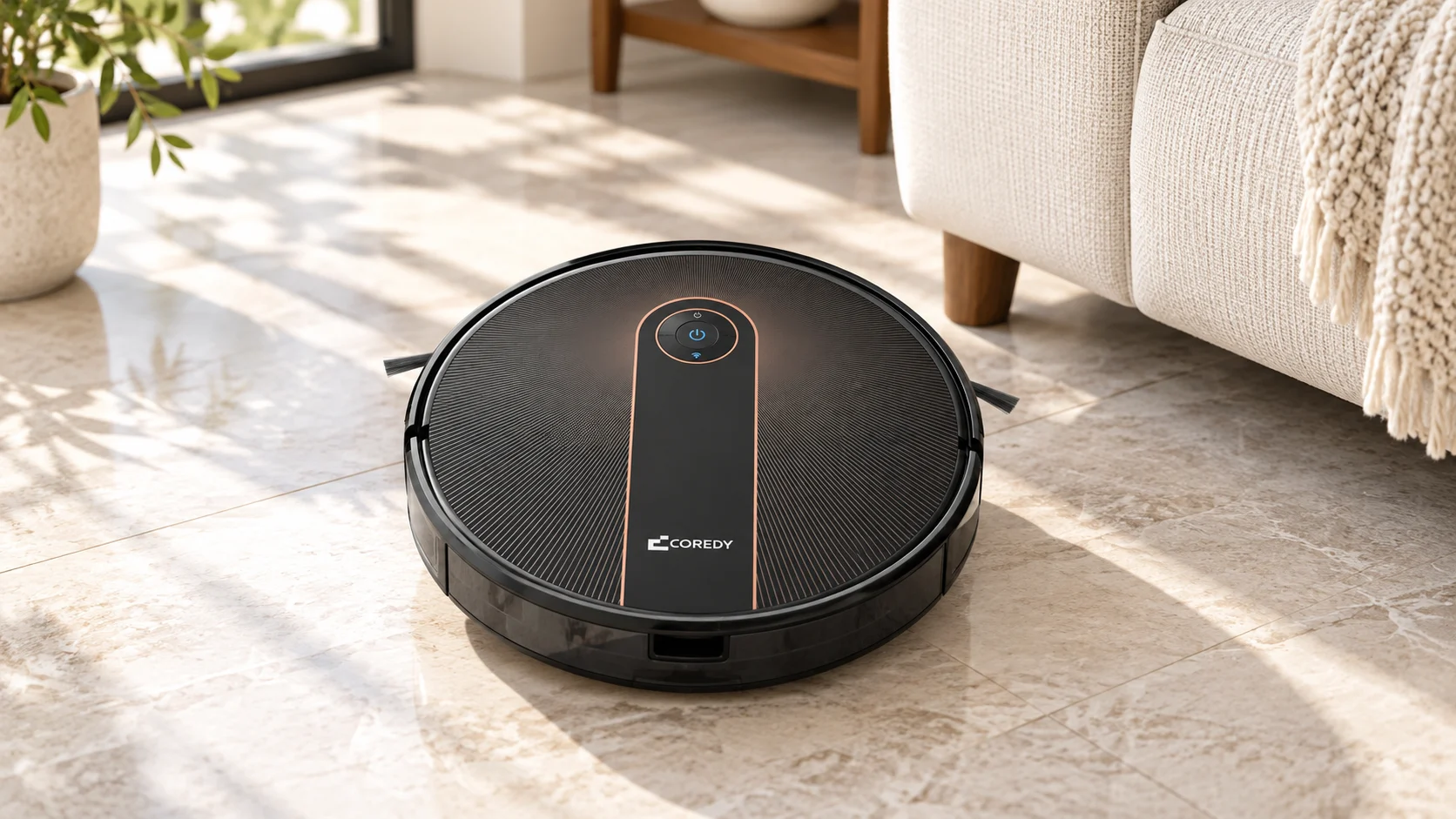
The original Coredy R750 is a low-profile robot vacuum with app control, carpet-boost functionality and support for compatible mopping equipment. It uses a reactive cleaning pattern rather than LiDAR room mapping. This review distinguishes it from the R750 Pro, because features and purchase options for the two versions have often been mixed together.
Review basis: This assessment uses manufacturer information and model-specific buying analysis. Advertised suction and runtime figures are not independent pickup or battery test results.

Quick verdict: who should buy the Coredy R750?
The original R750 suits a relatively simple, prepared floor plan where routine dry pickup is more important than precise room selection. Its limitations are meaningful: coverage is less predictable than on a mapped robot, the normal dock only charges, and mopping needs the right accessories and manual care. Some purchase options on this page concern a Pro variant, so check the full model and included dock before ordering.
Key features and model details
- Original R750; distinguish it from R750 Pro
- Reactive navigation rather than LiDAR maps
- Manufacturer-rated maximum suction of 2,000 Pa for the original R750
- App scheduling and supported voice-assistant controls
- Carpet-boost functionality
- Low-profile body for accessible furniture clearance
- Compatible mopping equipment must match the model
- Magnetic boundary support; inspect accessory inclusion
- Standard charging dock is not an auto-empty station
Pros
- App scheduling for repeated routine cleans
- Supported Alexa and Google Assistant integration
- Low-profile design can access suitable furniture gaps
- Carpet boost adjusts the vacuuming routine
- Physical boundary support for compatible strips
Cons
- Original R750 lacks LiDAR room control and automatic dirt disposal
R750 and R750 Pro: check the suffix before comparing
The original R750 and the R750 Pro are separate products. Coredy’s original R750 information describes a reactive cleaning pattern and a 2,000 Pa maximum. Specifications for a Pro version, including its tank arrangement and sensing features, should not be copied into a review of the original robot.
The existing purchase links on this page include different listing identifiers. Read the full product title and the model label shown by the seller, then confirm which dock and dustbin are included. A photograph of a larger station does not establish that the selected package includes it. Model-specific accessories should also be checked before purchase.
A reactive robot changes direction as it encounters obstacles. It can collect debris over repeated passes, but it does not give the owner the same predictable route planning or named-room control as a LiDAR platform. One session may spend longer in an open living room while a narrow doorway delays access elsewhere.
That makes room preparation and job size important. A smaller accessible area with furniture arranged to leave clear passages is a more realistic fit than a cluttered multi-room layout. If you need the kitchen cleaned reliably before a particular time, assess whether physically containing the job is acceptable or whether a mapped robot would be more useful.

Boundary strips and sensors are not virtual room maps
The original R750 supports compatible magnetic boundaries. These are physical accessories placed according to the instructions; they are not lines drawn on a saved LiDAR floor plan. Check whether the strips are supplied with the exact package or need to be purchased separately.
Bumper, obstacle and drop sensing help guide movement, but they do not establish camera-based recognition of cables or pet waste. Keep the sensing surfaces clean and follow the manual around stairs. A robot that turns away from a chair leg can still pull a thin cable into its brush.
Hard floors, rugs and the carpet-boost feature
The R750’s suction and brushes collect dry debris along the route it actually travels. Carpet boost can increase suction in appropriate conditions, but it is not proof of superior embedded-dirt removal. The type of carpet, brush condition and time spent crossing an area all affect the result.
Hard-floor homes with a few suitable low-pile rugs are a plausible use case. Loose rugs, tassels and abrupt thresholds can interrupt the route. Inspect the head and wheels before moving between surfaces, and stop a run if a rug repeatedly bunches or the brush stalls. Do not assume that a robot can clean every carpet simply because it can drive onto one.
Pet hair: why maintenance still matters
A robot is useful when it collects loose hair before it accumulates, especially in accessible floor areas. It does not eliminate hair wrapped around the brush ends, caster axle or side brush. Check those areas during the first week of a new schedule and shorten the interval if there is heavy shedding.
The original R750 needs manual dustbin emptying. Do not plan a holiday-length unattended routine on the assumption that the robot disposes of its own dirt. A packed bin reduces useful collection space and can restrict airflow. Keep a normal vacuum or handheld for sofas, stairs and hair embedded in upholstery.

Mopping equipment and the limits of a damp cloth
The original R750’s mopping capability depends on the correct compatible water-tank and cloth equipment. Confirm the contents of the selected bundle, because an accessory shown in a general product gallery may not be in every package. The Pro version uses different model-specific arrangements.
Treat this as light hard-floor wiping. A trailing cloth does not actively scrub dried food, wash grout or collect liquid spills through the dry suction path. Keep a fitted wet pad off carpet, use only permitted liquid and clean and dry the cloth after the job. If an automatic mop lift is essential, do not assume this model provides it.
App, voice control and the physical remote
Connected controls can make scheduling and basic operation more convenient, but the available functions are limited by the robot’s hardware. An app screen showing a route should not be described as an editable LiDAR room map. Check the app named in the exact unit’s manual and its supported Wi-Fi connection.
A physical remote, when supplied with the selected package, can be useful for local starts and steering. Voice integrations are for supported commands after account linking. They should not be interpreted as a way to send an original R750 to any named room on demand.
Battery claims and older-stock condition
Different modes and different R750 variants produce different runtime claims. Avoid choosing from an isolated number without the associated model and conditions. Higher suction, carpet travel and an ageing battery shorten usable cleaning time. Confirm that the unit charges and completes a normal route during the return period.
The original R750 is an older platform, so stored-stock condition deserves attention. A sealed box does not guarantee a freshly manufactured battery. Ask about returns and replacement-battery support, and inspect both the robot contacts and charging dock if purchasing used. These practical checks matter more than a broad claim that the robot can run for hours.
Care of the robot, filter and mop
Empty the bin before debris is compacted against the filter. Remove wound hair, inspect the brush guard and check that wheels turn freely. Clean sensors and charging contacts with the procedure in the manual. Do not wash the entire robot or wipe liquid into openings merely because the removable bin or mop cloth can be cleaned separately.
Check each filter’s instructions before rinsing. Refit any permitted washable component only when it is completely dry. If suction drops, inspect the bin, filter and intake before increasing power. If the robot has become erratic, check the caster, sensing surfaces and floor obstacles before assuming that a new battery will solve it.
What makes a worthwhile purchase
The R750 is a conditional value choice. It can be useful when the price reflects its basic navigation and the owner accepts floor preparation, bin emptying and occasional rescue. It is a poorer fit when a complex floor plan or repeated inaccessible rooms make coverage unpredictable.
Compare the full cost of the exact package: robot, needed mopping kit, boundary strips, replacement filters and battery support. Do not pay a mapped-robot price based on features borrowed from a Pro listing. The right decision is whether the original R750 removes enough routine work in your home to justify those limitations.
Alternatives and the buying decision
For room maps and selective vacuuming, compare the original Roborock Q5. For a mapped robot-and-base package, see the AIRROBO T10+ review. The Lefant M210 Pro is a useful comparison for buyers prioritizing a compact suction-port design. None of these comparisons establishes a measured pickup winner; they explain different ownership routines.
Setting up a routine that a robot can finish
The original R750's magnetic boundary support and reactive navigation serve a different purpose from app-drawn LiDAR rooms. Select it for a prepared simple route rather than expecting the map-based room control of a different product.
R750 Pro and the original R750 should remain separate throughout the purchase decision. A self-empty station linked as an alternative is not established as a compatible upgrade for every original R750.
What to budget for after purchase
For damp wiping, confirm the matching tank and cloth equipment instead of assuming they are supplied with every offer. The original robot's charging dock performs charging, not automatic mop care.
If a room repeatedly traps the robot, physical layout and compatible boundaries are more relevant than adding a higher suction claim. A clearer prepared route may provide more useful unattended floor coverage than another control feature.
Related reading and purchase options
Check the exact model, included tools, condition and current seller terms: Self-Empty Station.
Further reading: Can you refreeze vacuum sealed meat?.
Related guides and reviews
The robot vacuums without Wi-Fi guide helps if you want to prioritize local operation over connected features. For upkeep, follow our robot maintenance guide. Browse the reviews hub for other model-specific assessments.
Frequently asked questions
Does the original R750 have LiDAR mapping?
No. Its reactive cleaning pattern should not be described as LiDAR room mapping or camera-based object recognition.
Does every R750 purchase include an auto-empty station?
No. Check the exact model and package. The original R750’s ordinary charging dock does not empty the dustbin.
Can I use R750 Pro parts on the original R750?
Do not assume compatibility. Match the full model number and the manufacturer’s accessory compatibility information.
Final verdict
The original R750 suits a relatively simple, prepared floor plan where routine dry pickup is more important than precise room selection. Its limitations are meaningful: coverage is less predictable than on a mapped robot, the normal dock only charges, and mopping needs the right accessories and manual care. Some purchase options on this page concern a Pro variant, so check the full model and included dock before ordering.
Sources and review method
Coredy’s original R750 product information and the separate R750 Pro owner document were used to resolve the mixed model claims. Coredy original R750 information; Coredy R750 Pro owner document. Specifications and bundles can differ by region or production revision; match the rating label and supplied manual to the exact unit.

Abi Khan is the founder and a content writer at GlobVacs. His published work covers vacuum-cleaner buying guides, product comparisons and practical maintenance advice. Read his author profile and selected articles.